fetching data ... 
Background: An important treatment goal in the management of patients with rheumatoid arthritis (RA) is patients being satisfied with their condition, the patient acceptable symptom state (PASS). It is unclear whether reduction in disease activity, the main therapeutic aim of RA treatment, is associated with reaching PASS, or whether reductions in other factors are also important.
Objectives: To analyse change over one year of disease activity, patient reported outcomes (PROs) and psychological factors and their association with PASS at one year.
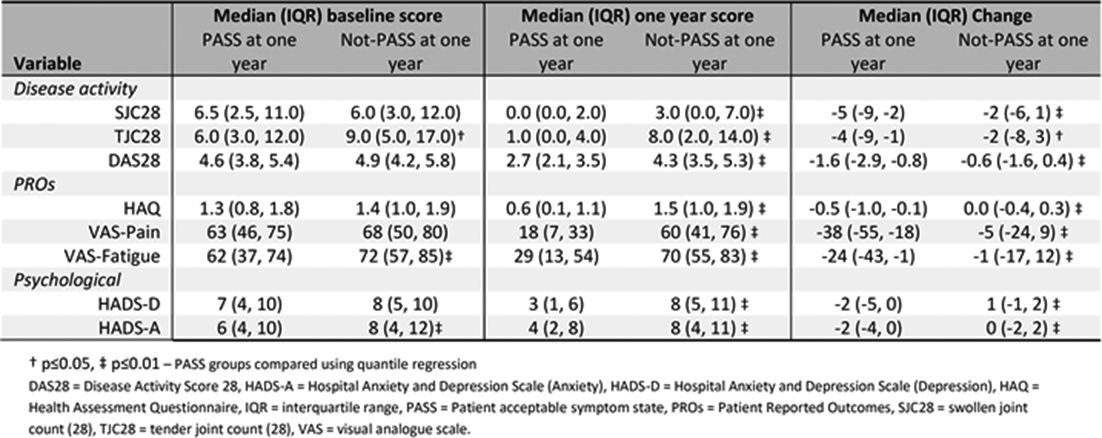
Methods: The Rheumatoid Arthritis Medication Study (RAMS) is a prospective cohort of patients with RA starting MTX for the first time in the United Kingdom. At baseline and one year, patients reported demographics and completed pain and fatigue visual analogue scales (VAS-pain/VAS-fatigue), the Hospital Anxiety and Depression Scale (HADS-A, HADS-D) and the Health Assessment Questionnaire (HAQ). A research nurse performed a 28 swollen and tender joint count (SJC28/TJC28) and the disease activity score (DAS28) was calculated. Patients answered the question “Is your current condition satisfactory, when you take your general functioning and your current pain into consideration?” at baseline and at one year. Only patients not in PASS at baseline are included in this analysis. Change in disease related factors (SJC28, TJC28, DAS28), PROs (HAQ, VAS-pain, VAS-fatigue), and psychological factors (HADS-A, HADS-D) from baseline to one year were calculated (see table 1). Predictors of PASS at one year were assessed using multivariable logistic regression, adjusting for age and gender. The discriminative power of disease activity, PROs and psychological factors were assessed by comparing the area under the curve (AUC) of the receiver operating characteristic curve.
Results: Of 358 not in PASS at baseline (mean (SD) age: 58.1 (13.0) years; 244 (68.2%) women), 241 (67.3%) were in PASS after one year. The only independent predictors of PASS were change in HAQ, VAS-pain and HADS-D (OR (95% CI) per unit change from baseline: HAQ 0.38 (0.16, 0.91); VAS-pain 0.96 (0.95, 0.98); HADS-D 0.86 (0.75, 0.99)). The model containing PROs had significantly greater AUC compared to a disease activity model (0.91 vs. 0.84, p=0.004) and a psychological factors model (0.91 vs. 0.81, p<0.0001).
Abstract FRI0019 – Table 1 Baseline, one year and change scores stratified by whether patients were in PASS at one year
Conclusions: Change in PROs have a greater association with attaining PASS at one year compared to disease related or psychological factors and should be taken into account when designing treatment strategies.
Disclosure of Interest: None declared
DOI: 10.1136/annrheumdis-2018-eular.5212