fetching data ... 
Background: PF-06438179/GP1111 (GP1111) is an infliximab (IFX) biosimilar in development for the treatment of immune-mediated inflammatory diseases, including rheumatoid arthritis (RA). The efficacy, safety and immunogenicity of GP1111 and European reference IFX (IFX-EU) have been reported to be similar over 30 weeks (Wks).
Objectives: To evaluate the efficacy, safety and immunogenicity of GP1111 and IFX-EU with longer-term treatment, and after treatment transition from IFX-EU to GP1111.
Methods: A randomised, double-blind, parallel-group study compared GP1111 with IFX-EU in biologic-naïve, adult patients with moderate-to-severe active RA on a stable dose of methotrexate (MTX). Patients were randomised (1:1) to GP1111 or IFX-EU (3 mg/kg IV at Wks 0, 2, 6, and then every 8 wks, with one dose escalation to 5 mg/kg allowed at or after Wk 14 for inadequate responders) for 30 weeks (treatment period 1). The primary endpoint was a≥20% improvement in ACR response (ACR20) at Wk 14. At Wk 30 (treatment period 2 [TP2]), patients receiving IFX-EU were blindly re-randomised (1:1) to remain on IFX-EU or transition to GP1111 for 24 wks. Here we report longer-term efficacy, safety and immunogenicity data from Wks 30–54.
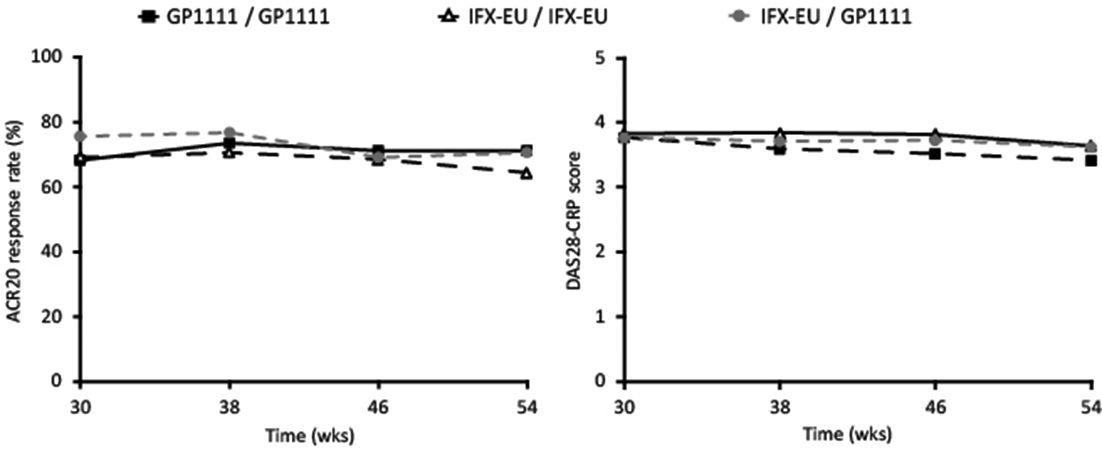
Results: 650 patients were randomised initially (GP1111, n=324; IFX-EU, n=326). At Wk 30, 566 patients entered TP2 (continued GP1111, n=280; continued IFX-EU, n=143; switched from IFX-EU to GP1111, n=143). ACR20 rates and DAS28-CRP scores were comparable between groups at all TP2 visits after re-randomisation in the TP2 population (figure 1). Incidences of TP2 treatment-emergent adverse events (AEs) (36.8%, 33.6%, and 37.8%), serious AEs (4.6%, 7.7% and 2.8%) and infusion-related reactions (3.2%, 8.4% and 4.2%) were comparable between the GP1111/GP1111, IFX-EU/IFX-EU, and IFX-EU/GP1111 groups, respectively. Pre-dose ADA rates at Wk 30 (TP2) were 47.1%, 53.8% and 45.5% for the GP1111/GP1111, IFX-EU/IFX-EU, and IFX-EU/GP1111 groups, respectively. Overall, post-dose ADA rates in TP2 were comparable between groups (52.1%, 60.1%, and 58.0% respectively).
Abstract FRI0137 – Figure 1 ACR20 response rate and change in DAS28-CRP score at Wk 30 and 54 for the overall population during TP2
Conclusions: Results from TP2 (Wks 30–54) continued to show the absence of clinically meaningful differences in efficacy, safety and immunogenicity between patients with RA remaining on GP1111 or IFX-EU, or when blindly switched from IFX-EU to GP1111.
Disclosure of Interest: R. Alten Grant/research support from: Pfizer Inc., Consultant for: Pfizer Inc., Speakers bureau: Pfizer Inc., V. Tseluyko Speakers bureau: Pfizer Inc., AstraZeneca, Bayer, Boehringer Ingelheim, Servier, Sanofi, Takeda, KRKA, T. Hala: None declared, S. Mehmedagic: None declared, M. Pileckyte: None declared, E. Dokoupilová: None declared, D. Jovic: None declared, M. Rehman Shareholder of: Proctor and Gamble, Employee of: Pfizer Inc., M. Zhang Shareholder of: Pfizer Inc., Employee of: Pfizer Inc., L. Sewell Shareholder of: Pfizer Inc., Employee of: Pfizer Inc., S. Hackley Shareholder of: Pfizer Inc., Employee of: Pfizer Inc., S. Salts Shareholder of: Pfizer Inc., Mirati Therapeutics, Employee of: Pfizer Inc., C. Cronenberger Shareholder of: Pfizer Inc., Employee of: Pfizer Inc., K. Schumacher Shareholder of: Novartis, Employee of: Sandoz Biopharmaceuticals, O. von Richter Employee of: Sandoz Biopharmaceuticals, B. Batko Consultant for: Pfizer Inc., Sandoz, MSD
DOI: 10.1136/annrheumdis-2018-eular.5121