fetching data ... 
Background: Spinal mobility measures are recommended for the assessment axial spondyloarthritis (axSpA). Simple, low-tech tools as goniometers and metric tapes are commonly used, resulting in high variability and low accuracy of the measurements. More recently, advanced technological systems have facilitated the measurement of human mobility with high precision, such as motion capture systems like the UCOTrack and its index, the UCOASMI, validated for use in axSpA patients. The development on inertial measurement units (IMUs) has produce wearable, cheap and self-contained devices that can measure motion usually using triads of gyroscopes, accelerometers and magnetometers. Some of the mobility angles measured using motion capture systems can also be measured using IMUs placed in pre-defined anatomical locations.
Objectives: To evaluate the validity of IMUs using the ViMove© system for measuring spinal mobility in patients with axSpA.
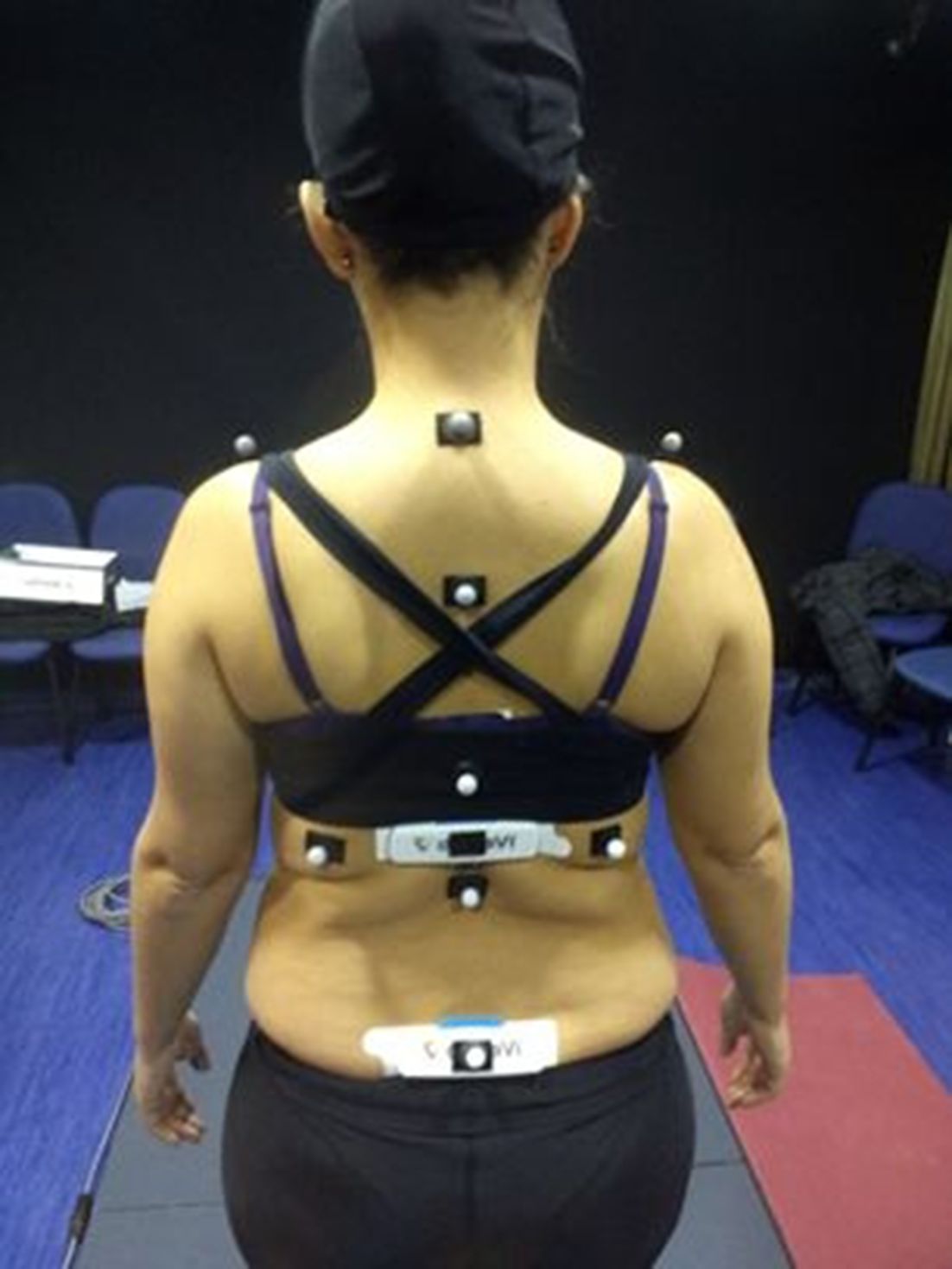
Methods: We recruited 20 patients with axSpA from the HU Reina Sofia of Cordoba. The UCOTrack was used as the gold-standard system to obtain mobility measurements. UCOTrack measurements were compared with ViMove© measurements, a system that includes two IMU sensors located in the lumbar spine (pelvis and L1- figure 1) or in the neck (occiput and T3). Conventional metrology measures and patient-reported outcomes were also collected.
Results: The table presents the measurements obtained at the L1 and occiput levels. UCOTrack and ViMove© measurements were very similar, with Root Mean Square Errors (RMSE) less than 10° and Variation Coefficients (VC) less than 10%. We found high intraclass correlation coefficients (ICC) between the two systems (0.84–0.99). Measurements with both systems correlated strongly and significantly with BASMI (0.60–0.92) and BASFI (0.51–0.84), but not with BASDAI.
Type of measurement |
UCOTrack© |
ViMove© |
VC |
RMSE |
ICC |
|---|---|---|---|---|---|
Lumbar (L1) |
|||||
Anterio flexion |
103.6 (17.3) |
99.0 (17.4) |
4.4% |
6.57 |
0.93 |
Extension |
24.6 (9.3) |
22.3 (9.6) |
9.4% |
4.22 |
0.90 |
Left rotation |
27.7 (10.4) |
27.4 (11.0) |
1.1% |
1.83 |
0.99 |
Right rotation |
26.8 (10.4) |
25.3 (10.1) |
5.6% |
3.14 |
0.95 |
Left lateral flexion |
70.7 (13.9) |
72.6 (16.6) |
2.7% |
8.71 |
0.84 |
Right lateral flexion |
68.4 (15.4) |
67.6 (16.7) |
1.2% |
7.87 |
0.88 |
Cervical (occiput) |
|||||
Flexion |
50.9 (12.5) |
52.3 (12.8) |
2.8% |
2.73 |
0.98 |
Extension |
43.1 (16.0) |
39.3 (14.4) |
8.8% |
5.44 |
0.94 |
Left rotation |
66.1 (20.2) |
63.8 (20.5) |
3.5% |
9.13 |
0.90 |
Right rotation |
62.1 (19.2) |
64.7 (21.7) |
4.2% |
9.72 |
0.89 |
Left lateral flexion |
34.3 (15.8) |
32.9 (15.5) |
4.1% |
7.77 |
0.88 |
Right lateral flexion |
34.7 (15.9) |
34.0 (16.3) |
2.0% |
7.10 |
0.90 |
Conclusions: The ViMove©, an IMU based system, is a valid method to assess spinal mobility in patients with axSpA. There was excellent agreement between ViMove© and UCOTrack and a strong correlations with conventional metrology (BASMI) and patient-reported physical function (BASFI). IMU systems are more feasible than motion capture systems because they do not require a motion laboratory and results can be obtained more quickly in an objective and quantitative way. The ViMove© system has potential for use both in the clinical and research setting and further evaluation of its reproducibility and sensitivity to change should be undertaken.
Acknowledgements: This study has been funded by Foreum (Foundation for Research in Rheumatology)
Disclosure of Interest: None declared
DOI: 10.1136/annrheumdis-2018-eular.1688