fetching data ... 
Background: Pregnancy involves adaptation to the immune system to prevent rejection of the foetus and this might have consequences on the activity of the rheumatoid arthritis (RA). Equally the aberrant immunity and disease activity of the RA might influence the pregnancy and foetal-neonatal outcomes.
Objectives: This study was designed to estimate the risk of adverse foetal-neonatal and maternal outcomes in pregnancies in women with RA.
Methods: We identified 2,350,339 singleton pregnancies using the Taiwan National Health Insurance database and birth registry between 2001 and 2012. Maternal history of RA, SLE, Sjögren’s syndrome, systemic sclerosis, vasculitis and poly/dermatomyositis were ascertained; among them, 845 individuals had RA. Odds ratios (ORs) and 95% confidence intervals (CIs) for pregnancy outcomes were estimated using an adjusted generalised estimating equation model.
Results: Pregnancies in women with RA were associated with an OR (95% CI) of 1.65 (1.37–1.98) for low birthweight (<2500 g) (n=114), 1.41 (1.128–1.68) for prematurity (<37 week) (n=124), and 1.62 (1.36–1.92) for small for gestational age (n=132). Maternal outcomes in pregnancies of women with RA were just associated with an OR (95% CI) of 1.34 (1.06–1.68) for preterm labour (n=74). Women with RA did not have an increased risk of post-partum death, cardiovascular complications, surgical complications, and the other systemic organ dysfunction.
Abstract OP0135 – Table 1
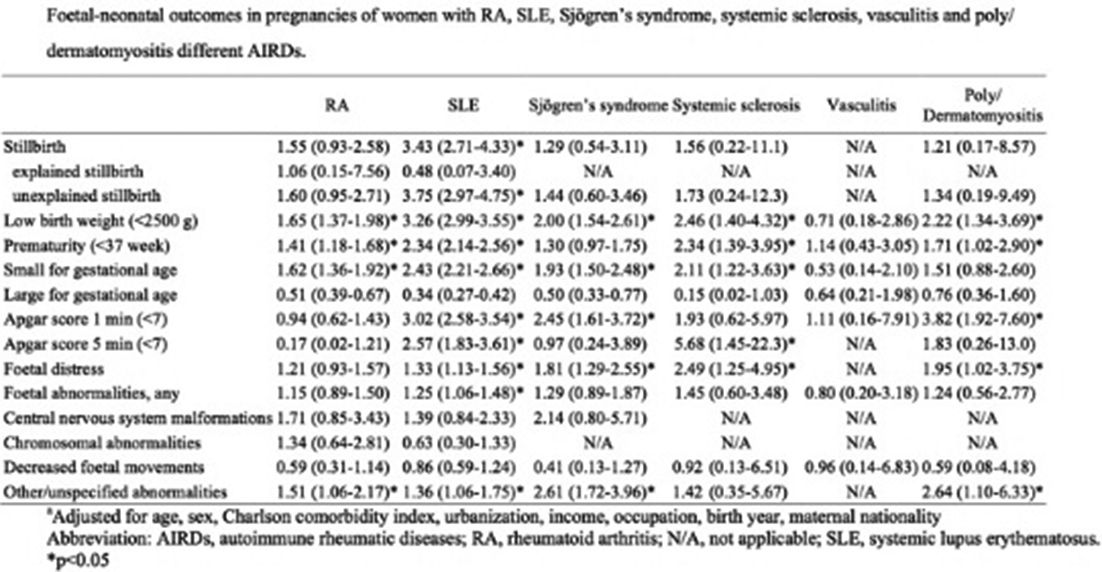
Conclusions: Pregnancies in women with RA were at a higher risk for multiple adverse foetal-neonatal outcomes, especially low birthweight (<2500 g), prematurity (<37 week), and small for gestational age. Maternal outcomes showed that just preterm labour was more common in women with RA. Women with RA should not be discouraged to seek pregnancy based on the disease alone.
References
Acknowledgements: The authors would like to thank Centre for Big Data Analytics and Statistics in Chang Gung Memorial Hospital for statistical consultation. The sponsors of the study had no role in the design and conduct of the study; collection, management, analysis, and interpretation of the data; and preparation, review, or approval of the manuscript.
Disclosure of Interest: None declared
DOI: 10.1136/annrheumdis-2018-eular.6143