fetching data ... 
Background: Non-United States completers of the Phase 3 BLISS-52 (BEL110752) and BLISS-76 (BEL110751) studies could continue treatment with BEL.
Objectives: To evaluate long-term safety, tolerability and organ damage progression in patients with SLE treated with BEL.
Methods: In this multicentre, open-label long-term study (BEL112234/NCT00712933), patients received intravenous BEL every 4 weeks, plus standard SLE therapy. Safety was assessed at each visit. Organ damage (Systemic Lupus International Collaborative Clinics/American College of Rheumatology Damage Index [SDI]) was assessed as a safety endpoint every 48 weeks. The study continued until BEL was commercially available in each patient’s country and included an 8 week follow–up period.
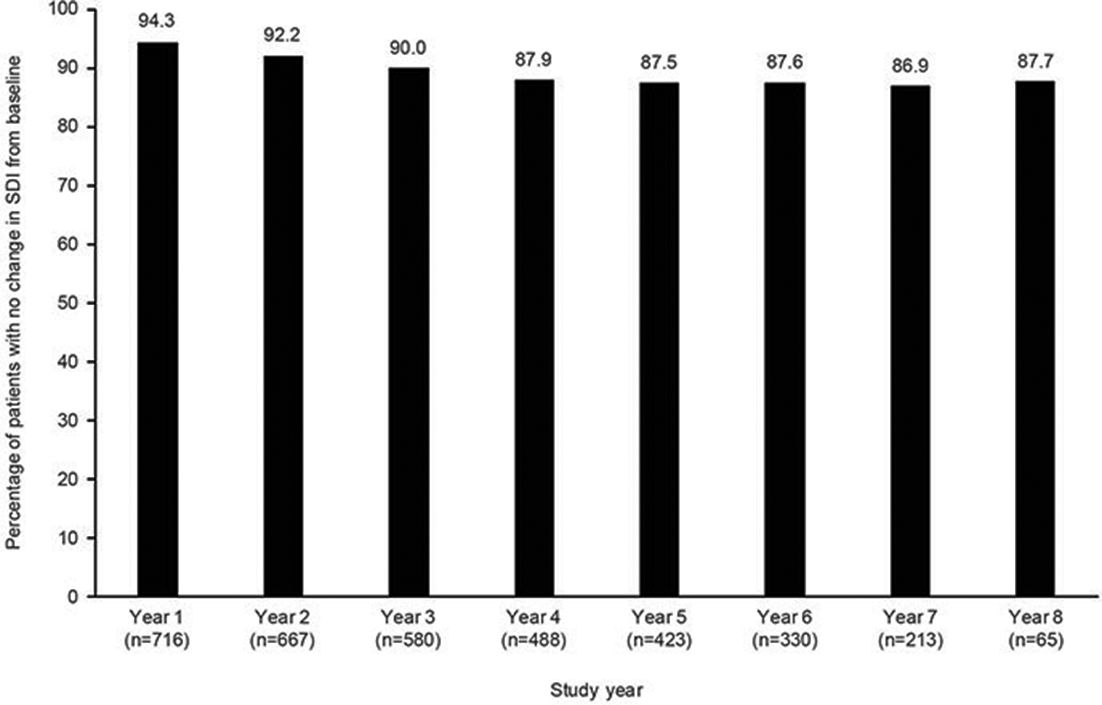
Results: In total, 738 patients entered the long-term study and were treated for up to 9 years (3352 patient-years). Of these, 735 (99.6%) received ≥1 dose of BEL; the mean (SD) number of infusions was 56.4 (27.02). The incidence of adverse events (AEs) remained stable or declined over time (table 1). The most common AEs were headache (n=205, 27.9%), nasopharyngitis (n=155, 21.1%), diarrhoea (n=143, 19.5%), arthralgia (n=136, 18.5%) and influenza (n=134, 18.2%). Sixty-nine patients (9.4%) experienced an AE resulting in discontinuation of BEL or study withdrawal. Eleven deaths occurred, one of which (cardiogenic shock) was possibly related to BEL. Three serious AEs of suicide attempt/ideation (0.4%) occurred. The mean (SD) SDI score was 0.6 (1.02) at baseline (prior to the first dose of BEL). At Year 8 87.7% of patients had no change in SDI score from baseline, indicating low organ damage accrual (figure 1).
aNumber of patients; bincluded opportunistic infections, tuberculosis, herpes zoster (recurrent and disseminated) and sepsis; ctwo deaths during post-treatment follow-up.
Conclusions: BEL displayed a stable safety profile with no new safety signals. There was minimal organ damage progression.
| Safety results, na (%) | Any time post baseline n=735 | Year 0-1 n=735 | Year 1 -2 n=701 | Year 2-3 n=620 | Year 3-4 n=514 | Year 4-5 n=442 | Year 5-6 n=345 | Year 67 n=219 | Year 78 n=65 | Year 8 + n=6 |
|---|---|---|---|---|---|---|---|---|---|---|
| ≥1 AE | 706 (96.1) | 617 (83.9) | 502 (71.6) | 441 (71.1) | 344 (66.9) | 261 (59.0) | 181 (52.5) | 92 (42.0) | 26 (40.0) | 3 (50.0) |
| ≥1 AE resulting in treatment discontinuation | 69 (9.4) | 13 (1.8) | 13 (1.9) | 20 (3.2) | 10 (1.9) | 7(1.6) | 5(1.4) | 0 | 0 | 0 |
| ≥1 serious AE | 231 (31.4) | 78 (10.6) | 58 (8.3) | 66 (10.6) | 44 (8.6) | 27 (6.1) | 16 (4.6) | 11 (5.0) | 1 (1.5) | 0 |
| Serious infections/infestations | 107 (14.6) | 36 (4.9) | 24 (3.4) | 26 (4.2) | 17 (3.3) | 14 (3.2) | 6(1.7) | 5 (2.3) | 1 (1.5) | 0 |
| Infections of special interestb | 95 (12.9) | 32 (4.4) | 16 (2.3) | 20 (3.2) | 21 (4.1) | 10 (2.3) | 11 (3.2) | 2 (0.9) | 0 | 0 |
| All malignant neoplasms (except non-melanoma skin cancer) | 6 (0.8) | 1 (0.1) | 1 (0.1) | 1 (0.2) | 2 (0.4) | 1 (0.2) | 0 | 0 | 0 | 0 |
| Depression/suicide/self-injury | 86 (11.7) | 40 (5.4) | 24 (3.4) | 14 (2.3) | 14 (2.7) | 4 (0.9) | 4(1.2) | 4(1.8) | 0 | 0 |
| Death | 11 (1.5)c | 2 (0.3) | 1 (0.1) | 2 (0.3) | 2 (0.4) | 2 (0.5) | 0 | 0 | 0 | 0 |
Acknowledgements: Study funded by GSK. Emma Hargreaves, MA, Fishawack Indicia Ltd, UK, provided editorial assistance funded by GSK.
Disclosure of Interest: R. Van Vollenhoven Grant/research support from: GSK, Consultant for: GSK, S. Navarra Speakers bureau: GSK, R. Levy Employee of: BLISS-52 investigator and GSK employee since ,Jan 2018 M. Thomas Grant/research support from: GSK, Consultant for: GSK, A. Heath Shareholder of: GSK, Employee of: GSK, T. Lustine Shareholder of: GSK, Employee of: GSK, A. Adamkovic Shareholder of: GSK, Employee of: GSK, J. Fettiplace Shareholder of: GSK, Employee of: GSK (at the time of study), M. L. Wang Shareholder of: GSK, Employee of: GSK, B. Ji Shareholder of: GSK, Employee of: GSK, D. Roth Shareholder of: GSK, Employee of: GSK
DOI: 10.1136/annrheumdis-2018-eular.3306