fetching data ... 
Background: We have previously shown that the incidence rate of total knee replacements started to decrease among rheumatoid arthritis (RA) patients following the introduction of biological (b) DMARDs, but less is known on the impact of bDMARDs on the need for joint replacements (JR) of the upper limbs.
Objectives: To investigate the association between bDMARD introduction for the treatment of patients with RA on the trends of upper limb JR among newly diagnosed RA patients compared with a matched general population cohort (GPC) in Denmark.
Methods: Nationwide register-based interrupted time-series analysis using the Danish National Patient Register and Civil Registration System. Study populations: incident RA patients diagnosed at a rheumatology or general internal medicine clinic/department from 1996–2010. Intervention: introduction of bDMARDs in Denmark in 2002. Comparison: Each RA patient was matched on age, sex and municipality with up to 10 non-RA individuals (GPC). Outcome: Composite outcome of first shoulder, elbow, wrist, or finger replacement surgery (JR). Statistical analyses: 5 year age- and sex-standardised incidence rates of JR calculated for incident RA patients diagnosed biannually compared with GPCs. Outcome trends in the pre-bDMARD era (1996–2001) were compared with those in the bDMARD era (2003–2015) with a 1 year lag period in 2002.
Results: From 1996 to 2010, 26 458 incident RA patients were identified and compared with 257,505 GPCs (Table). The JR incidence rate was stable among RA patients in 1996–2001, but started to decrease from 2003 and onwards. Among GPCs, the incidence rate increased throughout the study period.
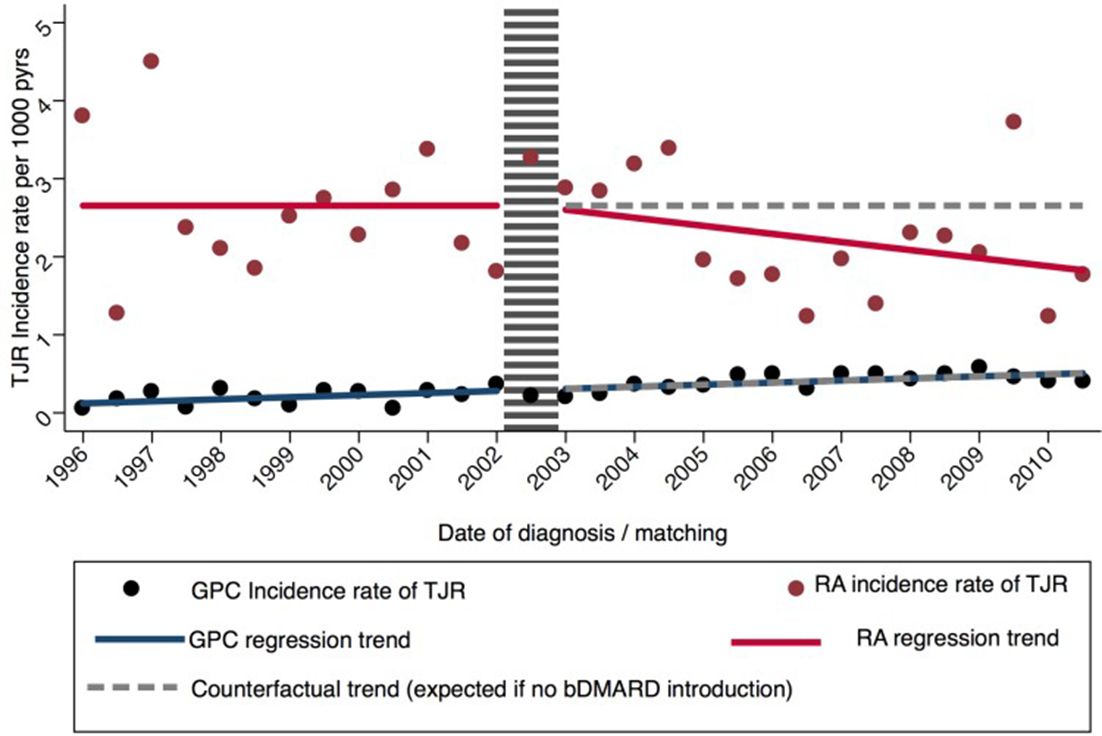
Conclusions: Following the introduction of bDMARDs, the incidence rate of upper limb JR started to decrease among RA patients, whereas the incidence rate steadily increased from 1996–2015 among matched GPCs. The baseline incidence rate was 7-fold higher among RA patients than GPCs, but the absolute need for upper limb JR was low in both groups.
Disclosure of Interest: R. Cordtz: None declared, S. Hawley: None declared, D. Prieto-Alhambra Grant/research support from: Amgen, Servier, and UCB, Consultant for: UCB, Speakers bureau: Amgen, P. Højgaard Speakers bureau: UCB and Celgene, K. Zobbe: None declared, A. Odgaard: None declared, S. Overgaard: None declared, L. E. Kristensen Speakers bureau: Pfizer, AbbVie, Amgen, UCB, BMS, Biogen, MSD, Novartis, Eli Lilly and Company, and Janssen Pharmaceuticals, L. Dreyer Speakers bureau: UCB and MSD
DOI: 10.1136/annrheumdis-2018-eular.2328
Cohort |
N |
Mean age at start of follow-up |
Females, n (%) |
n JR |
PYRS |
Baseline incidence rate/1000 pyrs |
△ per year* 1996–2001 |
△ in level 2003 |
△ per year* 2003–2015 |
Absolute/relative △ at midpoint in bDMARD era (mid-2006) compared with counterfactual value |
|---|---|---|---|---|---|---|---|---|---|---|
RA |
26 458 |
58.9 years |
18 691 (71%) |
295 |
1 23 814 |
2.65 (2.27–3.04) |
- |
- |
−0.10 (−0.21-+0.01) |
−0.44 (-0.49 to −0.39)/–17% |
GPC |
2 57 505 |
58.4 years |
1 82 192 (71%) |
377 |
1,152,052 |
0.11 (0.04–0.17) |
0.03 (0.02–0.03) |
- |
0.03 (0.02–0.03) |
No change |