fetching data ... 
Background: In patients with clinical depression, elevated interleukin-6 (IL-6) levels have been associated with higher symptom severity and greater resistance to standard antidepressant treatments. Depression and IL-6 elevation are highly prevalent in patients with rheumatoid arthritis (RA), and their co-occurrence may have an impact on health-related quality of life (HRQoL). Sarilumab is a human immunoglobulin G1 anti IL-6 receptor α (anti-IL-6Rα) monoclonal antibody for treatment of moderately-to-severely active RA.
Objectives: To explore the effect of sarilumab on HRQoL in patients with moderate-to-severely active RA with co-existing symptoms of depression.
Methods: Post-hoc statistical analyses were performed on the Medical Outcomes Study Short Form 36 (SF-36) in 2 randomized controlled trials, MOBILITY (NCT01061736) and TARGET (NCT01709578), of sarilumab subcutaneous 150 mg or 200 mg every 2 weeks vs placebo, each combined with conventional synthetic disease modifying anti-rheumatic drugs. Patients were classified at baseline for probable major depressive disorder1 (PMDD; SF-36 mental health (MH) domain score ≤56) or probable depressed mood and anhedonia2 (PDMA; score ≤10 on both items of the MH domain: “Have You Felt Downhearted and Depressed” and “Have You Felt So down in the Dumps that nothing could cheer you up”). Analyses of least squares mean differences in changes from baseline in SF-36 domain scores for sarilumab versus placebo in the PMDD and PDMA subgroups were performed at Weeks 4, 12 and 24 for TARGET and Weeks 24 and 52 for MOBILITY. Sensitivity analysis adjusted for baseline Disease Activity Score 28 C-reactive protein (DAS28-CRP).
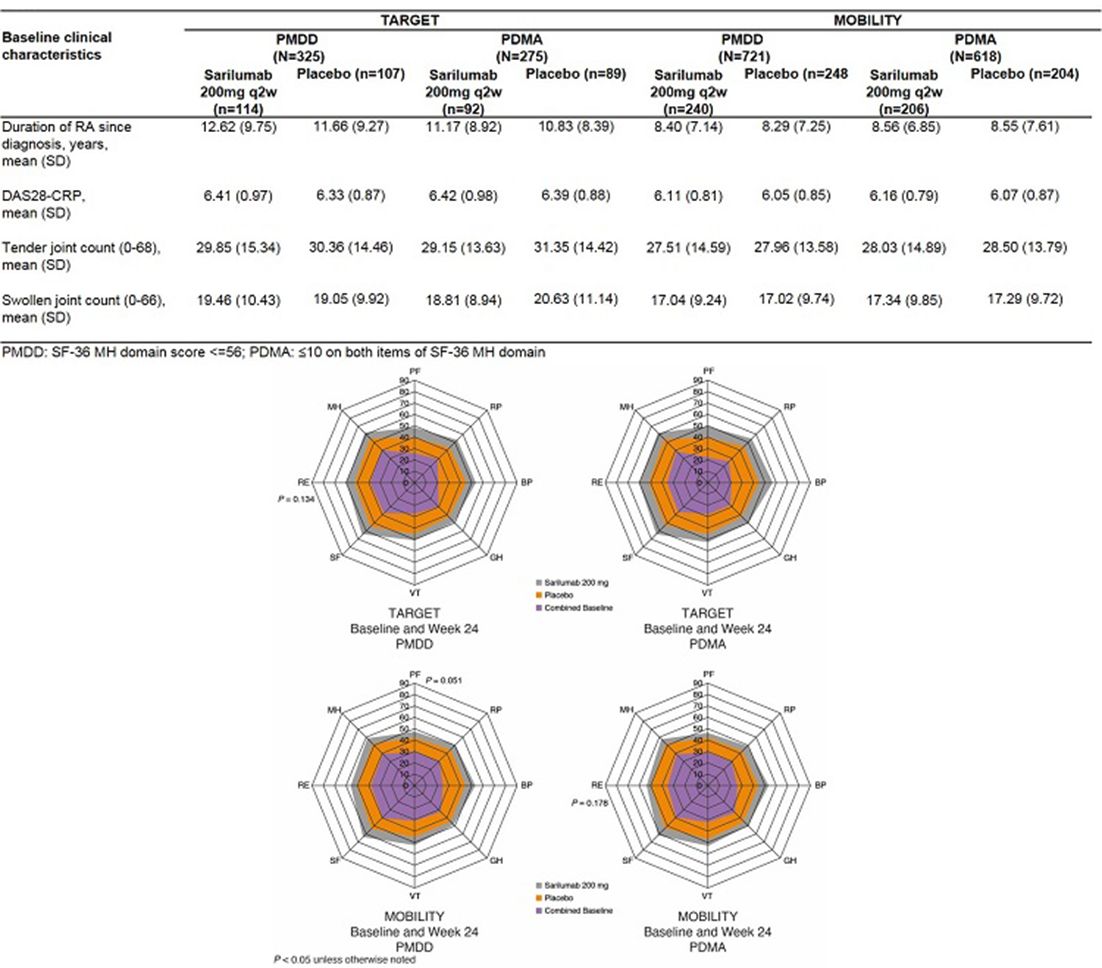
Results: Of the 546 patients from TARGET and 1197 from MOBILITY, 59.5% and 60.2% were classified as PMDD respectively, and 50.4% and 51.6% as PDMA. In both RCTs disease duration and baseline DAS-28 CRP, tender and swollen joint count (table 1) and SF-36 domain scores (figure 1) were similar between sarilumab and placebo within the PMDD and PMDA subpopulations. TARGET: MH scores for PMDD and PDMA subgroups were nominally higher (p<0.05) for sarilumab 200 mg versus placebo at all assessments. Both subgroups also scored nominally higher (p<0.05) in the domains of physical functioning (PF), role-physical (RP), bodily pain (BP), general health (GH), vitality (VT) and social functioning (SF) but not role-emotional (RE) in the PMDD subgroup at Week 24 (figure 1). MOBILITY: all scores except PF and RE were nominally higher (p<0.05) for sarilumab 200 mg versus placebo for Weeks 24 (figure 1). Sensitivity analysis provided similar results. Exploratory results also suggested reduced prevalence of depressive symptoms over the course of the trial.
Figure 1 PMDD: SF-36 MH domain score ≤56; PDMA: ≤10 on both items of SF-36 MH domain
Conclusions: In patients with RA and depressive symptoms, sarilumab provided clinically meaningful improvements in most domains of health status/HRQoL compared with placebo, which may be a function of targeting the IL-6Rα and subsequent reduction in disease activity.
References:
Acknowledgements: Research sponsored by Sanofi and Regeneron Pharmaceuticals, Inc.
Disclosure of Interest: V. Strand Consultant for: AbbVie, Amgen, Biogen, Celltrion, Consortium of Rheumatology Researchers of North America, Crescendo Bioscience, Eli Lilly, Genentech/Roche, GlaxoSmithKline, Hospira, Janssen, Merck, Novartis, Pfizer, Regeneron Pharmaceuticals, Sanofi and UCB, O. Hagino Shareholder of: Sanofi, Employee of: Sanofi, S. Guillonneau Shareholder of: Sanofi, Employee of: Sanofi, S. Boklage Shareholder of: Regeneron Pharmaceuticals, Inc., Employee of: Regeneron Pharmaceuticals, Inc., M. Reaney Shareholder of: Sanofi, Employee of: Sanofi, J. Sadeh Shareholder of: Sanofi, Employee of: Sanofi, N. Narcisse Consultant for: Sanofi, E. Mangan Shareholder of: Regeneron Pharmaceuticals, Inc., Employee of: Regeneron Pharmaceuticals, Inc., T. Kirmura Shareholder of: Regeneron Pharmaceuticals, Inc., Employee of: Regeneron Pharmaceuticals, Inc.
DOI: 10.1136/annrheumdis-2018-eular.3723