fetching data ... 
Background: Filgotinib (FIL), an oral selective JAK1 inhibitor, has shown good safety and efficacy in two phase 2b studies (background methotrexate (MTX, DARWIN 1) and as monotherapy (DARWIN 2)) in active rheumatoid arthritis (RA) patients with inadequate response to MTX1,2. We conducted a large-scale RNA sequencing study of genes expressed in blood samples from these studies.
Objectives: Identify RA-associated gene transcripts that are altered in response to FIL treatment.
Methods: PAXgene blood samples from 242 RA patients receiving either a stable dose of MTX and placebo (PBO) or FIL 200 mg once daily (QD, DARWIN 1); or PBO, FIL 100 mg, or 200 mg monotherapy QD (DARWIN 2), were collected and analyzed at baseline, week 1 and/or week 12. RNA in whole blood was sequenced (Illumina HiSeq 2500) after globin depletion. Differential gene expression analysis was performed on all time-paired data after subtracting gene expression changes in the PBO group. Spearman’s rank correlation of gene expression to time, dose, and disease activity score (DAS28) were calculated on samples without missing values. A false-discovery rate (FDR) of 10% was applied for all analyses
Results: Top-ranked gene sets positively associated with DAS28 disease activity at baseline over both studies included interferon alpha (IFN-α) and IFN gamma (IFN-γ) response, IL6/JAK/STAT3 signaling, and toll-like receptor signaling pathways (FDR<10%). Of 197 genes that positively correlated with disease score (increased gene expression with increased DAS28, FDR<10%), 117 (59%) trended toward reduced expression at 12 weeks with FIL in both studies. These genes were enriched in pathways which included granulocyte and macrophage activation. Conversely, of 256 genes negatively correlated with disease score (FDR<10%), 169 (66%) trended toward increased expression post-FIL (figure 1). Of 14724 genes expressed at >1CPM in at least 5% of the samples, 607 were differentially expressed following FIL treatment in either DARWIN1 or DARWIN2 with 48 genes significant in both studies (FDR<10%). Genes reaching significance in at least one study showed consistent magnitude and direction of change in both studies and were enriched in JAK/STAT, innate and adaptive immunity, and autoimmune associated pathways. CISH, SOCS2, SOCS3, VWA5a, APCDD1, DNASE1L3, and PIM3 correlated with both duration of treatment and FIL dose (FDR<10%). CISH and SOCS confirm JAK pathway modulation.
Figure 1 Heatmap of 453 DAS28-correlated genes and the corresponding change in gene expression with 12 wk FIL in Phase2b RA studies
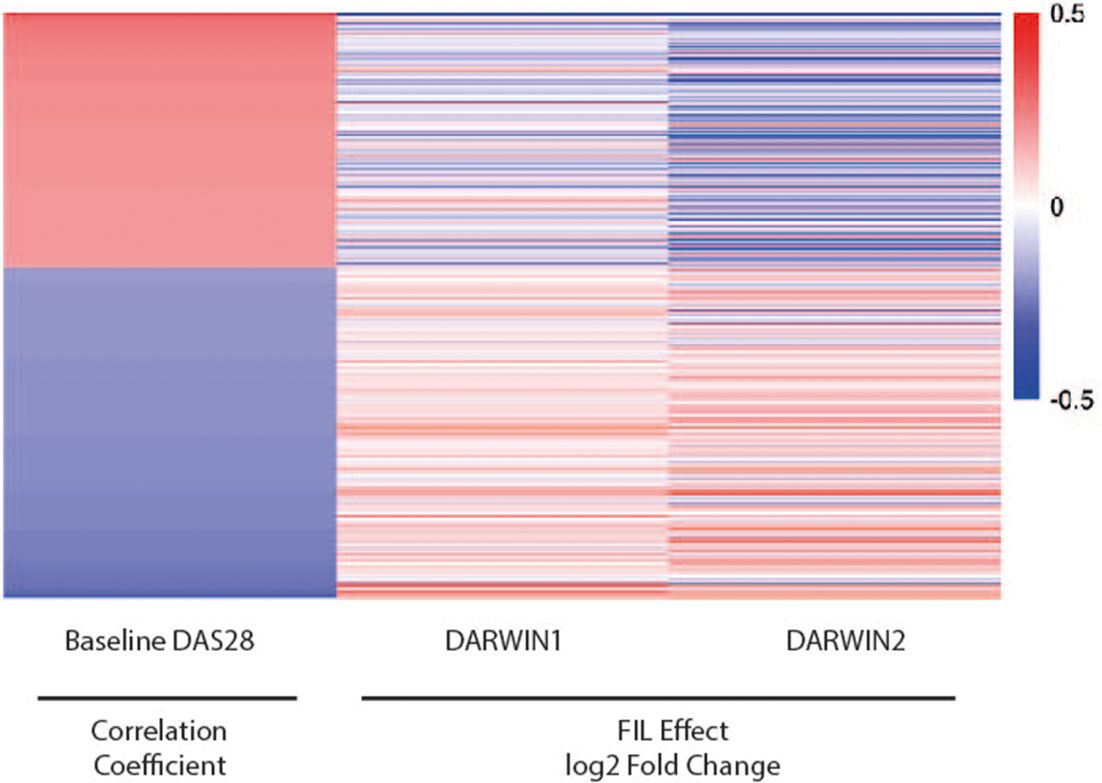
Conclusions: RA patients treated with FIL show reproducible changes in gene expression consistent with modulation of JAK/STAT signaling and innate and adaptive immunity. FIL was shown to partially reverse the dysregulated gene expression profile associated with baseline DAS28 score, consistent with the efficacy observed in RA patients.
References:
Disclosure of Interest: P. Taylor Consultant for: AbbVie, Biogen, BMS, Galapagos, GSK, Janssen, Lilly, MSD, Novartis, Sandoz, UCB;, J. Tarrant Employee of: GSI Employee, L. Zhao Employee of: GSI Employee, Y. Gindin Employee of: GSI Employee, A. Mirza Employee of: GSI Employee, P. Harrison Employee of: GLPG Employee, C. Tasset Employee of: GLPG Employee, R. Galien Employee of: GLPG Employee, A. Van der Aa Employee of: GLPG Employee, B. Downie Employee of: GSI Employee
DOI: 10.1136/annrheumdis-2018-eular.3759