fetching data ... 
Background: Lupus nephritis (LN) is currently classified according to the 2003 International Society of Nephrology/Renal pathology Society (ISN/RPS) classification system, which is based on histology. Most patients have proliferative lupus nephritis (PLN), which has been the most studied type of LN. Membranous lupus nephritis (MLN) is less frequent, accounting for 10%–20% of the cases. In some patients there is a combination of the two types.
Objectives: To compare MLN and PLN with respect to demographic, clinical and laboratory characteristics.
Methods: Single-centre retrospective observational study. All patients with biopsy-proven proliferative (class III and IV), membranous (class V) and mixed (class III or IV+V) LN (according to the 2003 ISN/RPS classification), followed at UCLH Rheumatology department from 1975 to 2017, were included. Individual clinical files were reviewed to obtain demographic, clinical, laboratory and pathological data. We also recorded data on treatment with corticosteroids, immunosuppressants and antimalarials. We compared groups using Pearson’s chi-squared test for qualitative variables and Mann-Whitney test for quantitative variables. Renal survival was analysed through the Kaplan-Meier method. Significance level was defined at 0.05.
Results: 187 patients were included (table 1). Age at diagnosis was not significantly different between groups (p=0.474). The groups differ regarding ethnicity – higher proportion of Caucasians with PLN versus higher proportion of Afro-Caribbeans with MLN. Patients with MLN present with higher C3 levels and significantly lower anti-dsDNA levels than the ones with proliferative changes. Thirty-four patients with PLN, 3 with MLN and 2 with mixed nephritis, progressed to end-stage renal disease. Cumulative renal survival rates at 5, 10, 15 and 20 years were 91, 81, 75% and 66% for PLN and 100, 97, 92% and 84% for MLN, respectively (Image 1).
Class III and IV |
Class V |
III+V or IV+V |
p |
||
|---|---|---|---|---|---|
Total, N |
135 |
38 |
14 |
||
Sex |
F, N (%) M, N (%) |
123 (91) 12 (9) |
33 (87) 5 (13) |
11 (79) 3 (21) |
0.303 |
Ethnicity |
Caucasian, N (%) |
67 (50) |
12 (32) |
3 (21) |
0.044 |
Afro-Caribbean, N (%) |
35 (26) |
18 (47) |
6 (43) |
||
Asian, N (%) |
33 (24) |
8 (21) |
5 (36) |
||
uPCR at LN diagnosis, median; IQR |
261.5; 372 |
254.0; 276 |
143.0; 195 |
0.663 |
|
Creatinine at LN diagnosis, median; IQR |
73.5; 40 |
54.5; 17 |
73; 58 |
0.106 |
|
Albumin at LN diagnosis, median; IQR |
32.5; 13 |
31; 9 |
35; 4 |
0.624 |
|
C3 at LN diagnosis, median; IQR |
0.61; 0.34 |
0.81; 0.57 |
0.64; 0.32 |
0.002 |
|
Anti-dsDNA at LN diagnosis, median; IQR |
863.0; 1616.75 |
80; 149.5 |
296; 242 |
0.000 |
|
Ever Low C3, N (%) |
107 (80) |
35 (92) |
11 (79) |
0.203 |
|
Ever anti-dsDNA positive, N (%) |
111 (83) |
32 (84) |
12 (86) |
0.950 |
|
Ever anti-Sm positive, N (%) |
25 (19) |
16 (42) |
6 (43) |
0.004 |
|
Ever anti-RNP positive, N (%) |
42 (31) |
19 (50) |
8 (57) |
0.030 |
|
Ever anti-Ro positive, N (%) |
54 (40) |
16 (42) |
10 (71) |
0.081 |
|
Ever anti-La positive, N (%) |
21 (16) |
3 (8) |
4 (29) |
0.168 |
|
Use of antimalarials, N (%) |
82 (66) |
27 (73) |
9 (69) |
0.732 |
|
Use of immunosuppressants, N (%) |
121 (95) |
35 (95) |
14 (100) |
0.669 |
|
Use of corticosteroids, N (%) |
125 (97) |
36 (95) |
13 (93) |
0.668 |
|
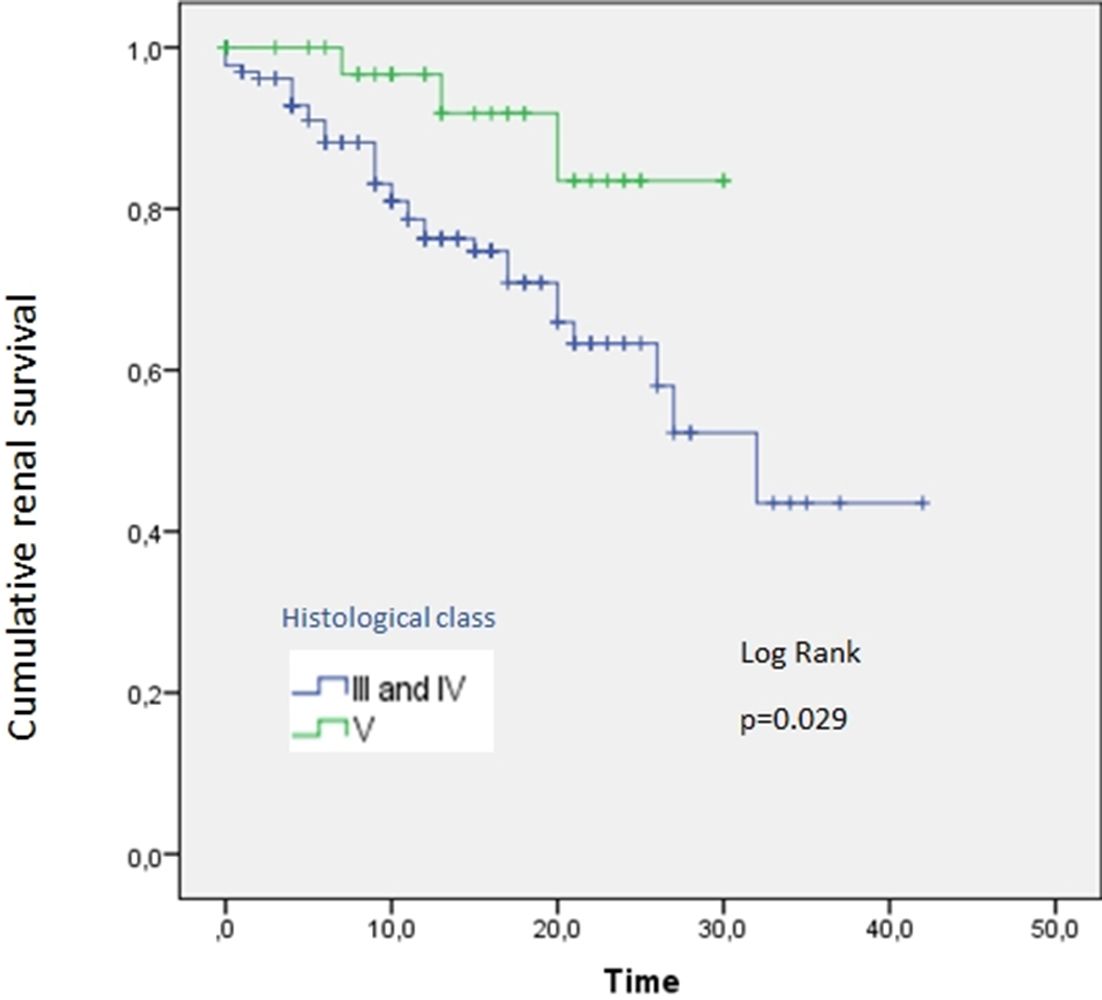
Conclusions: In spite of presenting in the context of the same autoimmune systemic disease, PLN and MLN appear to be very different entities, showing significant differences regarding serologic profiles and renal survival.
Disclosure of Interest: None declared
DOI: 10.1136/annrheumdis-2018-eular.5433