fetching data ... 
Background: Recently, the concept of interstitial pneumonia with autoimmune features (IPAF) was proposed by the American Thoracic Society.1 The serologic domain of IPAF is composed of antibodies to extractable nuclear antigens, cyclic citrullinated peptide antibody, a high titer of rheumatoid factor, and a high titer of antinuclear antibody. However, the clinical significance of the serologic domain of IPAF has not yet been evaluated in idiopathic pulmonary fibrosis (IPF).
Objectives: To investigate the clinical significance of autoantibody positivity in IPF.
Methods: We retrospectively reviewed the records of 528 patients who met the ATS/ERS/JRS/ALAT diagnostic criteria for IPF at a tertiary hospital from January 2007 through March 2014. Patients treated with pirfenidone or nintedanib, an established IPF treatment regimen, were excluded. All patients were divided into the following 3 groups: autoimmune IPF (n=153), patients with autoantibodies that met the criteria for the IPAF serologic domain; incomplete autoimmune IPF (n=68), patients who did not completely meet the criteria for the IPAF serologic domain; lone IPF (n=307), patients without autoantibodies. Multivariate Cox proportional hazards models with backward elimination were used to investigate the risk factors for mortality.
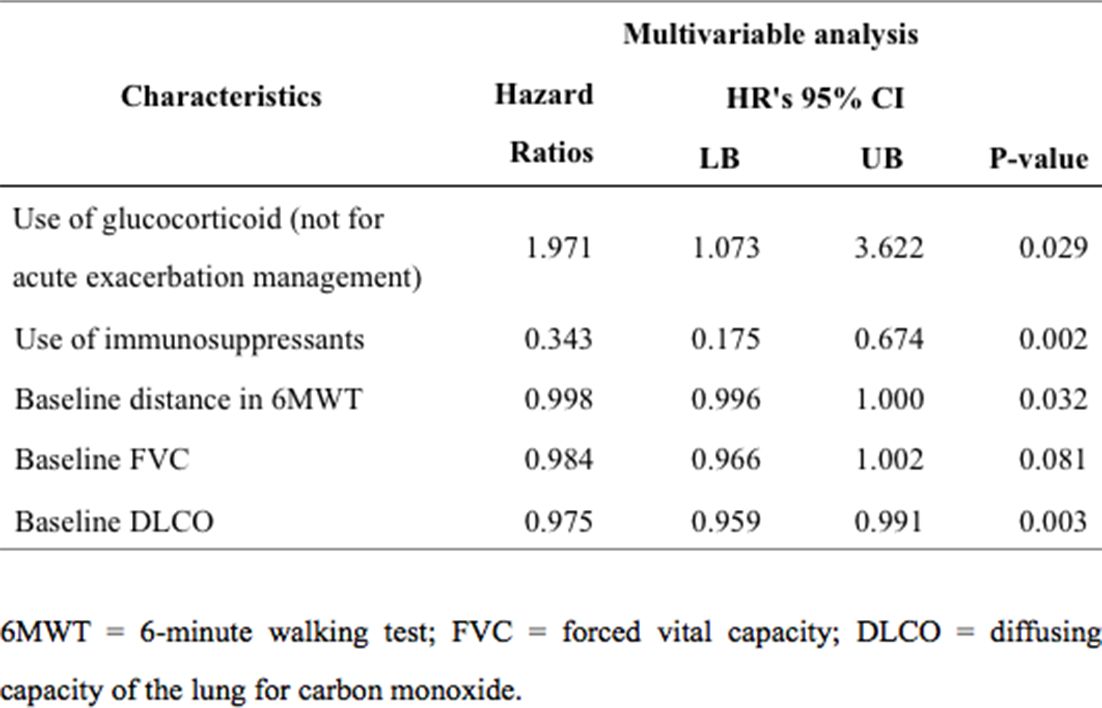
Results: The 5 year mortality rates were as follows: autoimmune IPF group, 54.9% (n=84, 3.4 years after diagnosis [median; IQR=1.9–5.0]); incomplete autoimmune IPF group, 64.7%; lone IPF group, 58.6% (n=180, 2.9 years after diagnosis [median; IQR=1.6–4.9]). Independent risk factors for mortality on multivariable analysis in the overall IPF patient population included age at diagnosis (adjusted hazard ratio (HR) 1.028, p=0.002), autoimmune IPF (adjusted HR 0.747, p=0.050), baseline SaO2 in the 6 min walking test (6MWT, adjusted HR 0.973, p=0.012), baseline distance in the 6MWT (adjusted HR 0.998, p=0.001), baseline forced vital capacity (adjusted HR 0.977, p<0.001), and diffusing capacity of the lungs for carbon monoxide (DLCO) (adjusted HR 0.979, p<0.001). In the autoimmune IPF group, use of glucocorticoid (not for management of acute exacerbation, adjusted HR 1.971, p=0.029), use of immunosuppressants (adjusted HR 0.343, p=0.002), baseline distance in 6MWT (adjusted HR 0.998, p=0.032), and baseline DLCO (adjusted HR 0.975, p=0.003) were independent risk factors for mortality on multivariable analysis.
Abstract SAT0602 – Table 1 Risk factors associated with mortality in autoimmune IPF patients
Conclusions: Our results suggest that positive autoimmunity might be a favourable factor for 5 year mortality in IPF patients compared to those without autoimmunity, and the use of immunosuppressants could be associated with improved mortality in autoimmune IPF patients.
Reference:
Disclosure of Interest: None declared
DOI: 10.1136/annrheumdis-2018-eular.6020