fetching data ... 
Background: In recent years, a substantial number of biosimilar (BioSm) products have come into the market for the treatment of rheumatic disorders, that might potentially improve patient access to treatment, resulting in cost savings and improved outcomes. However, given the limited regulatory evidence, clinical decision making continues to be a challenge.
Objectives: The objective of the study was to assess perceptions of prescribing biosimilars among rheumatologists and gain insights on barriers to access in the EU5 countries (United Kingdom (UK), France (FR), Italy (IT), Spain (SP) and Germany (DE)).
Methods: A cross-sectional survey was conducted in Q4 2016 in the EU5 among national, regional and hospital physicians who had been practicing between 3–30 years. Respondents completed a Physician Biosimilar Perceptual Questionnaire, which assessed the overall perception of anti-TNF biosimilars, specific barriers to prescribing them and cost factors influencing the current use and adoption of biosimilars. Data was analysed using descriptive statistics.
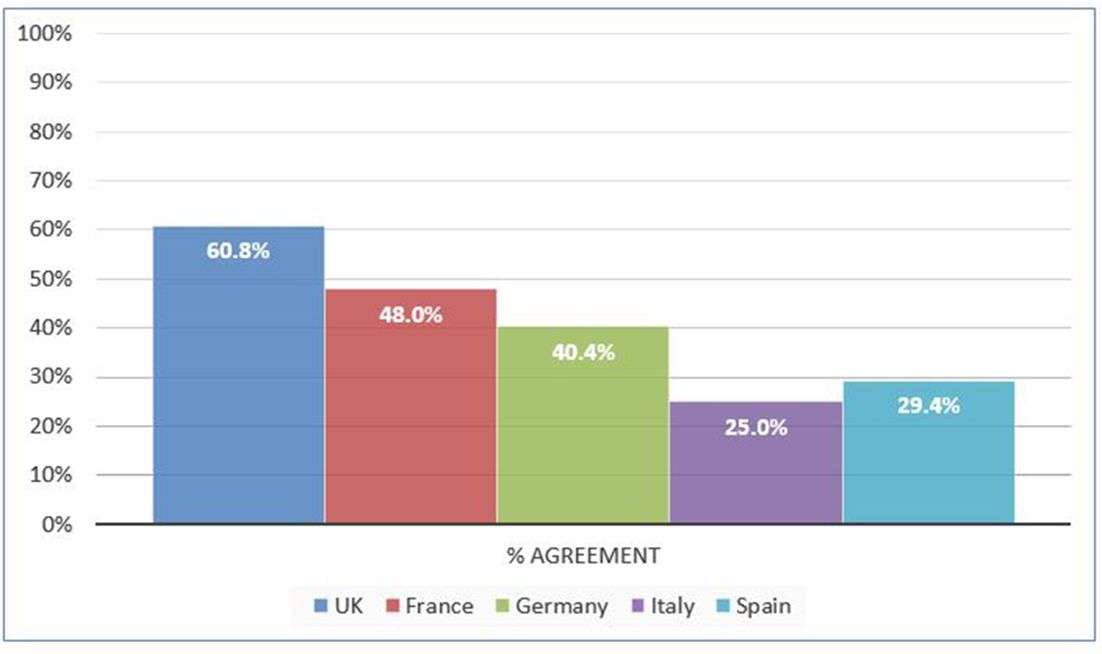
Results: A total of 256 rheumatologists in the EU5 were recruited as part of the study (with almost equal number of rheumatologists representing each EU5 country). Treating rheumatologists were practicing for an average of 16 years, mainly practicing in teaching hospitals (52%), and urban hospitals (21.9%). Overall, 83% of rheumatologists had awareness of biosimilars (range: 70% in DE and IT to 92% in UK). Among the different domains queried, only one in four rheumatologists trusted BioSm as much as branded biologics (range: 17.3% in IT to 39.2% in UK) and about 30% were comfortable with the safety profiles, and reported that long term efficacy and safety was of great importance for prescribing BioSm. Comparing perceptions of BioSm across countries, only 25% of rheumatologists in IT felt that BioSm offered equivalent efficacy to branded biologics, whereas 60.8% in the UK agreed with the same statement (figure 1). There was a consensus among respondents in all five countries regarding the lower cost of BioSm (range: 56.9% in SP to 72.5% in UK). Over 35% of the rheumatologists anticipated that clinical guidelines would require them to prescribe biosimilars. Data also showed that 63% chose BioSm for cost and 49% for formulary placement in clinical practice.
Abstract THU0644 – Figure 1 Perceptions of Physicians in EUS: Equivalent efficacy as branded biologics
Conclusions: Overall, rheumatologists expressed the greatest level of awareness of biosimilars, even though differences were seen among the countries. Long term safety and efficacy data was of key importance; however, cost and formulary coverage did impact the prescribing pattern.
Disclosure of Interest: C. Karki Employee of: Ipsos Healthcare, S. Shah Employee of: Ipsos Healthcare, L. Archer Employee of: Ipsos Healthcare, A. Baskett Shareholder of: ImmuPharma, Employee of: Ipsos Healthcare, E. Baynton Employee of: Ipsos Healthcare, L. Ha Employee of: Ipsos Healthcare, B. Shah-Manek Employee of: Ipsos Healthcare
DOI: 10.1136/annrheumdis-2018-eular.3751