fetching data ... 
Background: The risk of cardiovascular morbidities is higher in patients (pts) with RA and is exacerbated with type 2 diabetes (T2D).1 Recent analysis showed that abatacept (ABA), a biologic (b)DMARD, has a lower incidence of T2D in pts with RA in clinical practice.2
Objectives: To compare baseline characteristics of pts with RA on DMARDs and evaluate incidence of T2D among these pts based on DMARD exposure.
Methods: Administrative claims data (2006–2016) from Optum Clinformatics (database A), QuintilesIMS PharMetrics Plus (database B) and Truven MarketScan® (database C). Inclusion criteria were: 2 RA diagnosis codes+1 DMARD prescription; age ≥18 years;≥3 months baseline (pre-index date); and 3 months of follow-up (post-index date). Mutually exclusive treatment groups (grp) were created based on the first prescription (index date) using a hierarchy of ABA, non-ABA bDMARDs (TNF inhibitors [TNFi] and non-TNFi [excluding ABA]) and conventional DMARDs (cDMARD; MTX or hydroxychloroquine [HCQ]). Also, an RA grp without DMARD use (NoDMARD) was identified. The index date for NoDMARD was first diagnosis date. Incident T2D was identified as those without T2D prior to index using one International Classification of Disease (ICD)−9 or ICD-10 diagnosis code for T2D. Assessment of T2D risk between treatment grps was based on regression and disease risk score (DRS) models. Adjusted incidence rate for T2D was based on a Cox model (stratified by DRS grps and categorised into 4 equal grps using quartile scores) with treatment as the independent variable.
Results: In databases A, B and C, 84,875, 2 07 811 and 1 94 819 pts with RA were identified, respectively (table 1). The combined proportions of pts in each treatment grp were: 3%–4% ABA; 12%–16% non-ABA bDMARD; and 41%–45% cDMARDs. Pts treated with ABA were older compared with those on non-ABA bDMARDs and a greater proportion had T2D risk factors of obesity, hypertension, dyslipidaemia and heart failure (table 1). The adjusted hazard ratios for T2D were significantly higher for non-bDMARD grps of TNFi and other bDMARDs vs ABA (figure 1).
ABA |
TNFi |
Non-TNFi |
MTX only |
HCQ |
cDMARD – others |
NoDMARD |
|
|---|---|---|---|---|---|---|---|
Database A (N) |
2825 |
9569 |
632 |
12 676 |
18 233 |
4368 |
36 572 |
Age≥55 years |
52.5 |
38.8 |
60.3 |
63.3 |
53.4 |
62.6 |
61.3 |
Smoking |
11.3 |
9.8 |
8.7 |
11.2 |
11.2 |
11.7 |
14.1 |
Obesity |
9.7 |
7.1 |
6.2 |
7.4 |
7.9 |
8.2 |
10.0 |
Hypertension |
39.9 |
30.5 |
36.2 |
44.1 |
40.7 |
46.7 |
54.8 |
Dyslipidaemia |
35.9 |
28.4 |
29.1 |
41.2 |
39.9 |
43.9 |
52.2 |
Database B (N) |
6497 |
30 329 |
1664 |
29 821 |
49 652 |
10 358 |
79 490 |
Age≥55 years |
45.5 |
34.1 |
39.6 |
49.7 |
41.7 |
48.9 |
45.0 |
Smoking |
9.4 |
8.4 |
8.0 |
9.3 |
8.9 |
9.3 |
11.7 |
Obesity |
8.4 |
6.4 |
5.1 |
6.5 |
7.5 |
7.1 |
9.3 |
Hypertension |
36.1 |
25.2 |
27.2 |
34.4 |
31.9 |
35.8 |
42.4 |
Dyslipidaemia |
31.2 |
24.4 |
23.1 |
33.6 |
32.6 |
36.7 |
42.0 |
Database C (N) |
8853 |
29 671 |
1714 |
30 669 |
47 850 |
10 891 |
65 171 |
Age≥55 years |
50.7 |
36.0 |
43.3 |
54.9 |
46.1 |
54.5 |
53.1 |
Smoking |
4.7 |
5.0 |
5.5 |
5.4 |
5.2 |
5.3 |
6.8 |
Obesity |
5.4 |
4.6 |
5.0 |
4.8 |
5.2 |
4.8 |
6.4 |
Hypertension |
37.7 |
26.2 |
29.2 |
36.1 |
33.5 |
37.8 |
43.8 |
Dyslipidaemia |
28.9 |
23.4 |
23.1 |
31.1 |
30.2 |
33.7 |
38.4 |
All data are% unless indicated otherwise
Abstract THU0688 – Figure 1 Hazard Ratios for Incidence of T2D in Pts With RA on Different DMARDs.
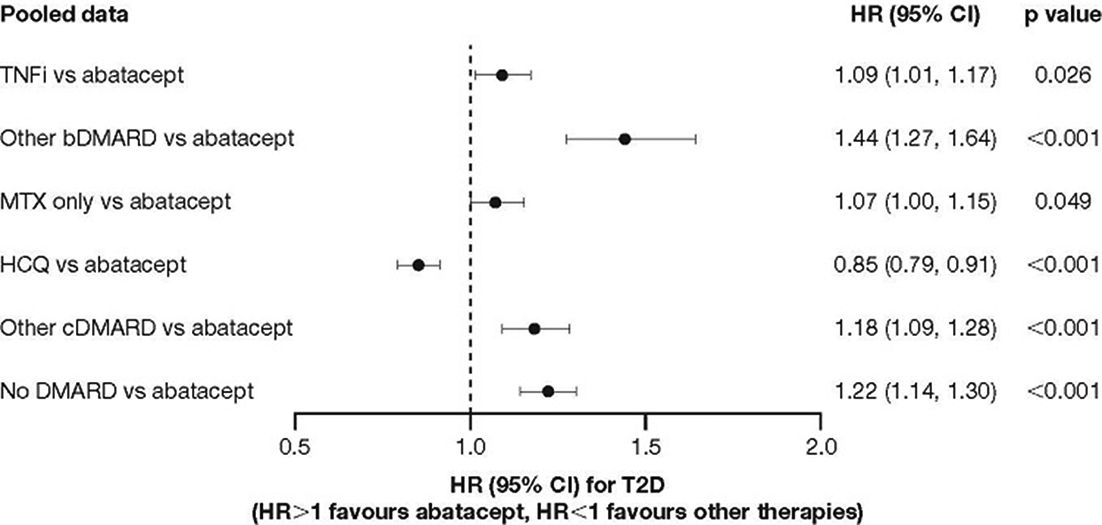
(HR>1 favours abatacept, HR<1 favours other therapies)
Conclusions: Pts with RA treated with abatacept had greater risk factors for T2D at baseline. However, the adjusted risk of new-onset T2D was lower among abatacept pts versus other bDMARDs.
References:
Disclosure of Interest: E. Alemao Shareholder of: Bristol-Myers Squibb, Employee of: Bristol-Myers Squibb, Z. Guo Employee of: Bristol-Myers Squibb, L. Ferri Employee of: Bristol-Myers Squibb, L. Burns Employee of: Bristol-Myers Squibb
DOI: 10.1136/annrheumdis-2018-eular.2033