fetching data ... 
Background: Seronegative antiphospholipid syndrome (SN-APS) is the term proposed to describe patients with clinical signs highly suggestive of APS but persistently negative for conventional antiphospholipid antibodies (aPL) assays. Therefore, new antigenic targets or different methodological approaches have been investigated to detect aPL in SN-APS [1].
Objectives: The aim of this study was to describe the clinical follow-up of a monocentric cohort of SN-APS patients.
Methods: The study included all consecutive SN-APS patients examined from 2014 to 2018. In all patients other possible causes of thrombosis or obstetric morbidity were ruled out. APL were investigated through two tests: 1. anti-cardiolipin/vimentin antibodies (aCL/Vim) by enzyme-linked immunosorbent assay (ELISA) 2. anti-cardiolipin antibodies (aCL) by thin-layer chromatography (TLC)-immunostaining.
Results: We enrolled 121 patients (all Caucasian except one Asian and one Hispanic women). Clinical and demographic characteristics are reported in
Clinical and demographic characteristics
| Features | SN-APS
|
|---|---|
| Male/Female | 14/107 |
| Mean age in years (from-to) | 42.58 (16-78) |
| PAPS/SAPS | 78/43 (64.5/35.5) |
| SLE | 28 (23.1) |
| Others autoimmune diseases | 15 (12.4)
|
| Pregnancy morbidity | 56/107 (52.3) |
| Spontaneous abortions | 49 (45.8) |
| Normal fetus deaths | 22 (20.6) |
| Premature births | 7 (6.54) |
| Thrombosis | 72 (59.5) |
| Arterial thrombosis | 36 (29.8) |
| Venous thrombosis | 48 (39.7) |
| Recurrent thrombosis | 28 (23.1) |
| Thrombosis + Pregnancy morbidity | 8 (6.6) |
| Non-criteria APS features | 45 (37.2) |
| Livedo reticularis | 18 (14.9) |
| Thrombocytopenia | 12 (9.9) |
| Migraine | 19 (15.7) |
| Seizures | 5 (4) |
| Others | 11 (9) |
| Cardiovascular risk factors | 50 (41.3) |
| Hypercholesterolemia | 8 (6.6) |
| Smoking | 22 (18.2) |
| Hypertension | 22 (18.2) |
| OC/HRT | 7 (5.8) |
| Diabetes | 4 (3.3) |
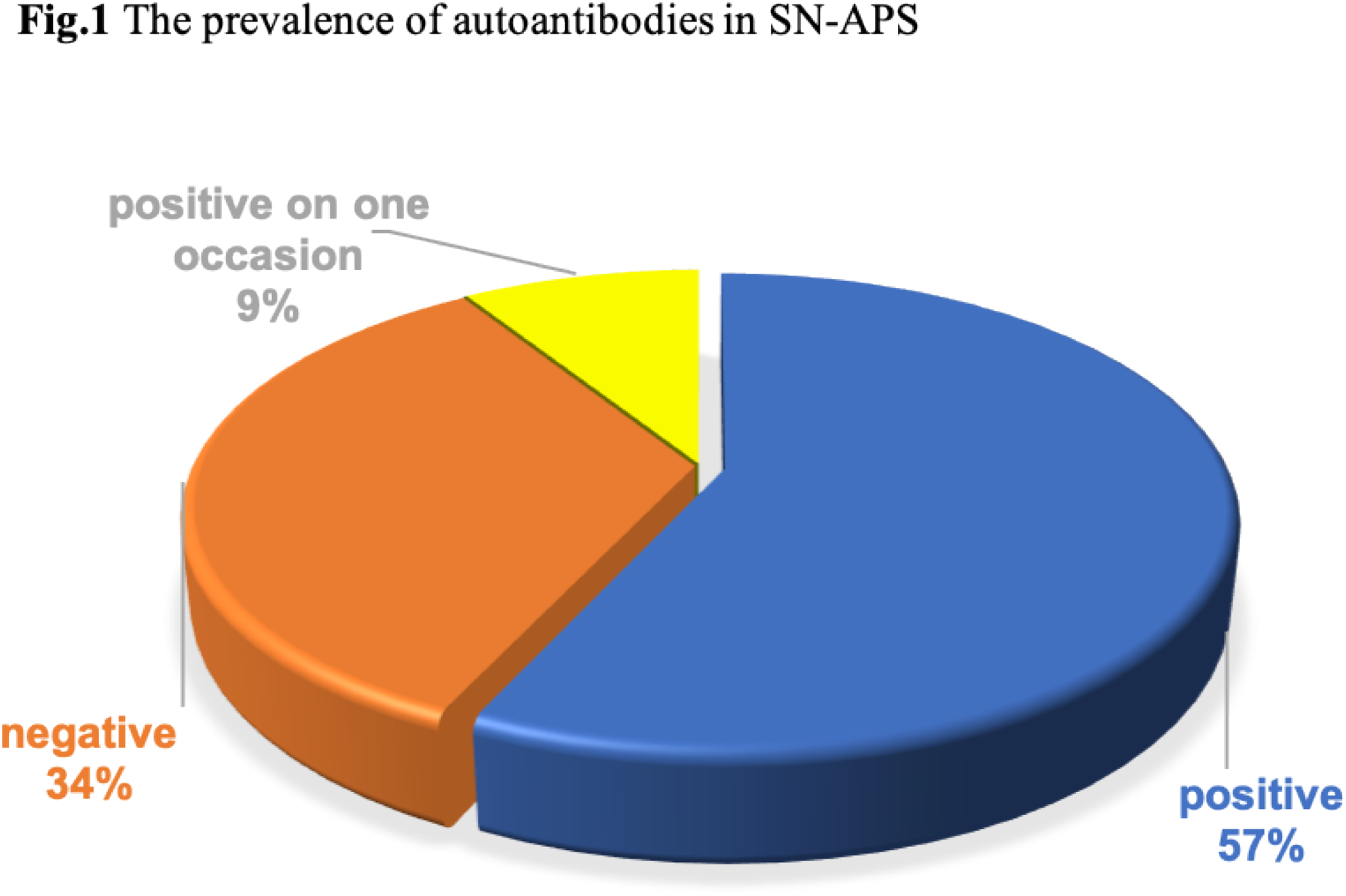
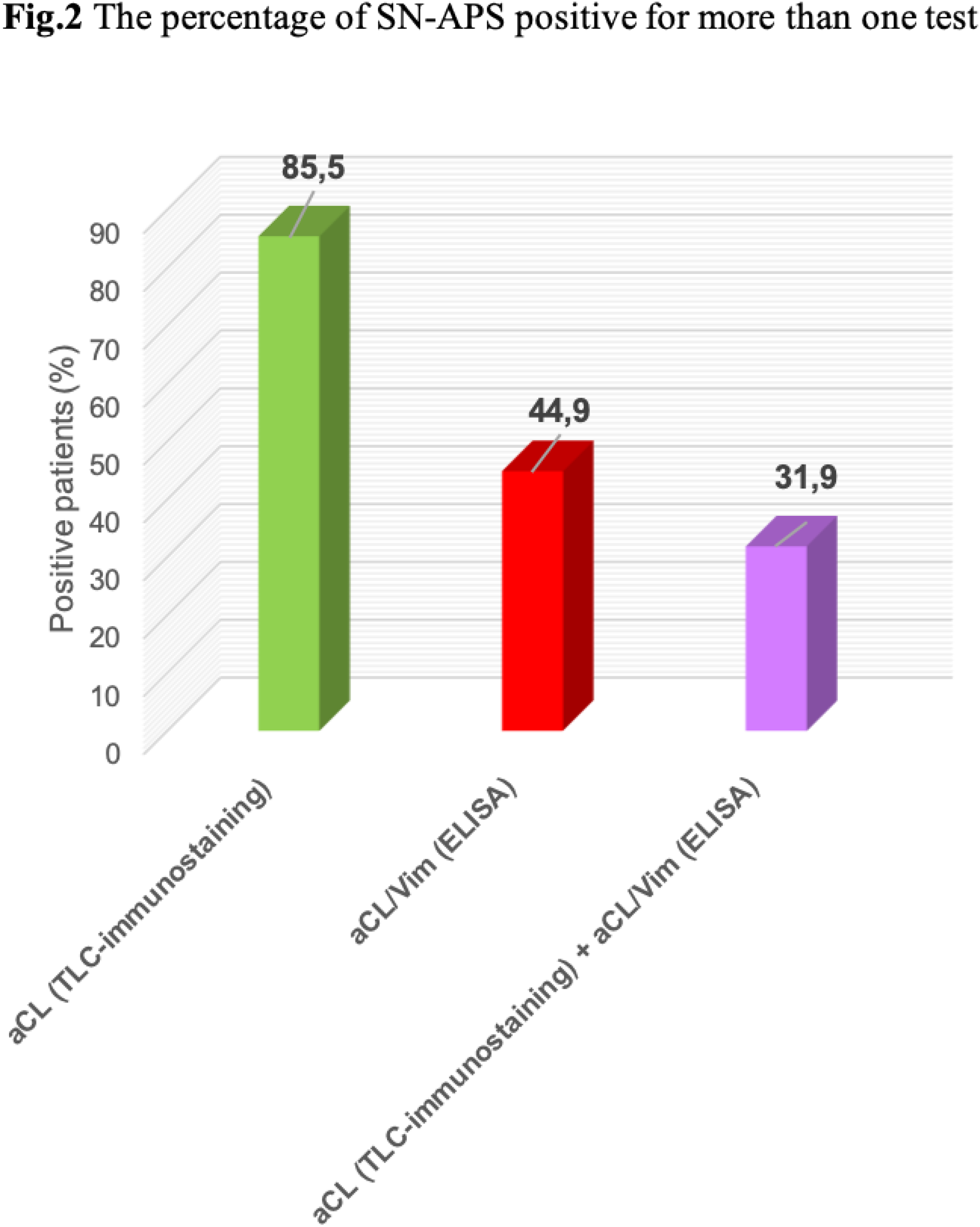
Sixty-nine out 121 patients (57%) resulted positive for at least one non-conventional test in two occasions more than 12 weeks apart (
Patients with double positivity showed a higher prevalence of mixed thrombotic and obstetrical features than patients with single positivity (p < 0.001, likelihood positive ratio 8.2).
Non-conventional aPL positivity better supported the diagnosis of APS and, following the therapeutic changes implemented, in a median follow up of 41 months (IQR 39.5) only 3 cases of recurrent thrombosis (2 cases of arterial thrombosis during treatment with antiaggregant therapy and one case of venous thrombosis in treatment with new oral anticoagulant therapy) were observed. During the follow-up, 35 patients with obstetric morbidity who resulted positive for the tests had 20 pregnancies; 12 of them (60%) experienced a good outcome under conventional treatment for classical APS.
Conclusion: The results demonstrate that new methods – TLC-immunostaining – or new antigens - CL/Vim – allow to detect aPL in so-called “SN-APS” patients and, consequently, to prescribe the most appropriate therapy.
REFERENCES:
[1]Conti F et al. The Mosaic of “Seronegative” Antiphospholipid Syndrome. J Immunol Res. 2014;2014:389601
Disclosure of Interests: Silvia Mancuso: None declared, Simona Truglia Speakers bureau: Lilly, BMS, Serena Recalchi: None declared, Gloria Riitano: None declared, Francesca Romana Spinelli Grant/research support from: Pfizer, Speakers bureau: Lilly, BMS, Celgene, Fulvia Ceccarelli: None declared, Maurizio Sorice: None declared, cristiano alessandri Grant/research support from: Pfizer, fabrizio conti Speakers bureau: BMS, Lilly, Abbvie, Pfizer, Sanofi