fetching data ... 
Background: Subjects with clinically significant arthralgia who will eventually develop inflammatory arthritis (IA) had a higher HAQ at baseline (1). Here we investigated the change in patients reported outcomes (PRO) over time in ACPA+ at risk of IA subjects.
Objectives: In ACPA+ subjects at risk of developing IA, to analyse the change in PRO results in order to identify an imminent phase of progression.
Methods: In a single centre prospective observational cohort, PRO from 109 ACPA+ subjects without clinical arthritis were collected prospectively at 0, 12, 26, 39 weeks; the last time-point was 52 weeks for the individuals who did not progress to IA (non-progressors) or the last visit preceding progression (within 12 weeks) for those who developed IA (progressors). Data on the following PRO were collected: HAQ, “general health” (GH-VAS), “fatigue” (fatigue-VAS), and “global pain” (GP-VAS) using visual analogic scale measures graded 0 to 100. We firstly used mixed models repeated measures ANOVA analysis then included covariates such as gender, shared epitope (SE) (HLA DRB1*01, *04 and/or *10), anti-CCP2 antibody (CCP2) and/or rheumatoid factor (RF) high titre (≥3ULN), and smoking exposure (Ever/Never).
Results: All analysis met sphericity assumption. In this selection, 20% of subjects (24/109) developed IA within a median of 77 weeks (Range 37-369.43), non-progressors were followed for a median of 216 weeks (Range 50-590), 74 subjects were SE positive (68%), 81 had a CCP2 and/or RF high titre (74%), and 66 were previous or current smokers (61%).
Analysis revealed significant differences between both groups for the last visit, and within the progressor group for the last visit compared to all previous visits regarding the GH-VAS, GP-VAS and HAQ (
Mixed Models repeated measures
| General Health | Global Pain | HAQ | Fatigue | |
|---|---|---|---|---|
| Within subject effects;
|
P= 0.004
|
P < 0.001
| P = 0.115 | P = 0.459 |
| Pairwise comparison within group |
Non-progressors:
|
Non-progressors:
|
Non-progressors:
|
Non-progressors:
|
|
Progressors:
|
Progressors:
|
Progressors:
|
Progressors:
|
|
| Pairwise comparison between group |
Last visit:
|
Last visit:
|
Last visit:
| P-value > 0.05 |
| Mauchly’s test of sphericity | P = 0.099 | P = 0.050 | P = 0.057 | P = 0.722 |
| N (Progressors/total) | 24/109 | 15/102 | 24/107 | 19/102 |
Repeated measure ANOVA between groups
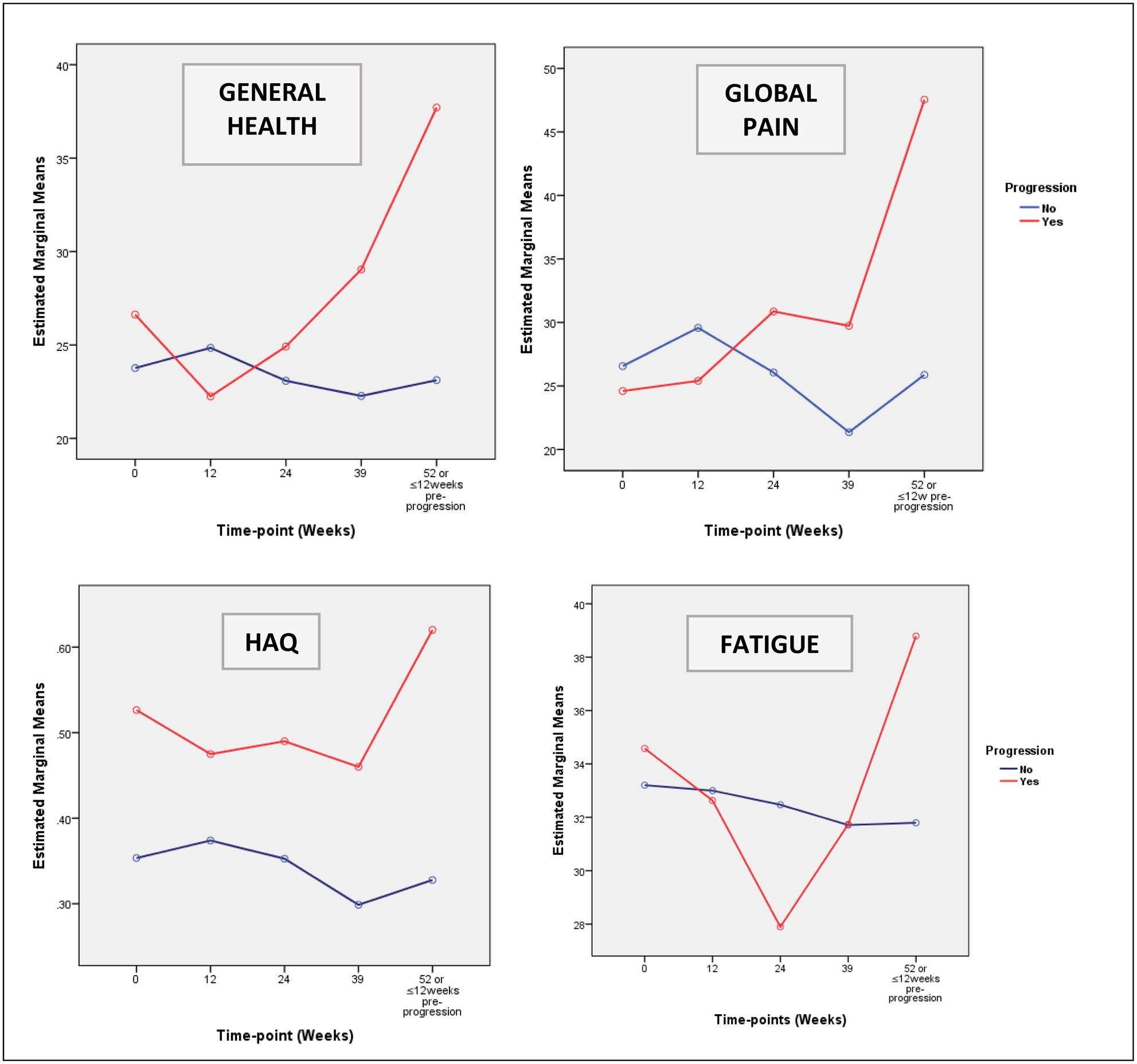
Conclusion: These results show for the first time a significant deterioration in the PRO of general health, global pain, and HAQ weeks just preceding clinical arthritis development. This phase prior progression needs to be thoroughly studied to improve the accuracy of predicting imminent progression.
REFERENCES:
[1]Ten Brinck RM et al. Functional limitations in the phase of clinically suspect arthralgia are as serious as in early clinical arthritis; a longitudinal study. RMD open. 2017;3(1):e000419.
Disclosure of Interests: Laurence Duquenne: None declared, Kulveer Mankia: None declared, Leticia Garcia-Montoya: None declared, Jacqueline Nam: None declared, Andrea Di Matteo Grant/research support from: the publication was conducted while Dr. Di Matteo was an ARTICULUM fellow, Paul Emery Grant/research support from: AbbVie, Bristol-Myers Squibb, Merck Sharp & Dohme, Pfizer, Roche (all paid to employer), Consultant of: AbbVie (consultant, clinical trials, advisor), Bristol-Myers Squibb (consultant, clinical trials, advisor), Lilly (clinical trials, advisor), Merck Sharp & Dohme (consultant, clinical trials, advisor), Novartis (consultant, clinical trials, advisor), Pfizer (consultant, clinical trials, advisor), Roche (consultant, clinical trials, advisor), Samsung (clinical trials, advisor), Sandoz (clinical trials, advisor), UCB (consultant, clinical trials, advisor)