fetching data ... 
Background: Increased Body Mass Index (BMI) is associated with Psoriatic Arthritis (PsA) but with uncertain pathophysiological significance. BMI does not reflect body fat distribution, but fat storage site is important as increased ectopic fat including visceral adipose tissue (VAT), liver fat, and muscle fat infiltration (MFI), are associated with increased type 2 diabetes and coronary heart disease (CHD) risk 1 . To date no study has compared detailed body composition in PsA with the general population and other metabolic diseases.
Objectives: 1. To characterize the body composition profile of PsA compared to age, sex, and BMI-matched metabolic disease free (MDF) individuals, and type 2 diabetes. 2. To relate body composition to risk of type 2 diabetes and CHD in PsA versus MDF controls.
Methods: MRI body composition profiles were available for 29 PsA participants in the IMAPA study 2 . After excluding 3 participants with concomitant type 2 diabetes, body composition was compared in 26 PsA participants with 130 age, sex, and BMI-matched healthy MDF controls (matched 1:5) and 454 individuals with type 2 diabetes from UK Biobank, using Wilcoxon signed-rank test. Analyses were repeated adjusted for age, sex, and BMI. The propensity of PsA patients to develop CHD or type 2 diabetes based on their body composition profile was compared to that of matched MDF controls.
Results: PsA participants had significantly more ectopic fat including greater visceral adipose tissue (VAT) volume and liver fat percentage compared to MDF controls (
Comparison of body composition parameters in PsA, MDF controls, and type 2 diabetes
| Variable | PsA | MDF controls | p-value* | Adj. p value** | Type 2 diabetes | p-value † | Adj. p value ‡ |
|---|---|---|---|---|---|---|---|
| Age (years) | 56.0 (9.0) | 57.4 (6.5) | 0.766 | - | 65.4 (6.9) | < 0.001 | - |
| BMI (kg/m 2 ) | 31.2 (6.4) | 30.5 (5.3) | 0.799 | - | 29.9 (5.2) | 0.397 | - |
| VAT (L) | 5.89 (2.10) | 4.34 (1.83) | <0.001 | <0.001 | 5.93 (2.56) | 0.662 | 0.301 |
| Visceral fat index (L/m 2 ) | 2.06 (0.73) | 1.52 (0.64) | <0.001 | <0.001 | 2.03 (0.84) | 0.337 | 0.175 |
| Abdominal subcutaneous adipose tissue (L) | 10.48 (4.90) | 9.42 (4.86) | 0.288 | 0.071 | 8.58 (3.93) | 0.109 | 0.339 |
| Abdominal fat index (L/m 2 ) | 5.87 (2.39) | 4.93 (2.29) | 0.084 | <0.001 | 5.04 (1.92) | 0.052 | 0.024 |
| Liver fat (%) | 8.88 (4.42-13.18) | 3.29 (1.98-7.25) | 0.002 | 0.002 | 6.13 (2.77-11.63) | 0.392 | 0.656 |
| MFI (%) | 7.74 (2.57) | 7.43 (1.95) | 0.748 | 0.292 | 8.61 (2.29) | 0.736 | 0.191 |
Values are mean (SD) (liver fat, median (IQR)). *PsA vs. MDF controls. **PsA vs. MDF controls adjusted for age, sex, and BMI. †PsA vs. Type 2 diabetes. ‡ PsA vs. Type 2 diabetes adjusted for age, sex, and BMI.
Body Composition Profiles of IMAPA PsA participants (pink) versus A. UK Biobank matched MDF controls (green), and B. type 2 diabetes (T2D) (green).
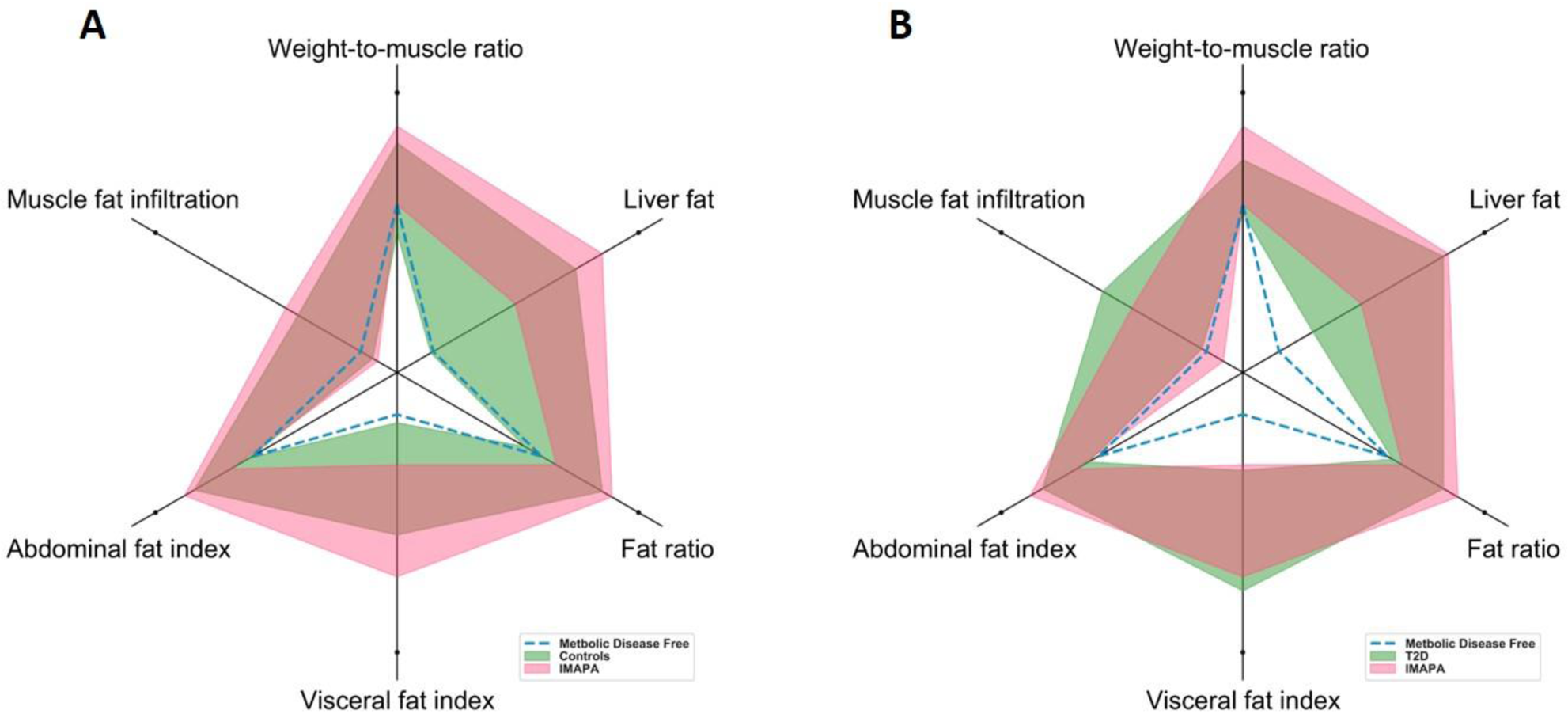
Conclusion: This is the first study to report that individuals with PsA have a body composition profile associated with an adverse metabolic phenotype, with greater VAT and ectopic liver fat than the general population and more similar to that of type 2 diabetes, in line with their greater cardiometabolic risk. These data mandate a revision of the management approach to PsA that includes attention to weight loss interventions.
REFERENCES:
[1]Linge et al. Body Composition Profiling in the UK Biobank Imaging Study. Obesity. 2018;26(11):1785
[2]Ferguson et al. Effect of PDE4 Inhibition with Apremilast on Cardiometabolic Outcomes in Psoriatic Arthritis – Initial Results from Immune Metabolic Associations in Psoriatic Arthritis (IMAPA) Study. Arthritis Rheumatol. 2019; 71(suppl 10).
Acknowledgments: Celgene; BHF (RE/13/5/30177)
Disclosure of Interests: Lyn D. Ferguson: None declared, Jennifer Linge Shareholder of: AMRA Medical AB, Employee of: AMRA Medical AB, Olof D. Leinhard Shareholder of: AMRA Medical AB, Employee of: AMRA Medical AB, Iain McInnes Grant/research support from: Bristol-Myers Squibb, Celgene, Eli Lilly and Company, Janssen, and UCB, Consultant of: AbbVie, Bristol-Myers Squibb, Celgene, Eli Lilly and Company, Gilead, Janssen, Novartis, Pfizer, and UCB, Stefan Siebert Grant/research support from: BMS, Boehringer Ingelheim, Celgene, GlaxoSmithKline, Janssen, Novartis, Pfizer, UCB, Consultant of: AbbVie, Boehringer Ingelheim, Janssen, Novartis, Pfizer, UCB, Speakers bureau: AbbVie, Celgene, Janssen, Novartis, Naveed Sattar Grant/research support from: Boehringer Ingelheim, Consultant of: Amgen, Boehringer Ingelheim, AstraZeneca, Eli Lilly, Novo Nordisk, Sanofi, and Janssen, Speakers bureau: Amgen, Boehringer Ingelheim, AstraZeneca, Eli Lilly, Novo Nordisk, Sanofi, and Janssen