fetching data ... 
Background: Gout is the most common inflammatory arthritis with both the prevalence and incidence showed significant rise in the UK in recent years 1 .
The most frequent reasons for referral from primary care were diagnostic uncertainty 54%, failure to respond to primary care management 28%, and complex comorbidity 25% 2 .
From primary care perspective, increased urate level (p=0.0001), young age (p=0.009), fewer comorbidities (p=0.039) constituted the most common risk for gout General Practice consultations and in addition to poor compliance to urate lowering treatment ULT (p=0.004) and lower CVS risk scores (p=0.038) these all factors comprised the independent risk factors for Gout flares 3 .
Objectives: To compare the management of gout in the rheumatology services in Wales against the 2017 British Society for Rheumatology (BSR) Guidelines.
Methods: •A descriptive study over an 8-week period from January to February 2019, used Simple Analysis in calculating the frequency (%).
•Data were collected from notes of 79 patients referred to rheumatology departments across Wales using the British Society for Rheumatology (BSR) 2017 Gout Guidelines Audit Tool.
•The audit cohort comprised 62% of chronic gout patients and 38% of acute admissions.
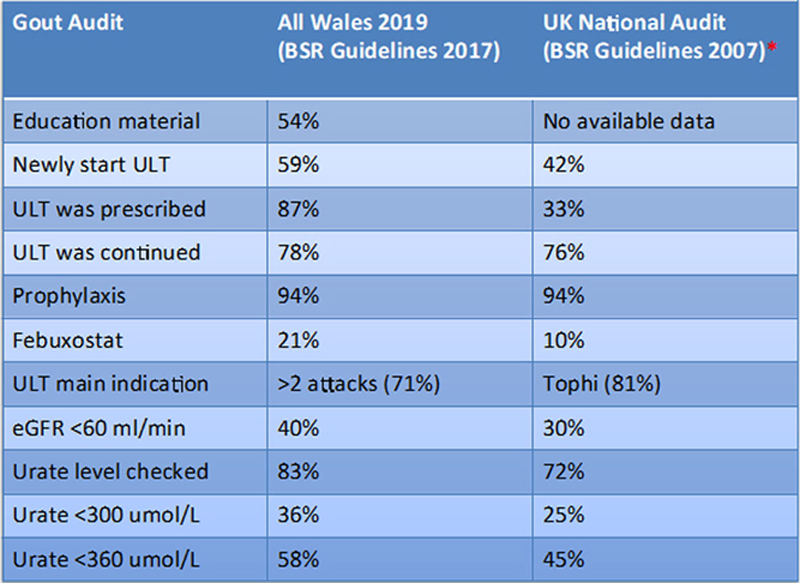
Conclusion: •Gout management by rheumatologists across Wales concords well with the recent BSR guidelines for most audit standards and showed an improvement in percentage of patients who achieved a target serum uric acid level <300 and <360 umol/L according to the BSR and EULAR guidelines, respectively.
•Areas for improvement include documentation of Patient Education, improvement of audit tool (Age, Alcohol, current ULT).
•To spread the message to primary care setting, where gout is predominantly managed, to ensure that ULT is optimized to achieve target serum uric acid level to benefit patients.
REFERENCES:
[1]Kuo C, Grainge MJ, Mallen C , et al Rising burden of gout in the UK but continuing suboptimal management: a nationwide population study, Annals of the Rheumatic Diseases 2015; 74: 661-667.
[2]*Management of gout by UK rheumatologists: a British Society for Rheumatology national audit. Roddy E, Packham J, Obrenovic K, Rivett A, Ledingham JM.Rheumatology (Oxford). 2018 May 1; 57(5):826-830.
[3]Callear J, Blakey G, Callear A , et al Gout in primary care: Can we improve patient outcomes? BMJ Open Quality 2017;6:u210130.w4918. doi: 10.1136/bmjquality.u210130.w4918
Acknowledgements: Dr Martin Bevan for supervising the work and Rheumatology Units across Wales for collecting data and the British Society for Rheumatology in formulating the audit tool.
Disclosure of Interests: None declared.