fetching data ... 
Background: Psoriatic arthritis and psoriasis, collectively termed psoriatic disease (PsD), are associated with increased cardiovascular (CV) risk. Metabolites comprise biomarkers that may add predictive value over traditional CV risk factors.
Objectives: We aimed to identify metabolites associated with CV events (CVEs) and to determine whether they could improve CV risk prediction beyond traditional CV risk factors.
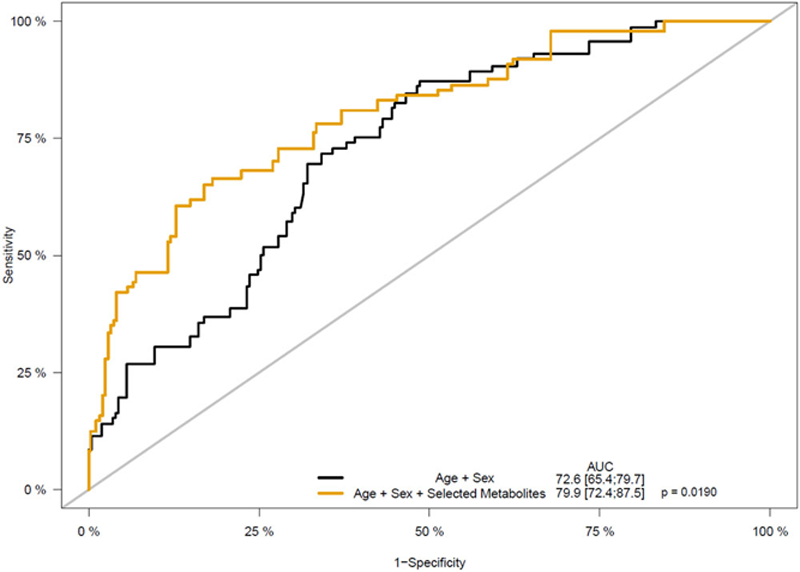
Methods: Patients from a longitudinal PsD cohort without a prior history of CVEs were included. In the first available serum sample, a targeted nuclear magnetic resonance (NMR) metabolomics platform was used to quantify 64 metabolite measures comprised of lipoprotein subclasses, fatty acids, glycolysis precursors, ketone bodies and amino acids. The study outcome included any of the following CVEs occurring within the first 10 years of biomarker assessment: angina, myocardial infarction, congestive heart failure, transient ischemic attack, cerebrovascular accident, revascularization procedures and CV death. The association of each metabolite with incident CVEs were analyzed separately using Cox proportional hazards regression models first adjusted for age and sex, and subsequently for traditional CV risk factors. Variable selection was performed using penalization with boosting after adjusting for age and sex. The added predictive value of the selected metabolites to improve risk prediction beyond traditional CV risk factors was assessed using the area under the receiver operator characteristic curve (AUC).
Results: A total of 977 patients with PsD, followed between 2002 and 2019, were analyzed (mean age 49.1 ± 12.6 years, 45.1% female). During a mean follow-up of 7.1 years, 70 (7.2%) patients developed incident CVEs. In Cox regression models adjusted for CV risk factors, alanine, tyrosine, total high-density lipoprotein (HDL) cholesterol, medium and large HDL particles, and the degree of unsaturation of fatty acids were significantly associated with decreased CV risk. Glycoprotein acetyls, apolipoprotein B, remnant cholesterol, very low-density lipoprotein (VLDL) cholesterol, and very small VLDL particles were associated with an increased CV risk. In proportional sub-distribution hazards regression models adjusted for age and sex, 13 metabolites were selected (
Regression coefficients of the selected metabolites in a model adjusted for age and sex.
| Category | Metabolite | Model adjusted for Age and Sex |
| Amino Acids | Alanine | -0.1179 |
| Glycine | -0.0339 | |
| Tyrosine | -0.1010 | |
| Fatty acid ratios, relative to total fatty acids | Docosahexaenoic acid | -0.0862 |
| Unsaturation degree, double bonds per fatty acid | -0.1265 | |
| Fluid Balance | Albumin | +0.0685 |
| Glycerides | Triglycerides in IDL cholesterol | +0.1546 |
| Glycolysis precursors | Glucose | +0.1391 |
| Inflammation | Glycoprotein acetyls | +0.1478 |
| Ketone bodies | Acetoacetate | +0.0464 |
| Lipoprotein subclasses | HDL 3 Cholesterol | -0.0211 |
| Medium HDL | -0.0296 | |
| Large HDL | -0.0309 |
Predictive performance of a model with age and sex alone is compared to a model with age and sex plus selected metabolites.
Conclusion: Using NMR metabolomics profiling, we identified a variety of metabolites associated with a lower and higher risk of developing CVEs in patients with PsD. Further study of their underlying association with CVEs is needed to clarify the clinical utility of these biomarkers to guide CV risk assessment in this population.
REFERENCES:
[1]Eder L, Wu Y, Chandran V, et al. Incidence and predictors for cardiovascular events in patients with psoriatic arthritis. Ann Rheum Dis 2016;75(9):1680-6.
[2]Soininen P, Kangas AJ, Wurtz P, et al. Quantitative serum nuclear magnetic resonance metabolomics in cardiovascular epidemiology and genetics. Circ Cardiovasc Genet 2015;8(1):192-206.
Acknowledgements: Keith Colaco is supported by the Enid Walker Estate, Women’s College Research Institute, Arthritis Society (TGP-19-0446), National Psoriasis Foundation (Early Career Grant) and the Edward Dunlop Foundation. Lihi Eder is supported by a Young Investigator Award from the Arthritis Society and an Early Researcher Award from the Ontario Ministry of Science and Innovation. The study was supported in part by a discovery grant from the National Psoriasis Foundation and an operating grant from the Arthritis Society (YIO-16-394).
Disclosure of Interests: None declared