fetching data ... 
Background: The COVID-19 pandemic has resulted in unforeseen challenges for humanity, taking a significant toll, especially the immune-suppressed individuals. In this regard, the health and general well-being of people with rheumatic diseases, the great majority users of immunosuppressives, have been at stake.
Objectives: To explore the impact of the COVID-19 pandemic on people with rheumatic diseases on immunosuppression during the first wave, concerning a) (self-)management of their disease; b) interaction with the health care team; c) emotional well-being and d) overall health.
Methods: A qualitative study was conducted following a phenomenological approach. Adults (>18 years) with a rheumatic disease from four European countries (Cyprus, England, Greece, Portugal). Patients were recruited through patient’s associations and social media and were invited to participate in semi-structured, audio-recorded interview or focus groups, between July - August 2020. Following a pilot study the information provided was transcribed verbatim, anonymized and translated into English where necessary. An inductive approach was adopted to carry out a thematic framework analysis with the assistance of ATLAS.ti to identify key themes and subthemes. Data validation strategies were employed, and Ethical approval and informed consent were obtained.
Results: Participants were 24 patients (21 women, age range 33 to 74 years) divided by 7 focus-groups and 1 individual interview. Most frequent diagnoses were rheumatoid arthritis (n=7), lupus (n=4), juvenile idiopathic arthritis (n=3).
Three key themes with 3-7 subthemes were identified within the analytical framework, centred around the impact of the Covid-19 on patients’ lives (
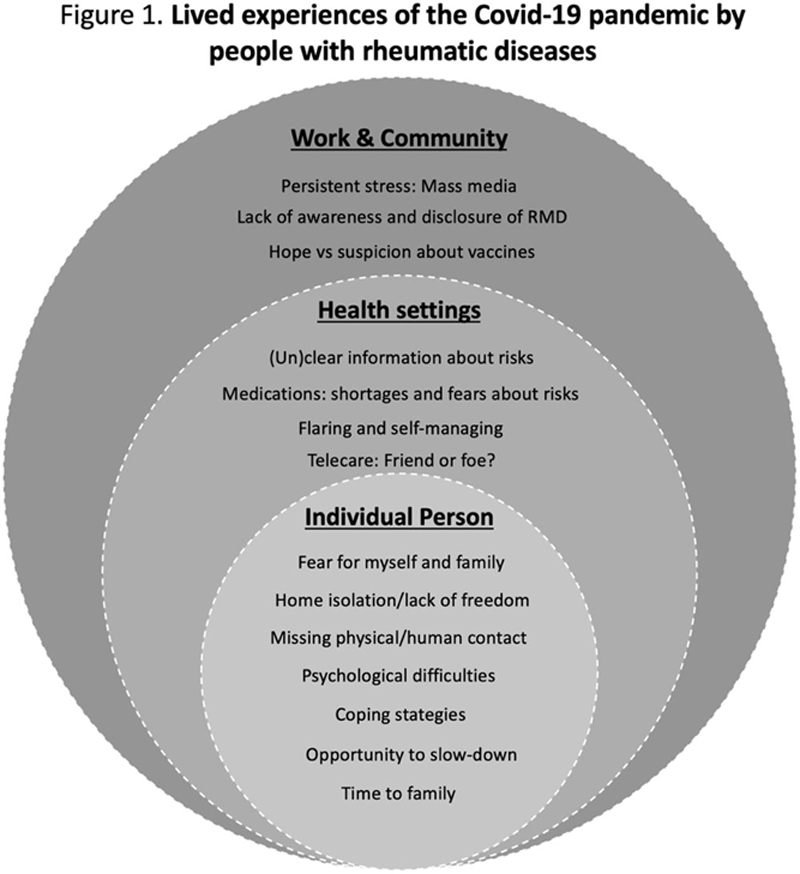
Conclusion: When experiencing a significant life-event people require some time to process the different lived experiences. This study provides insights on how patients from four countries coped with the new challenges. Such insights are invaluable for health care providers and policy makers, in guiding more meaningful support tailored to individual needs, especially at times of crisis. The study highlights the impact of COVID-19 on the lives of people with rheumatic disease. A follow-up study is currently underway to examine the effect of subsequent waves of the pandemic.
REFERENCES:
[1]Golden SD, Earp JA. Social ecological approaches to individuals and their contexts: twenty years of health education & behavior health promotion interventions. Health Educ Behav. 2012;39(3):364-72. doi: 10.1177/1090198111418634.
[2]Walsh F. Family resilience: a framework for clinical practice. Fam Process. 2003;42(1):1-18. doi: 10.1111/j.1545-5300.2003.00001.
Acknowledgements: We thank the participants of this study.
Disclosure of Interests: None declared