fetching data ... 
Background: Industry, regulators, and the rheumatology community have recognized the need for observational studies to monitor the safety of new antirheumatic agents. Registries provide a unique opportunity to understand the safety of newer therapies, but pharmacovigilance studies require large number of patients to evaluate rare drug-related adverse-events (AEs). Because JAK-inhibitors (JAKi) have only recently been approved for the treatment of rheumatoid arthritis, it makes sense to combine data from several registries in order to obtain a sufficiently large sample size to promote earlier detection of adverse events.
Objectives: The purpose of this analysis was to evaluate how AEs are assessed in the various registries in preparation for a collaborative pharmacovigilance analysis, and present preliminary results.
Methods: The “JAK-pot” collaboration includes 19 RA registries. The principal investigators of the participating registries were sent a structured questionnaire on AE assessment and 18 (94%) provided complete responses on the AE assessment procedures of their registries. We present simple descriptive statistics of the AE assessment procedures employed by the participating registries.
Results: The 19 registries represent 7186 patients initiating a JAKi (
| Country, registry | N° of patients on JAKi included |
| Austria, BIOREG | 87 |
| Belgium, TARDIS | 2113 |
| Canada, RHUMADATA | 363 |
| Czech Republic, ATTRA | 197 |
| Denmark, DANBIO | 506 |
| Finland, ROB-FIN | 229 |
| Germany, RABBIT | 620 |
| Italy, GISEA | 244 |
| Israel, I-RECORD | 96 |
| Netherlands, METEOR | 4 |
| Norway, NOR-DMARD | 97 |
| Portugal, REUMA.PT | 44 |
| Romania, RRBR | 252 |
| Russia, ARBITER | 428 |
| Slovenia, biorx.si | 141 |
| Spain, BIOBADASER | 139 |
| Switzerland, SCQM | 738 |
| Turkey, TURKBIO | 404 |
| UK, BSRBR | 484 |
After ineffectiveness, AEs was the second most common reason for JAKi discontinuation (25.5%), with large differences between registries (
Of the participating registries, 2 registries do not collect AEs, while 16 (89%) assess incident AEs, by means of a pre-specified extraction form (3 registries), by free text (5 registries), by a combination of both (6 registries) and/or the use of linkage to external electronic records (3registries). AEs are coded using a predefined coding system by 11 registries (MeDRA (8), other (3)), but nearly all are recording the severity of the AE (15, 94%), AE related-death (15, 94%), or AE-related hospitalisation (15, 94%). AEs of special interest, such as serious infections (15, 94%), thromboembolic events (15, 94%), or shingles (9, 56%), are recorded by most registries. Incident AEs are linked by the treating physician to specific therapies in 11 registries (69%), while the other 5 registries extrapolate potential causal associations based on therapy start and stop dates. A pre-specified adjudication process for AEs is made only by 5 registries (31%).
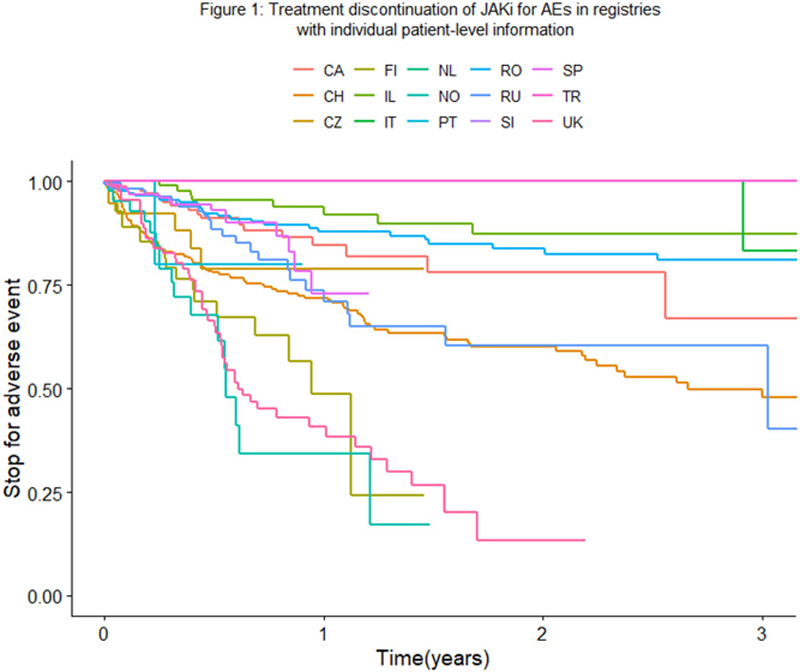
Conclusion: Substantial heterogeneity exists among registries regarding AE assessment within the JAK-pot collaboration. These differences must be taken into account when analysing the safety of JAKi across different countries in collaborative studies. For comparative analyses, stratified analyses by country are required to account for differential AE assessment and varying degrees of potential under-reporting.
Disclosure of Interests: Kim Lauper: None declared, Denis Mongin: None declared, Sytske Anne Bergstra: None declared, Denis Choquette: None declared, Catalin Codreanu: None declared, Diederik De Cock: None declared, Lene Dreyer: None declared, Ori Elkayam: None declared, Kimme Hyrich: None declared, Florenzo Iannone: None declared, Nevsun Inanc: None declared, Eirik kristianslund: None declared, Tore K. Kvien: None declared, Burkhard Leeb: None declared, Galina Lukina: None declared, Dan Nordström: None declared, Karel Pavelka: None declared, Manuel Pombo-Suarez: None declared, Ziga Rotar: None declared, Maria Jose Santos: None declared, Anja Strangfeld: None declared, Delphine Courvoisier: None declared, Axel Finckh Speakers bureau: Eli-Lilly, Pfizer, Consultant of: Eli-Lilly, Pfizer, Grant/research support from: BMS, Pfizer.