fetching data ... 
Background: Hydroxychloroquine (HCQ) is a well-tolerated drug that contributes to downregulating the immune response against autoantigens and it has been used in several autoimmune diseases. In systemic sclerosis (SSc) it is used to treat inflammatory arthritis without proof of efficacy.
Objectives: Our aim was to evaluate the use of HCQ and its impact on Health Assessment Questionnaire disability index (HAQ-DI) and the Cochin Hand Function Status (CHFS). in a large SSc cohort compared to a propensity matched group of SSc patients not using HCQ.
Methods: SSc patients from the European Scleroderma Trials and Research (EUSTAR) data base treated with HCQ for at least 6 months were evaluated. Demographic and clinical data, concomitant drugs, duration of HCQ treatment and reasons for its discontinuation, HAQ-DI and CHFS (at least 2 evaluation) were recorded and were the outcome variables of interest. Statistical analysis was performed using propensity score matching for age, gender, disease duration, corticosteroids, immunosuppressives, vasoactive drugs, DMARDs in a 3:1 control:HCQ ratio. Standard descriptive statistics and Student’s t-test and Chi-square test were used to assess the propensity-matched groups.
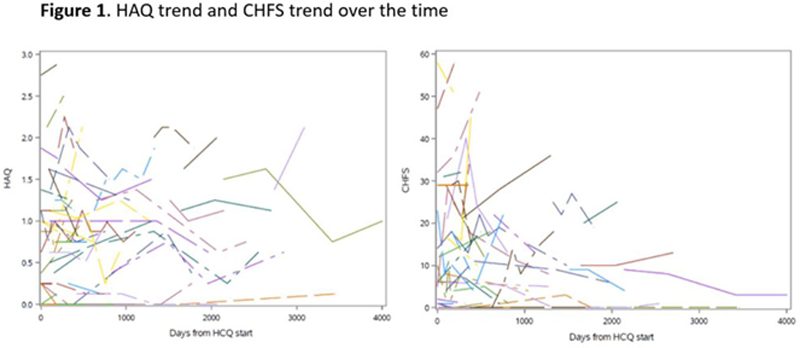
Results: 1,636 of 17,805 SSc patients (9.2%) were treated with HCQ for at least 6 months; out of these 3% (50/1636). had at least a baseline and follow-up HAQ-DI evaluation, (and 44/1636 (2.7%) had at least a baseline and follow-up CHFS evaluation. Propensity matching assured that pts were matched for demographic variables such as gender (mean on HCQ vs no HCQ:femals:92.0 vs 85.3), age(49.8 vs 49.97yrs) disease duration(8.3 vs 9.1 yrs), limited disease(55.3 vs 62.6%) as well as background medications (P>0.1-0.9). We did not find any significant changes in HAQ or CHFS (difference in slope) over 365 days of treatment, comparing the HCQ-treated group to the non-HCQ treated patients (p=0.240 for both (
Conclusion: Results from the EUSTAR registry showed that HCQ was used by 9.2% of SSc patients. HCQ use did not improve the HAQ or CHFS, comparing HCQ users to non-HCQ users.
Disclosure of Interests: Silvia Bellando Randone: None declared, Holly Wilhalme: None declared, Cosimo Bruni: None declared, Elise Siegert: None declared, Paolo Airò: None declared, Rosaria Irace: None declared, Oliver Distler: None declared, Andrea Doria: None declared, Lidia P. Ananieva: None declared, László Czirják: None declared, Christopher Denton: None declared, Yannick Allanore: None declared, Valeria Riccieri: None declared, ALESSANDRA VACCA: None declared, Ivan Foeldvari Consultant of: Gilead, Novartis, Pfizer, Hexal, BMS, Sanofi, MEDAC, Anna-Maria Hoffmann-Vold Speakers bureau: Actelion, Boehringer Ingelheim, Roche, Merck Sharp & Dohme, Lilly and Medscape, Consultant of: Actelion, Boehringer Ingelheim, Roche, Bayer, ARXX, and Medscape, Grant/research support from: Boehringer Ingelheim, Armando Gabrielli: None declared, Marco Matucci-Cerinic: None declared, Daniel Furst: None declared