fetching data ... 
Background: Acute anterior uveitis (AAU) is the most common extra-articular manifestation in axial spondyloarthritis (axSpA), affecting up to 40% of patients and causing significant burden. 1 Previous studies have shown that tumour necrosis factor inhibitors (TNFi) can reduce the incidence of AAU flares in patients with radiographic axSpA (ankylosing spondylitis), 2-4 but few have focused on patients across the full axSpA spectrum. 1
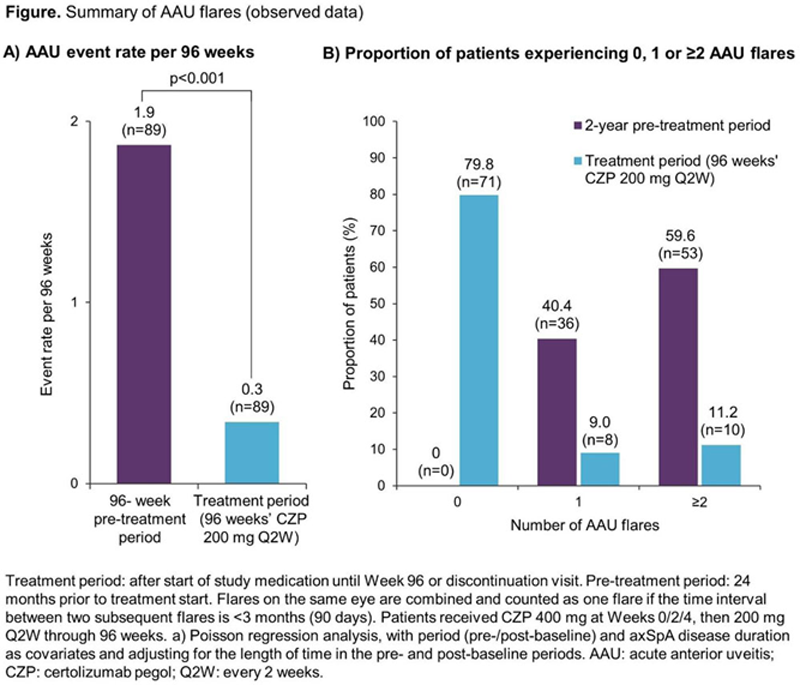
Objectives: To report 2-year outcomes from the phase 4, open-label C-VIEW study (NCT03020992), which investigated the impact of certolizumab pegol (CZP) treatment on AAU in patients with active axSpA and a recent history of AAU.
Methods: C-VIEW prospectively investigated patients with active axSpA who were HLA-B27 positive and had recurrent AAU, with a history of ≥1 AAU flare in the year prior to baseline (additional study criteria and study design are described elsewhere 5 ). The primary efficacy variable was the incidence of AAU flares during 96 weeks of CZP treatment versus the 2-year pre-baseline period. AAU incidence was evaluated using Poisson regression adjusted for duration of time in each period, with period (pre- and post-baseline) and axSpA disease duration as covariates. Secondary efficacy variables were Assessment of SpondyloArthritis international Society 20%/40% (ASAS20/40) response rates, as well as mean Ankylosing Spondylitis Disease Activity Score (ASDAS) and mean Bath Ankylosing Spondylitis Disease Activity Index (BASDAI) to Week 96.
Results: Of 115 enrolled patients, 89 initiated CZP treatment; 83 completed Week 96. The primary analysis revealed an 82% reduction in the incidence of AAU flares during CZP treatment compared with pre-baseline (
Conclusion: These data support the use of CZP for the treatment of patients with axSpA and a history of recurrent AAU. During 96 weeks’ CZP treatment, there was a significant reduction of 82% in the AAU flare rate compared to pre-baseline. There were also substantial improvements in patients’ axSpA disease activity.
REFERENCES:
[1]Martin TM. Curr Opin Rheumatol 2002;14:337–41.
[2]van der Heijde D. Rheumatology (Oxford) 2017;56:1498–509.
[3]van Bentum RE. J Rheumatol 2019;46:153–9.
[4]van Denderen JC. J Rheumatol 2014;41:1843–8.
[5]van der Horst-Bruinsma I. RMD Open 2020;6:e001161.
Changes in axSpA disease activity to Week 96
| Disease activity measure |
Week 0
|
Week 48
|
Week 96
|
| ASAS responder rates, n (%) | |||
| ASAS20 | N/A | 65 (75.6) | 62 (75.6) |
| ASAS40 | N/A | 46 (53.5) | 48 (58.5) |
| ASDAS, mean (SD) | 3.5 (1.0) | 2.0 (0.9) | 1.9 (1.0) |
| BASDAI, mean (SD) | 6.5 (1.5) | 3.3 (2.1) | 3.0 (2.1) |
Observed data are shown. Patients received CZP 400 mg at Weeks 0/2/4, then 200 mg Q2W through 96 weeks. ASAS20/40: Assessment of SpondyloArthritis international Society 20%/40%; ASDAS: Ankylosing Spondylitis Disease Activity Score; axSpA: axial spondyloarthritis; BASDAI: Bath Ankylosing Spondylitis Disease Activity Index; CZP: certolizumab pegol; Q2W: every 2 weeks; SD: standard deviation.
Acknowledgements: This study was funded by UCB Pharma. Editorial services were provided by Costello Medical.
Disclosure of Interests: Irene van der Horst-Bruinsma Speakers bureau: AbbVie, BMS, MSD, Pfizer, UCB Pharma, Consultant of: AbbVie, Eli Lilly, MSD, Novartis, UCB Pharma, Grant/research support from: AbbVie, MSD, Pfizer, Rianne van Bentum: None declared, Frank Verbraak Speakers bureau: Bayer, IDxDR, Novartis, UMC, Consultant of: Bayer, Novartis, Grant/research support from: Bayer, Thomas Rath Speakers bureau: AbbVie, BMS, Chugai, Eli Lilly, MSD, Novartis, Pfizer, Roche, UCB Pharma, Consultant of: AbbVie, BMS, Chugai, Eli Lilly, MSD, Novartis, Pfizer, Roche, UCB Pharma, Bengt Hoepken Shareholder of: UBC Pharma, Employee of: UCB Pharma, Oscar Irvin-Sellers Shareholder of: UCB Pharma, Employee of: UCB Pharma, Thomas Kumke Shareholder of: UCB Pharma, Employee of: UCB Pharma, Lars Bauer Shareholder of: UCB Pharma, Employee of: UCB Pharma, Martin Rudwaleit Speakers bureau: AbbVie, Eli Lilly, Novartis, UCB Pharma, Consultant of: AbbVie, Celgene, Eli Lilly, Janssen, Novartis, UCB Pharma