fetching data ... 
Background: Several anti-inflammatory drugs which were targeted different mechanisms and investigated for both prevention and treatment for COVID-19.
Objectives: The current study aimed to investigate whether patients regularly using colchicine or hydroxychloroquine (HCQ) have an advantage of protection from COVID-19 or developing less severe disease.
Methods: Patients who were taking colchicine or HCQ regularly for a rheumatic disease including Familial Mediterranean Fever, Behçet’s syndrome, Systemic Lupus Erythematosus, Rheumatoid Arthritis and Sjogren’s syndrome as well as their healthy household contacts as the control group were included into the study. The clinical data regarding COVID-19 were collected using a standard form, and serum samples were analyzed for anti-SARS-COV-2 nucleocapsid IgG. Patients treated with any biologic or immunosuppressive treatments were not included into the study.
Results: A total of 635 regular colchicine users with their 643 household contacts and 317 regular HCQ users with their 333 household contacts were analyzed. Anti-SARS-Cov2 IgG was positive in 43 (6.8%) regular colchicine users and 35 (5.4%) household contacts (OR=1.3; 95% CI:0.8-2; p=0.3) (
Severity of COVID-19 in regular colchicine or HCQ users and these patients’ household contacts
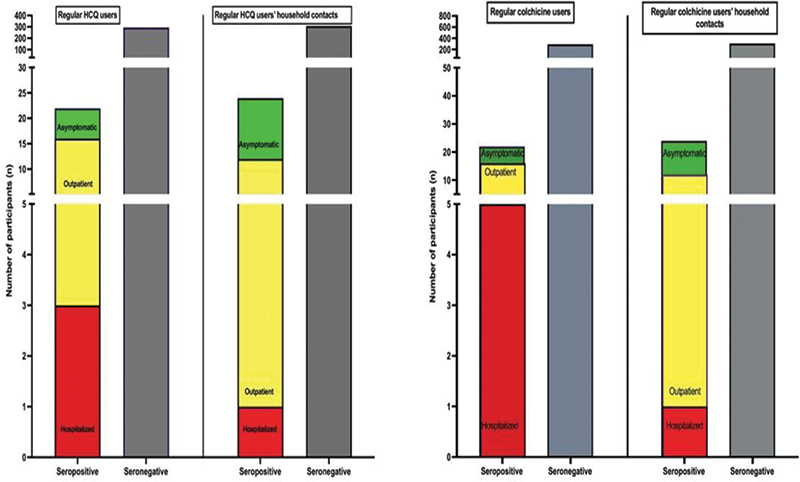
Disease specific outcomes of the entire cohort
| Variable | FMF (n=373) | FMF HHC* (n=386) | P | Behcet Patients (n=262) | Behcet HHC (N=257) | P | SLE Patients (N=197) | SLE HH (n=221) | p | RA Patients (n=79) | RA HH (n=73) | P | Sjögren patients (N=41) | Sjögren HH (N=39) | p |
|---|---|---|---|---|---|---|---|---|---|---|---|---|---|---|---|
| Age, mean ± SD years | 36.4 ± 13.2 | 36.3 ± 16.1 | 0.9 | 42.9 ± 11.4 | 38.1 ± 15.2 | 0.001 | 44.2 ± 12.6 | 39.4 ± 17 | 0.002 | 53.9 ± 10.3 | 40.3 ± 16.6 | 0.001 | 57.1 ± 11.2 | 46.2 ± 16.1 | 0.001 |
| Gender, n (%) | |||||||||||||||
| Female | 249 (66.8) | 173 (44.8) | 0.001 | 160 (61.1) | 118 (45.9) | 0.001 | 184 (93.4) | 75 (33.9) | 0.001 | 73 (61.1) | 20 (27.4) | 0.001 | 41 (100) | 10 (25.1) | 0.001 |
| Positive antibody to SARS-COV-2, n (%) | 25 (6.7) | 23 (5.9) | 0.6 | 18 (6.9) | 12 (4.7) | 0.3 | 14 (7.1) | 19 (8.6) | 0.6 | 4 (5.1) | 2 (2.7) | 0.5 | 4 (9.8) | 3 (7.7) | 0.9 |
| Symptomatic COVID-19 in seropositive cases, n (%) | 18 (72) | 10 (43.4) | 0.04 | 11 (61.1) | 7 (58.3) | 0.6 | 11 (78.6) | 9 (47.3) | 0.07 | 3 (75) | 0 (0) | 0.4 | 2 (50) | 3 (100) | 0.4 |
| Hospital admission in seropositive cases, n (%) | 1 (3.8) | 0 (0) | - | 4 (22.2) | 1 (8.3) | 0.3 | 2 (14.3) | 0 (0) | 0.2 | 1 (25) | 0 (0) | - | 1 (25) | 1 (33.3) | 0.3 |
| Mean colchicine dose, mg/day ± SD | 1.5 ± 0.4 | - | - | 1.4 ±0.4 | - | - | - | - | - | - | - | - | - | - | - |
| Mean duration of colchicine usage, years ± SD | 11.3 ± 8.3 | - | - | 10.4 ± 7.7 | - | - | - | - | - | - | - | - | - | - | - |
| Mean HCQ dose, mg/day ± SD | - | - | - | - | - | - | 263.6 ± 95.1 | - | - | 255 ± 90.8 | - | - | 273.7 ± 132.5 | - | - |
| Mean duration of HCQ usage, years ± SD | - | - | - | - | - | - | 10.1 ± 6.6 | - | - | 7.3 ± 5.2 | - | - | 9 ± 6.3 | - | - |
HCQ hydroxychloroquine , FMF familial mediterranean fever, HHC household contacts, RA rheumatoid arthritis, SLE systemic lupus erythematosus
Conclusion: Being on a regular treatment of colchicine or HCQ was not resulted in the prevention of COVID-19 or amelioration of its manifestations.
Disclosure of Interests: None declared