fetching data ... 
Background: Health professionals in rheumatology (HPRs) should participate in post-graduate or continuous education to update and advance their knowledge and skills. This can improve patient outcomes and increase quality of care. 1 EULAR aims to become a leading provider of postgraduate education for HPRs.
Objectives: The aims of this study were to evaluate the current motivations for participating in postgraduate education of HPRs, identify barriers and facilitators for participation in postgraduate education, and evaluate participation in the current educational offerings of EULAR for HPRs across Europe.
Methods: An online survey was developed and distributed in collaboration with the EULAR Standing Committee of Education and Training (ESCET) and the Paediatric Rheumatology European Society (PReS). The questionnaire was translated by national HPR representatives in 24 languages to cover the 25 national member organisations. Barriers were assessed using 5-point Likert scales, higher scores representing higher barriers. Quantitative data were analysed using descriptive statistics. In addition, we ran the Latent Dirichlet Allocation (LDA) on the answers to the open questions. LDA is an unsupervised probabilistic topic modelling technique that extracts the meanings of a pre-defined number of topics. Design of the survey and reporting of results were done according to the Checklist for Reporting Results of Internet E-Surveys (CHERRIES).
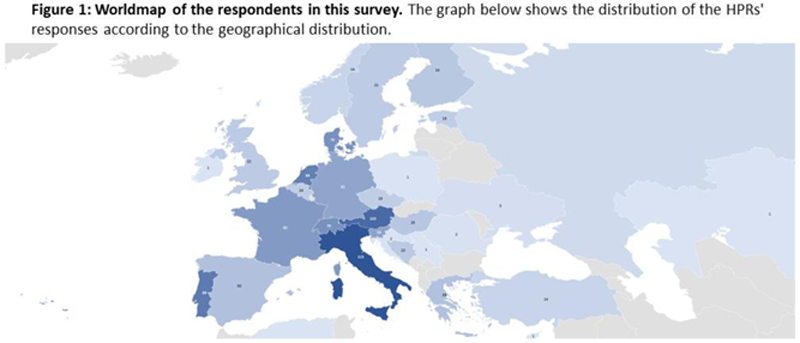
Results: The online questionnaire was accessed 3,589 times but only 667 complete responses were recorded. HPRs from 34 European countries responded to the survey; 80% of whom were women. The highest-ranked educational need was prevention, including lifestyle interventions and professional development. Although EULAR was well known among HPRs, only 32.1% of HPRs in adult care and 18.6% of HPRs in paediatric care have ever heard of the EULAR School of Rheumatology (
A: Feedback on EULAR. Data are presented separately for HPRs in adult and paediatric care; except for the filter questions, no mandatory questions were included in the survey. To clarify the number of responses per question, the number of valid answers for each question was reported.
| Variables | HPRs in adult care | HPRs in paediatric care |
|---|---|---|
| Have you ever heard of the EULAR School of Rheumatology? | 614 | 43 |
| I am not sure, n(% ) | 62 (10.1%) | 7 (16.3%) |
| No, n(% ) | 355 (57.8%) | 28 (65.1%) |
| Yes, n(% ) | 197 (32.1%) | 8 (18.6%) |
| Are you aware of courses offered by the EULAR School of Rheumatology? (sub question ) | 197 | 8 |
| I am not sure, n(% ) | 30 (15.2%) | 2 (25.0%) |
| No, n(% ) | 63 (32.0%) | 5 (62.5%) |
| Yes, n(% ) | 104 (52.8%) | 1 (12.5%) |
| Have you ever attended one of the EULAR School of Rheumatology courses? (sub question ) | 103 | 1 |
| I am not sure, n(% ) | 1 (1.0%) | 0 |
| No, n(% ) | 47 (45.6%) | 0 |
| Yes, n(% ) | 55 (53.4%) | 1 (100%) |
| Have you ever participated in a EULAR annual congress meeting? | 618 | 43 |
| I am not sure, n(% ) | 11 (1.8%) | 0 |
| No, n(% ) | 457 (73.9%) | 39 (90.7%) |
| Yes, n(% ) | 150 (24.3%) | 4 (9.3%) |
The main barriers to participation in EULAR’s educational offerings were identified by HPRs in adult care and in paediatric care (respectively) as: the unfamiliarity with the course content (3.48 [±1.50]; 3.92 [±1.46]), the associated costs (3.44 [±1.35]; 3.69 [±1.28]) and English language (2.59 [±1.50]; 2.80 [±1.34]).
Conclusion: EULAR is well-known by HPRs in Europe, however, awareness of educational offerings is low and barriers to participation are numerous. To become the leading provider of postgraduate training by 2023, EULAR could use a “franchise” model that can be tailored to local conditions. This could be achieved by strengthening national organizations by actively involving them in the development of training programs and disseminating these programs and offerings through their networks.
REFERENCES:
[1]World Health Organization. Health workforce: Education and training: World Health Organization; 2019 [Available from:
Disclosure of Interests: Lisa Sperl: None declared, Tanja Stamm Speakers bureau: AbbVie, Novartis, Roche, Sanofi, and Takeda, Consultant of: AbbVie and Sanofi Genzyme, Grant/research support from: AbbVie and Roche, Margaret Renn Andrews: None declared, Mathilda Bjork: None declared, Carina Boström: None declared, Jeannette Cappon: None declared, Jenny de la Torre-Aboki: None declared, Annette de Thurah: None declared, Andrea Domjan: None declared, Razvan Dragoi Speakers bureau: Received speaker fees last year from: Pfizer, Elly Lilly, Sandoz, Abbvie, Secom, EwoPharma, Fernando Estevez-Lopez: None declared, Ricardo J. O. Ferreira: None declared, George E. Fragoulis: None declared, Jolanta Grygielska: None declared, Katti Korve: None declared, Marja Leena Kukkurainen: None declared, Christel Madelaine-Bonjour: None declared, Andrea Marques: None declared, Jorit Meesters: None declared, Rikke Helene Moe: None declared, Ellen Moholt: None declared, Erika Mosor: None declared, Claudia Naimer-Stach: None declared, Mwidimi Ndosi: None declared, Polina Pchelnikova: None declared, Jette Primdahl: None declared, Polina Putrik: None declared, Anne-Kathrin Rausch Osthoff: None declared, Hana Smucrova: None declared, Sinisa Stefanac: None declared, Marco Testa: None declared, Leti van Bodegom-Vos: None declared, Wilfred Peter: None declared, Heidi A. Zangi: None declared, Olena Zimba: None declared, T.P.M. Vliet Vlieland: None declared, Valentin Ritschl: None declared