fetching data ... 
Background: The term “early spondyloarthritis (SpA)” has been frequently used to refer to the first phase of the disease, however, no standardized definition on “early” has been established. The ASAS-SPEAR (SPondyloarthritis EARly definition) project aims at developing a consensual definition on what is meant by “early SpA”. In order to inform the ASAS-SPEAR working group, it is highly relevant to assess the current meaning of “early SpA” in the literature.
Objectives: To identify all possible definitions of “early SpA” employed in the literature, including “early axial SpA (axSpA)” and “early peripheral SpA (pSpA)”.
Methods: A systematic literature review was conducted in Medline, EMBASE and the Cochrane Library (through April 28 th , 2021). The eligibility criteria were studies with any design, in adults that included any mention of “early SpA” or its subtypes in the title or abstract. Two reviewers independently identified eligible studies and extracted data, including the literal definition of early SpA used in each of them. The proportion of studies reporting a definition was calculated, and the different definitions were assessed, including the core of the definition: whether they were based on symptom duration, disease duration, radiographic damage, a combination of them or any other aspects, and their boundaries.
Results: Out of 9,651 titles identified, 355 publications reporting data from 186 studies were included (291 full papers, 64 conference abstracts). Among them, 217 (61%) were cohort studies, 72 (20%) were reviews and 46 (13%) were clinical trials. Over time, an increasing number of publications on early SpA were identified: <2005 (n=34), 2005-2010 (n=48), 2011-2015 (n=109) and 2016-2020 (n=164). Overall, 63 studies (34%) included the term “early axSpA”, 60 (32%) “early ankylosing spondylitis (AS)”, 58 (31%) “early SpA”, 4 (2%) “early non-radiographic axSpA (nr-axSpA)” and 1 (1%) “early pSpA”. In total, 116 (62%) studies reported a specific definition: 40 (34%) based it on symptom duration, 35 (30%) on radiographic damage, 32 (28%) on disease duration, 6 (5%) on both symptom/disease duration and radiographic damage, and 3 (3%) on other aspects. Symptom duration was defined as the time since the onset of low back pain in 21/40 (53%) studies, whereas in 14/40 (35%) the symptom of onset was not specified. Thirty-five of 116 studies (30%) included a definition referred to “early SpA”, 38 (33%) to “early axSpA”, 38 (33%) to “early AS”, 4 (3%) to “early nr-axSpA”, and 1 (1%) to “early pSpA”.
Top 3 candidate definitions for “early SpA” and subtypes
| Core of the definition | Number of studies, n (%) | |
|---|---|---|
| SpA (n= 35) | nr-axSpA | 10 (29%) |
| < 2 years duration | 10 (29%) | |
| < 1 year duration | 6 (17%) | |
| AxSpA (n=38) | < 5 years duration | 12 (34%) |
| < 3 years duration | 9 (24%) | |
| nr-axSpA duration | 8 (21%) | |
| AS/r-axSpA (n=38) | <10 years duration | 9 (24%) |
| nr-axSpA | 7 (18%) | |
| < 2 years duration | 6 (16%) | |
| nr-axSpA (n=4) | nr-axSpA | 2 (50%) |
| < 1 year & nr-axSpA | 1 (25%) | |
| < 5 years & nr-axSpA | 1 (25%) | |
| pSpA (n=1) | < 12 weeks duration | 1 (100%) |
“Duration” refers to symptom duration or disease duration.
Number of studies stratified by the core of the definition.
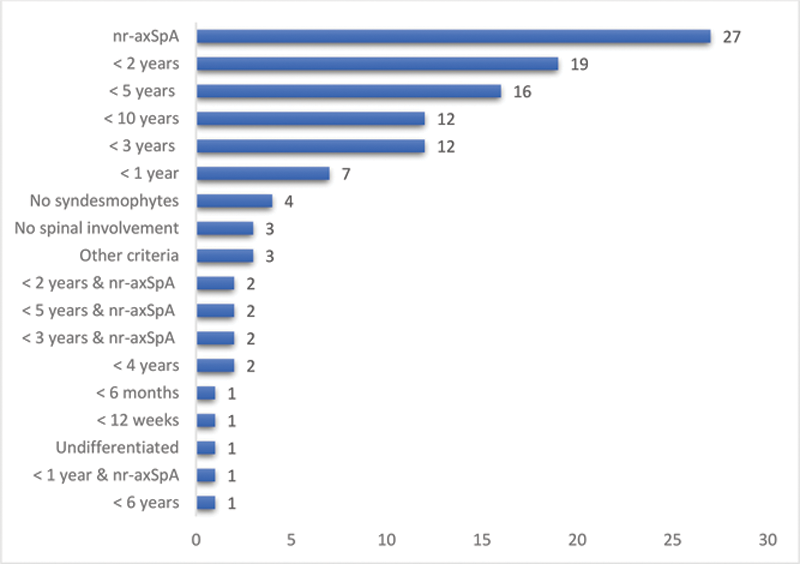
Conclusion: Over time, the term “early SpA” and its subtypes are increasingly used. Despite addressing early SpA, more than one third of the studies did not include a clear definition of the term. The studies reporting a definition of early SpA showed a large heterogeneity, with two out of three of them based on the duration of symptoms or disease. These results emphasize the need for a standardised definition of early SpA.
Acknowledgements: The Assessment of Spondyloarthritis international Society (ASAS) supported Diego Benavent financially for this work.
Disclosure of Interests: Diego Benavent Speakers bureau: Jannsen, Roche, Grant/research support from: Novartis., Dafne Capelusnik Speakers bureau: Bristol Myers Squibb, Pfizer, Grant/research support from: Pfizer, Désirée van der Heijde Consultant of: AbbVie, Bayer, BMS, Cyxone, Eisai, Galapagos, Gilead, Glaxo-Smith-Kline, Janssen, Lilly, Novartis, Pfizer, UCB Pharma., Employee of: Director of Imaging Rheumatology bv., Robert B.M. Landewé Consultant of: AbbVie, BMS, Galapagos, Gilead, GSK, Janssen, Lilly, Novartis, Pfizer, UCB, Denis Poddubnyy Speakers bureau: AbbVie, Bristol-Myers Squibb, Eli Lilly, MSD, Novartis, Pfizer, and UCB, Consultant of: AbbVie, Biocad, Eli Lilly, Gilead, GlaxoSmithKline, Janssen, MSD, Novartis, Pfizer, Samsung Bioepis, and UCB, Grant/research support from: AbbVie, Eli Lilly, MSD, Novartis, and Pfizer, Astrid van Tubergen Consultant of: Novartis, Galapagos, Grant/research support from: Pfizer, UCB, Novartis, Louise Falzon: None declared, Sofia Ramiro Speakers bureau: Eli Lilly, MSD, Novartis, UCB, Consultant of: AbbVie, Eli Lilly, MSD, Novartis, Pfizer, UCB, Sanofi, Grant/research support from: AbbVie, Galapagos, Novartis, Pfizer, UCB, Victoria Navarro-Compán Speakers bureau: AbbVie, Eli Lilly, Janssen, MSD, Novartis, Pfizer, UCB Pharma, Consultant of: AbbVie, Eli Lilly, MSD, Novartis, Pfizer, UCB Pharma, Grant/research support from: Abbvie and Novartis