fetching data ... 
Background: Polyacrylamide hydrogel (iPAAG), manufactured by Contura International, is CE marked for the symptomatic treatment of patients with knee osteoarthritis (OA).
iPAAG fulfils an unmet clinical need for an effective, long-acting, safe and minimally invasive treatment that may postpone and potentially prevent knee surgery for those with OA.
Objectives: To compare the effectiveness of single intra-articular injections of iPAAG and hyaluronic acid (HA) in participants with moderate to severe knee OA.
To compare the effectiveness of iPAAG and HA in subgroups based on age, BMI or Kellgren-Lawrence (KL) grade at baseline by assessing changes from baseline in transformed WOMAC pain subscale scores.
Methods: This prospective, double-blind study (NCT04045431) randomized 239 participants to receive a single intra-articular injection of either 6 mL iPAAG (n=119) or 6 mL HA (n=120). The study was approved by the Capital Region’s Committee on Health Research Ethics. All participants provided informed consent prior to study activities.
Outcomes included changes in the WOMAC pain, stiffness and function subscales and Patient Global Assessment of disease impact (PGA) at 52 weeks. All statistical analyses were based on the ITT principle using a mixed model for repeated measurement with a restricted maximum likelihood-based approach. The estimated mean treatment difference based on this model was reported with 95 % CI and p-value.
Results: Demographic and baseline characteristics were similar between treatment groups with an average age at treatment of approximately 67 years (range 31 – 90 years) and slightly more females (53%) than males.
There was a clinically relevant decrease in WOMAC pain subscale score from baseline to 52 weeks in both groups (
Mean plot of transformed WOMAC pain subscale (0-100) – ITT analysis set
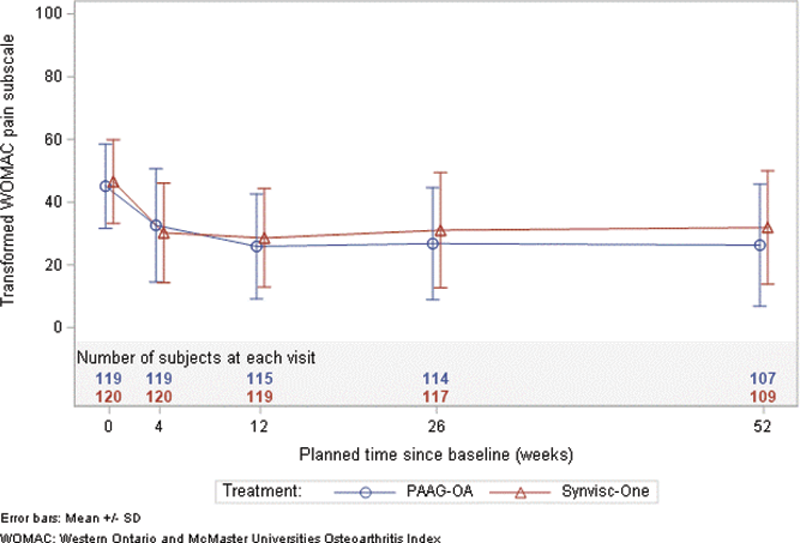
The treatment difference in favor of iPAAG compared to HA for the WOMAC pain subscale score was statistically significant in the subgroup with age at baseline <70 years but did not reach statistical significance in the subgroup with age at baseline ≥70 years.
The treatment difference in favor of IPAAG compared to HA for the WOMAC pain subscale score was statistically significant in the subgroup with normal BMI but did not reach statistical significance in the subgroups with overweight or obese BMI.
The treatment difference in favor of IPAAG compared to HA for the WOMAC pain subscale score was statistically significant in the subgroup with KL grade 2 or 3. In the subgroup with KL grade 4, a treatment difference in favor of HA was not statistically significant.
Change from baseline in transformed (0-100) WOMAC pain subscale at week 52
| LSMean (95% CI ) | Treatment difference (95% CI ) | p-value | |
|---|---|---|---|
| Overall | |||
| HA | -13.3 (-16.7; -10.0) | ||
| iPAAG | -17.9 (-21.3; -14.6) | 4.6 (-0.1; 9.4) | 0.0572 |
| Age <70 years | |||
| HA | -14.0 (-18.3; -9.6) | 0.0195 | |
| iPAAG | -21.3 (-25.5; -17.0) | 7.3 (1.2; 13.4) | |
| Age ≥ 70 years | |||
| HA | -12.5 (-17.6; -7.4) | 0.7970 | |
| iPAAG | -13.4 (-18.7; -8.2) | 1.0 (-6.3; 8.2) | |
| BMI normal | |||
| HA | -13.5 (-18.1; -8.9) | 0.0110 | |
| iPAAG | -17.5 (-22.2; -12.9) | 10.9 (2.6; 19.1) | |
| BMI overweight | |||
| HA | -14.3 (-19.5; -9.2) | 0.6114 | |
| iPAAG | -16.1 (-21.0; -11.3) | 1.8 (-5.3; 8.9) | |
| BMI obese | |||
| HA | -14.5 (-22.7; -6.2) | 0.5565 | |
| iPAAG | -17.8 (-25.6; -10.0) | 3.3 (-8.0; 14.7) | |
| KL grade 2 or 3 | |||
| HA | -13.4 (-17.0; -9.7) | 0.0332 | |
| iPAAG | -18.9 (-22.5; -15.4) | 5.6 (0.5; 10.7) | |
| KL grade 4 ) | |||
| HA | -13.1 (-21.9; -4.3) | 0.6757 | |
| iPAAG | -10.3 (-20.6; 0.0) | -2.8 (-16.4; 10.8) |
Conclusion: At 52 weeks after treatment, the effectiveness of iPAAG was numerically superior to HA but not statistically significantly different.
In subgroups of participants with normal BMI, participants <70 years old or participants with KL grade 2 or 3 iPAAG performed statistically significantly better than HA at 52 weeks after treatment.
Disclosure of Interests: None declared