fetching data ... 
Background: There has been considerable uncertainty about the impact of biologic DMARDs (bDMARDs) on COVID-19 morbidity and vaccine efficacy, which may have influenced prescribing during the pandemic.
Objectives: To assess trends in the prescription of three commonly used bDMARDs with different modes of action - adalimumab (ADA), rituximab (RTX) and tocilizumab (TOC) - in England before and during the COVID-19 pandemic.
Methods: The National Health Service (NHS) Secondary Care Medicines dataset was utilised to analyse temporal trends in bDMARD prescriptions issued by all NHS hospital pharmacies in England. Monthly averages of prescriptions issued for ADA, RTX and TOC for combined indications, standardised using WHO Defined Daily Doses (DDD), were described from January 2019 to November 2021. Interrupted time-series analyses (ITSA) were used to estimate the effect of the pandemic on prescription trends for ADA, RTX and TOC; Newey-West standard errors with lags were used to account for autocorrelation between observation periods in these models.
Results: Temporal trends in ADA, RTX and TOC prescriptions are shown in
Trends in prescriptions issued for ADA, RTX and TOC in England before and after the onset of the COVID-19 pandemic, assessed using interrupted time-series analyses. The absolute change in prescriptions issued in March 2020, relative to April 2020, is shown.
| Rituximab | Adalimumab | Tocilizumab | |
|---|---|---|---|
| Prescription trend before March 2020 | -0.23% per year(95% CI -0.97 to 0.52) | +2.94% per year(95% CI 2.14 to 3.73) | +0.04% per year(95% CI -0.07 to 1.53) |
| Absolute change in prescriptions in March 2020 | -46.3% | +15.5% | +10.7% |
| Prescription trend after March 2020 | +2.11% per year(95% CI 0.52 to 3.70) | +3.24% per year(95% CI 2.02 to 4.46) | +0.64% per year(95% CI 0.38 to 0.90) |
| Difference in trends post vs. pre-March 2020 | +2.33% per year(95% CI 0.51 to 4.17)P=0.014 | +0.30% per year(95% CI -1.03 to 1.63)P=0.65 | +0.60% per year(95% CI 0.31 to 0.90)P<0.001 |
Temporal trends in prescriptions for ADA, RTX and TOC in England between January 2019 and November 2021. Monthly averages of prescriptions for combined disease indications are shown, standardised using WHO Defined Daily Doses.
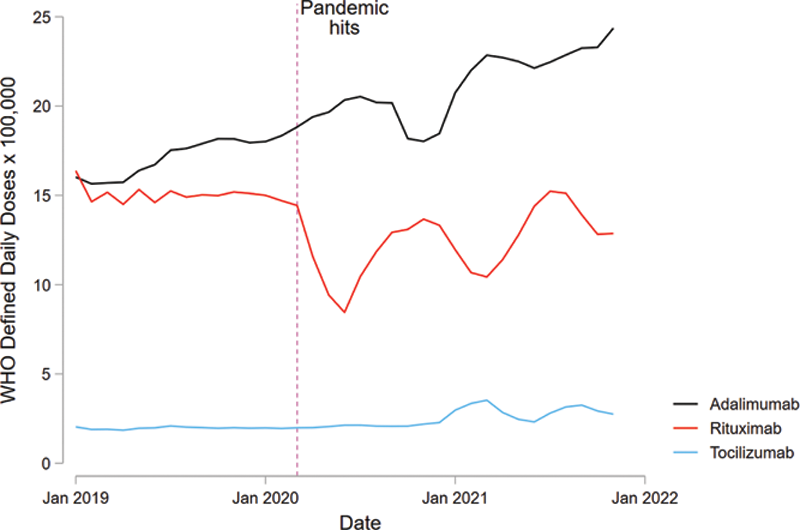
For ADA, the pre-pandemic trend of increasing prescriptions continued during the pandemic, with no differences in prescription trends seen in ITSA models (
Conclusion: Prescriptions for RTX in England halved during the early COVID-19 pandemic, and remain below pre-pandemic levels as of November 2021. This likely reflects concerns about RTX use and increased COVID-19 mortality and reduced vaccine efficacy. 1,2 In contrast, prescriptions for ADA have continued to increase during the pandemic, while prescriptions for TOC surged in December 2020, coinciding with the more widespread use of TOC for the treatment of severe COVID-19.
REFERENCES:
[1]Strangfeld A, et al. Factors associated with COVID-19-related death in people with rheumatic diseases: results from the COVID-19 Global Rheumatology Alliance physician-reported registry. Ann Rheum Dis. 2021;80:930-942
[2]Boekel L, Wolbink GJ. Rituximab during the COVID-19 pandemic: time to discuss treatment options with patients. Lancet Rheumatol. 2021 Dec 23
Disclosure of Interests: Mark Russell Speakers bureau: Lilly; Menarini, Sathiyaa Balachandran: None declared, Sam Norton: None declared, Edward Alveyn: None declared, Deepak Nagra: None declared, Maryam Adas: None declared, James Galloway Speakers bureau: Abbvie, Biovitrum, BMS, Celgene, Chugai, Gilead, Janssen, Lilly, Novartis, Pfizer, Roche, Sanofi, Sobi and UCB