fetching data ... 
Background: International clinical practice guidelines for the management of osteoarthritis (OA) 1 2 recommend exercise, education and diet as first-line interventions since they are safe, low cost and reported to be effective, in reducing OA pain and disability, regardless of the severity of the disease. However, these treatments require high levels of adherence, which may be difficult to achieve. One of the possible reasons that can jeopardise patients’ adherence with first-line interventions for OA is the lack of awareness of the role that these treatments play in their care.
Objectives: To investigate the level of awareness of non-pharmacological and non-surgical treatments for hip and knee OA in a cohort of people with this disease in Sweden.
Methods: A cross-sectional, online survey-based study was conducted in Sweden. People with diagnosed knee or hip OA were recruited through social media outlets and patients’ associations. The survey was divided into two sections: (i) participants’ demographic and clinical characteristics (e.g. gender, age, income, work, height, weight, level of physical activity, previous surgeries, pain, level of disability) and (ii) a set of items with 22 treatments (e.g., weight advice, physical activity, drugs, supplements etc) where participants were asked to report whether each treatment was ‘recommended’, ‘optional’, ‘not recommended’, or ‘I don’t know’ - for the management of knee or hip OA. In the analyses, we grouped the 22 proposed treatments into ‘recommended’, ‘optional’, and ‘not recommended’ according to existing international guidelines. 1 2 Based on the responses, participants were categorised as “aware” if they correctly identified all the treatments, “partially aware” if they correctly identified at least one treatment, and “not aware” if they did not correctly identify any of the treatments.
Results: Participants comprised 123 people with OA of the knee, hip or both (N=65, 22%; N=27, 22% and N= 33, 26% respectively). Their mean (SD) age was 60.3 (8.8) and 108 (88%) were women. Forty-eight (39%) were “aware” of the recommended treatments, 63 (50%) “partially aware” and 14 (11%) were “not aware”. Regarding the optional treatments, 2 (2%) were “aware”, 103 (82%) “partially aware” and 20 (16%) were “not aware”. For the treatments that were not-recommended, none was “aware”, while 69 (55%) and 56 (45%) were considered “partially aware” and “not aware”, respectively.
Participants’ responses to each treatment
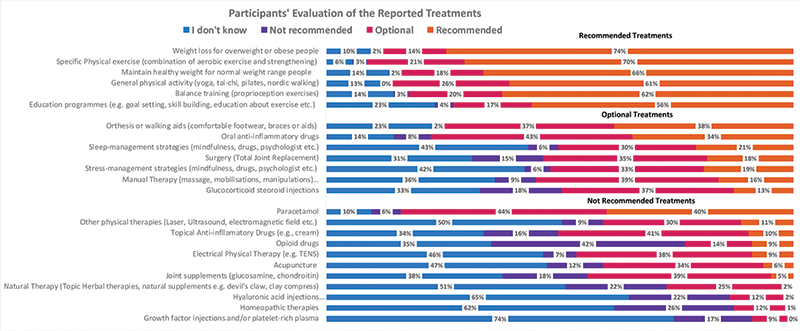
Conclusion: Survey participants seem to be more aware of the recommended treatments than the optional and not-recommended ones. A more holistic approach in the education of people with OA should be pursued, providing them with a complete overview of the possible OA treatments. This would help patients identify the most appropriate treatment option for their OA and facilitate a shared decision-making with their health professionals.
REFERENCES:
[1]Bannuru RR, Osani MC, Vaysbrot EE, et al. OARSI guidelines for the non-surgical management of knee, hip, and polyarticular osteoarthritis. Osteoarthr Cartil. 2019;27:1578–89.
[2]Fernandes L, Hagen KB, Bijlsma JWJ, et al. EULAR recommendations for the non-pharmacological core management of hip and knee osteoarthritis. Ann Rheum Dis. 2013;72:1125–35.
Acknowledgements: This work is part of the project funded by EULAR (European Alliance of Associations for Rheumatology) “HPR: The EULAR health professionals research grant 2020.”
Disclosure of Interests: None declared