fetching data ... 
Background Juvenile idiopathic arthritis (JIA) is the most frequently occurring rheumatic disease of childhood. It causes ongoing joint inflammation, pain and stiffness making everyday activities difficult. Studies have emphasised the negative impacts JIA has across physical, social, psychological, and educational development.
Devices exist to assist with daily activities such as washing, eating, or writing. However, a survey we conducted in 2018 highlighted that the majority of these are designed for adults. Those designed for Children and Young People (CYP) are often either difficult to use, stigmatising, patronising, or fail to address their unique needs and contexts. This has resulted in numerous unmet needs and a lack of effective innovations for this population.
The innovation, JIA Toolbox, was co-designed, meaning CYP with JIA, their parents, healthcare professionals, teachers and design researchers collectively collaborated throughout its development. Here, we present the intervention stage of the project, where JIA Toolbox was tested and evaluated by CYP with JIA.
Objectives To evaluate the potential impacts of JIA Toolbox in improving independence and functional ability of CYP with JIA.
To obtain real-world feedback on JIA Toolbox to inform future device refinement.
To provide contemporary data on CYP’s experiences of living with JIA to inform future innovation.
Methods JIA Toolbox was tested over a 9-week period.
This suite of innovations consisted of:
Prototype 1: A wearable pain management device
Prototype 2: A motivational physiotherapy tool
Prototype 3: A communication aid for use in school
Image/graph:
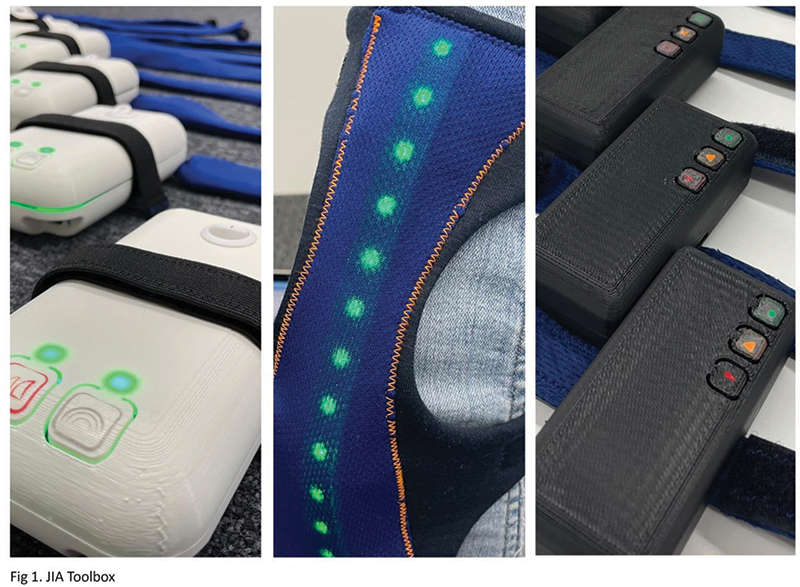
A sample size of 10 CYP (7-16yrs), their parents and teachers were involved. Whilst small, this number was felt adequate due to the individual and qualitative nature of JIA condition experience.
Their involvement included:
Training sessions for data collection and prototype use. CYP and their parents recorded their daily experience using a digital booklet with specific questions about their condition and prototype use.
3-week baseline data collection without JIA Toolbox.
5-week intervention data collection with JIA Toolbox.
1-week post intervention data collection without JIA Toolbox.
End of intervention interview.
Results Analysis of the findings is currently being undertaken. Preliminary results indicate that 70-90% of the sample group found one or more of the innovations highly beneficial, helping with their overall condition management.
Prototype 1 was highlighted as an effective therapeutic aid “it helped soothe my knee, I liked how you can position it exactly where it hurts”. One patient found it reduced pain when used with joint injections.
Prototype 2 was helpful for physiotherapy exercises “to keep count” and “know how long to hold it for” with preliminary data indicating at least 50% of users increased the regularity of their physio stretches over the intervention period. The innovation acted as an ongoing reminder, “it encouraged him to do his physio stretches as he hadn’t been doing any before”.
Prototype 3 “helped communicate when I was in pain and needed help”. The use of this intervention depended on the child’s individual confidence, with those feeling less confident, relying more on the technology. These users found it beneficial, “the teacher knew I needed a rest break without me having to say anything in front of the rest of the class”.
Participants also highlighted areas that could be improved to increase ease of use and engagement.
Conclusion Based on initial results, the proof-of-concept was successful with these innovations proving to be beneficial to CYP with JIA.
The patient data will allow refinement of these devices and provide insights into the lived experiences of CYP with JIA.
These devices may have applicability to both adult populations with rheumatic disease and CYP with other conditions. Further research will explore these avenues in the future. Next steps include applying for further funding to undertake a feasibility study with a larger sample population.
Acknowledgements I would like to thank The Children’s Hospital Charity, based at Sheffield Children’s Hospital, for their funding to undertake this project and ongoing support. I would also like to thank NIHR Children and Young People MedTech Cooperative for their early support and ongoing assistance throughout this project. Special thanks to all of the children, young people, families and teachers who contributed their time and expertise.
Disclosure of Interests None Declared.
Keywords: Self-management, Inflammatory arthritides, Non-pharmacological interventions
DOI: 10.1136/annrheumdis-2023-eular.2308