fetching data ... 
Background Bimekizumab (BKZ), a monoclonal IgG1 antibody that selectively inhibits interleukin (IL)-17F in addition to IL-17A, has demonstrated consistent and sustained efficacy up to Week (Wk) 52 across the full spectrum of axial spondyloarthritis (axSpA), in patients (pts) with non-radiographic axSpA (nr-axSpA) and radiographic axSpA (r-axSpA; i.e. ankylosing spondylitis).[1,2]
Objectives To evaluate the impact of BKZ on MRI inflammatory lesions of the sacroiliac joints (SIJ) and spine to Wk 52 in the phase 3 studies BE MOBILE 1 (nr-axSpA) and BE MOBILE 2 (r-axSpA).
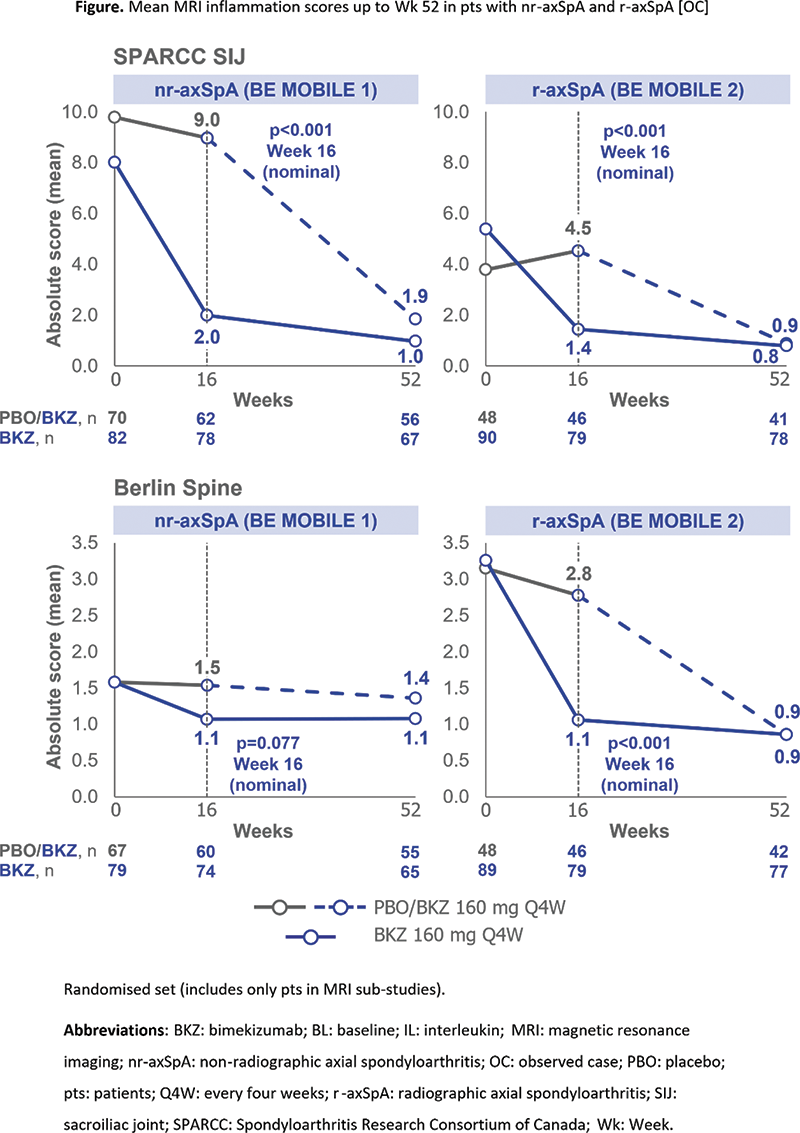
Methods BE MOBILE 1 (NCT03928704) and BE MOBILE 2 (NCT03928743) study designs have been reported previously.[1] From Wk 16, all pts received subcutaneous BKZ 160 mg every 4 wks (Q4W). MRI endpoints (Spondyloarthritis Research Consortium of Canada [SPARCC] SIJ and ASspiMRI-a Berlin modification [hereafter termed ‘Berlin spine’] inflammation scores) were assessed at baseline (BL), Wk 16 and Wk 52 via central reading by two independent expert readers with an adjudicator, and were measured in the subset of pts in the MRI sub-studies. SPARCC SIJ and Berlin spine scores range from 0–72 and 0–69, respectively, with lower scores indicating less inflammation. We report observed case mean absolute SPARCC SIJ and Berlin spine scores and the proportion of pts with inflammation of the SIJ/spine at BL achieving MRI remission (SPARCC SIJ <2; Berlin spine ≤2)[3] to Wk 52.
Results At BL, 60% of pts with nr-axSpA (152/254) and 42% of pts with r-axSpA (138/332) had SPARCC SIJ assessments as part of the MRI sub-studies; 57% (146/254) and 41% of pts (137/332) had Berlin spine assessments, respectively. Of these, 63% of nr-axSpA (BKZ: 50, placebo [PBO]: 46) and 46% of r-axSpA (BKZ: 42, PBO: 21) pts had SIJ inflammation (SPARCC SIJ ≥2)[3] at BL; 21% (BKZ: 17, PBO: 13) and 41% (BKZ: 36, PBO: 20) had spine inflammation (Berlin spine >2)[3] at BL, respectively. At BL, mean SPARCC SIJ and Berlin spine scores were comparable between BKZ- and PBO-randomised pts (Figure 1). Reductions in mean absolute SPARCC SIJ and Berlin spine scores observed at Wk 16 were maintained to Wk 52 for continuous BKZ pts; pts who switched from PBO to BKZ at Wk 16 (PBO-switcher) reached similar levels of improvement to continuous BKZ pts at Wk 52 (Figure 1). Among pts with SIJ inflammation at BL, a greater proportion of BKZ- vs PBO-randomised pts achieved SPARCC SIJ remission at Wk 16; a similar pattern was observed for pts with inflammation of the spine at BL, with a greater proportion of BKZ- vs PBO-randomised pts achieving Berlin spine remission at Wk 16 (Table 1). The proportion of continuous BKZ and PBO-switcher pts achieving MRI remission largely improved to Wk 52 (Table 1).
Conclusion Across the axSpA spectrum, dual inhibition of IL-17A and IL-17F with BKZ resulted in a reduction in MRI inflammatory lesions of the SIJ and spine and an increased proportion of pts achieving MRI remission at Wk 52.
References
Image/graph:
| Wk 16 | Wk 52 | ||||
|---|---|---|---|---|---|
| n/N (%) | PBO | BKZ 160 mg Q4W | PBO→ BKZ 160 mg Q4W | BKZ 160 mg Q4W | |
| SPARCC SIJ remissiona | BE MOBILE 1 (nr-axSpA) | 9/42 (21.4) | 30/48 (62.5) | 20/35 (57.1) | 32/40 (80.0) |
| BE MOBILE 2 (r-axSpA) | 4/21 (19.0) | 23/41 (56.1) | 12/18 (66.7) | 28/37 (75.7) | |
| Berlin spine remissionb | BE MOBILE 1 (nr-axSpA) | 1/12 (8.3) | 8/15 (53.3) | 3/11 (27.3) | 6/15 (40.0) |
| BE MOBILE 2 (r-axSpA) | 2/18 (11.1) | 23/31 (74.2) | 10/16 (62.5) | 23/30 (76.7) | |
Randomised set (includes only pts in MRI sub-studies). aSPARCC SIJ <2, assessed in the subgroup of pts with SPARCC SIJ ≥2 at BL; bBerlin spine ≤2, assessed in the subgroup of pts with Berlin spine >2 at BL.
Acknowledgements This study was funded by UCB Pharma. Medical writing support was provided by Costello Medical, funded by UCB Pharma.
Disclosure of Interests Xenofon Baraliakos Speakers bureau: AbbVie, BMS, Chugai, Eli Lilly, Galapagos, Gilead, MSD, Novartis, Pfizer and UCB Pharma, Paid instructor for: AbbVie, BMS, Chugai, Eli Lilly, Galapagos, Gilead, MSD, Novartis, Pfizer and UCB Pharma, Consultant of: AbbVie, BMS, Chugai, Eli Lilly, Galapagos, Gilead, MSD, Novartis, Pfizer and UCB Pharma, Victoria Navarro-Compán Speakers bureau: AbbVie, Eli Lilly, Janssen, MSD, Novartis, Pfizer and UCB Pharma, Consultant of: AbbVie, Eli Lilly, MSD, Novartis, Pfizer and UCB Pharma, Grant/research support from: AbbVie and Novartis, Denis Poddubnyy Speakers bureau: AbbVie, BMS, Eli Lilly, MSD, Novartis, Pfizer and UCB Pharma, Consultant of: AbbVie, Biocad, Eli Lilly, Gilead, GSK, MSD, Moonlake, Novartis, Pfizer, Samsung Bioepis and UCB Pharma, Grant/research support from: AbbVie, Eli Lilly, MSD, Novartis and Pfizer, Maureen Dubreuil Consultant of: Amgen and UCB Pharma, Grant/research support from: Pfizer paid to institution, Alexander Bennett Speakers bureau: AbbVie, Eli Lilly, MSD, Novartis, Pfizer and UCB Pharma, Paid instructor for: AbbVie, Biogen, Novartis, Pfizer and UCB Pharma, Grant/research support from: Pfizer, Lennart Jans Speakers bureau: AbbVie, Novartis, Eli Lilly and UCB Pharma, Ute Massow Employee of: UCB Pharma, Carmen Fleurinck Employee of: UCB Pharma, Thomas Vaux Employee of: UCB Pharma, Alicia Ellis Employee of: UCB Pharma, Natasha de Peyrecave Employee of: UCB Pharma, Walter P Maksymowych Speakers bureau: AbbVie, BMS, Boehringer-Ingelheim, Celgene, Eli Lilly, Galapagos, Janssen, Novartis, Pfizer and UCB Pharma, Consultant of: AbbVie, BMS, Boehringer-Ingelheim, Celgene, Eli Lilly, Galapagos, Janssen, Novartis, Pfizer and UCB Pharma, Grant/research support from: AbbVie, Janssen, Novartis, Pfizer and UCB Pharma, Employee of: Chief Medical Officer for CARE ARTHRITIS.
Keywords: Spondyloarthritis, Clinical Trials, bDMARD
DOI: 10.1136/annrheumdis-2023-eular.786