fetching data ... 
Background Upadacitinib (UPA), a Janus kinase inhibitor, was effective and well tolerated in patients (pts) with non-radiographic axial spondyloarthritis (nr-axSpA) through 14 weeks (wks) of treatment.[1]
Objectives This analysis assessed the efficacy and safety of UPA vs placebo (PBO) through 1 year.
Methods The SELECT-AXIS 2 nr-axSpA study included a 52-wk randomized, double-blind, PBO-controlled period. Enrolled adults had a clinical diagnosis of active nr-axSpA fulfilling the 2009 ASAS classification criteria, objective signs of inflammation based on MRI sacroiliitis and/or elevated C-reactive protein, and an inadequate response to NSAIDs. One-third of pts had an inadequate response to biologic DMARDs. Pts were randomized 1:1 to UPA 15 mg once daily or PBO. Concomitant medications, including NSAIDs, had to be kept stable through wk 52. The study protocol outlined that pts who did not achieve ASAS20 at any two consecutive study visits between wks 24 to 52 should receive rescue therapy with NSAIDs, corticosteroids, conventional synthetic/biologic DMARDs, or analgesics. Cochran-Mantel-Haenszel (CMH) test with non-responder imputation incorporating multiple imputation (NRI-MI) was used to handle missing data and intercurrent events for binary efficacy endpoints. Mixed-effect model repeated measures (MMRM) was used to assess continuous efficacy endpoints. NRI was used for binary endpoints after rescue and as observed analysis excluding data after rescue for continuous endpoints. Treatment-emergent adverse events (TEAEs) are reported through wk 52.
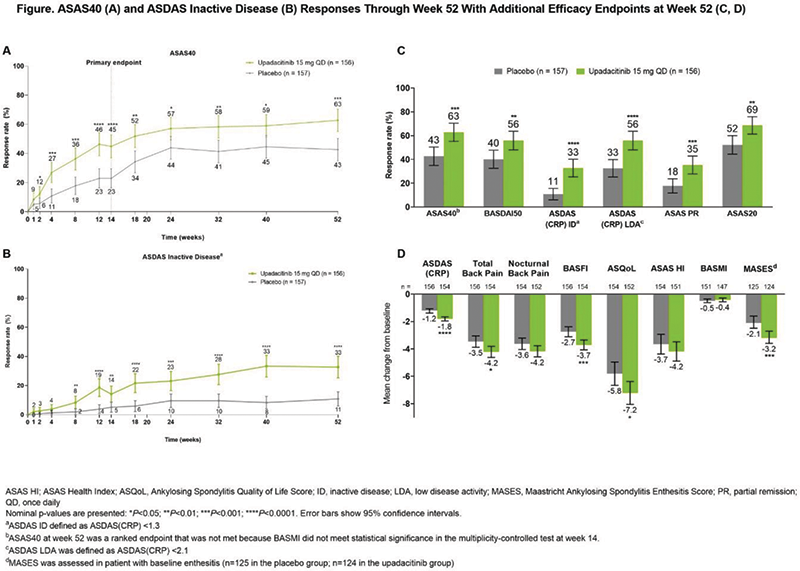
Results Of the 314 pts randomized, 259 (82%; UPA, n=130; PBO, n=129) completed wk 52 on study drug. More pts achieved an ASAS40 response with UPA vs PBO from wks 14 to 52 with a 20% treatment difference at wk 52 (63% vs 43%; nominal P <.001; Figure 1). The proportion of pts achieving ASDAS inactive disease with UPA remained higher than PBO at wk 52 (33% vs 11%; nominal P <.0001; Figure 1). Consistent improvements and maintenance of efficacy were also seen across other disease activity measures. Between wks 24 and 52, fewer pts on UPA (9%) than PBO (17%) received rescue therapy. A similar proportion of pts in each treatment group had a TEAE (Table 1). Infections were the most common TEAE; the rates of serious infections and herpes zoster were higher with UPA vs PBO, although no new serious infections were reported from wks 14 to 52. COVID-19 events were balanced between treatment groups. No opportunistic infections, malignancy excluding non-melanoma skin cancer, adjudicated major adverse cardiovascular events, inflammatory bowel disease, or deaths were reported. Two pts (1.3%) on PBO had adjudicated venous thromboembolic events.
Conclusion UPA showed consistent improvement and maintenance of efficacy vs PBO through 1 year across multiple disease activity measures. No new safety risks were identified with longer-term UPA exposure. These results continue to support the benefit of UPA in pts with active nr-axSpA.
Reference [1]Deodhar A, et al. Lancet. 2022;400(10349):369–379.
Image/graph:
| Event, n (%) | PBO (n = 157) | UPA 15 mg QD (n = 156) |
|---|---|---|
| Any AE | 103 (66%) | 107 (69%) |
| Serious AE | 6 (3.8%) | 6 (3.8%) |
| AE leading to D/C | 4 (2.5%) | 6 (3.8%) |
| COVID-19-related AE | 22 (14%) | 24 (15%) |
| Deaths | 0 | 0 |
| Infection | 60 (38%) | 68 (44%) |
| Serious infection | 1 (0.6%) | 2 (1.3%) |
| Herpes zoster | 1 (0.6%) | 5 (3.2%) |
| Malignancy other than NMSC | 0 | 0 |
| NMSC | 1 (0.6%) | 0 |
| Hepatic disorder | 7 (4.5%) | 6 (3.8%) |
| Neutropenia | 1 (0.6%) | 8 (5.1%) |
| MACE (adjudicated) | 0 | 0 |
| VTE (adjudicated) | 2 (1.3%)a | 0 |
| Uveitisb | 3 (1.9%) | 2 (1.3%) |
| Inflammatory bowel disease | 0 | 0 |
aBoth patients had non-serious events of deep vein thrombosis in the lower limb with risk factors including obesity and prior deep vein thrombosis in one patient and concomitant COVID-19 infection in the other patient.
bThree events of uveitis occurred in each treatment group (among n = 3 patients in the PBO group and n = 2 patients in the UPA group); two events in the PBO group and one in the UPA group occurred in patients with a history of uveitis.
Acknowledgements AbbVie funded this study and participated in the study design, research, analysis, data collection, interpretation of data, review, and approval of the abstract. All authors had access to relevant data and participated in the drafting, review, and approval of this publication. No honoraria or payments were made for authorship. Medical writing support was provided by Julia Zolotarjova, MSc, MWC, of AbbVie.
Disclosure of Interests Filip van den Bosch Speakers bureau: AbbVie, Amgen, Galapagos, Janssen, Lilly, Merck, MoonLake, Novartis, Pfizer, and UCB., Consultant of: AbbVie, Amgen, Galapagos, Janssen, Lilly, Merck, MoonLake, Novartis, Pfizer, and UCB., Atul Deodhar Consultant of: AbbVie, Amgen, Aurinia, BMS, Celgene, GSK, Janssen, Lilly, MoonLake, Novartis, Pfizer, and UCB, Grant/research support from: AbbVie, Bristol Myers Squibb, Celgene, GSK, Lilly, Novartis, Pfizer, and UCB, Denis Poddubnyy Speakers bureau: AbbVie, Biocad, BMS, Galapagos, Gilead, GlaxoSmithKline, Janssen, Lilly, MSD, Medscape, MoonLake, Novartis, Peervoice, Pfizer, Roche, Samsung Bioepis, and UCB, Consultant of: AbbVie, Biocad, BMS, Galapagos, Gilead, GlaxoSmithKline, Janssen, Lilly, MSD, Medscape, MoonLake, Novartis, Peervoice, Pfizer, Roche, Samsung Bioepis, and UCB, Grant/research support from: AbbVie, Lilly, MSD, Novartis, and Pfizer., Walter P Maksymowych Consultant of: AbbVie, BMS, Celgene, Galapagos, Gilead, Janssen, Lilly, Novartis, Pfizer, and UCB, Grant/research support from: AbbVie, Novartis, Pfizer, and UCB, Employee of: Chief Medical Officer of CARE Arthritis Limited, Désirée van der Heijde Consultant of: AbbVie, Bayer, BMS, Cyxone, Eisai, Galapagos, Gilead, GSK, Janssen, Lilly, Novartis, Pfizer, and UCB, Employee of: Director of Imaging Rheumatology BV, Tae-Hwan Kim Speakers bureau: AbbVie, Celltrion, Kirin, Lilly, and Novartis., Mitsumasa Kishimoto Consultant of: AbbVie, Amgen, Asahi-Kasei Pharma, Astellas, Ayumi Pharma, BMS, Chugai, Daiichi Sankyo, Eisai, Gilead, Janssen, Lilly, Novartis, Ono Pharma, Pfizer, Tanabe-Mitsubishi, and UCB., Xenofon Baraliakos Speakers bureau: AbbVie, BMS, Celgene, Chugai, Merck, Novartis, Pfizer, and UCB, Consultant of: AbbVie, BMS, Chugai, MSD, Novartis, Pfizer, and UCB, Grant/research support from: AbbVie and Novartis, Yuanyuan Duan Shareholder of: AbbVie, Employee of: AbbVie, Kristin D’Silva Shareholder of: AbbVie, Employee of: AbbVie, Peter Wung Shareholder of: AbbVie, Employee of: AbbVie, In-Ho Song Shareholder of: AbbVie, Employee of: AbbVie.
Keywords: Spondyloarthritis
DOI: 10.1136/annrheumdis-2023-eular.2374