fetching data ... 
Background Ankylosing Spondylitis (AS) Disease Activity Score (ASDAS) is the recommended instrument to assess disease activity in axial spondyloarthritis (axSpA).[1] However, the Bath AS Disease Activity Index (BASDAI) remains commonly used in clinical practice. The recommended treatment target for axSpA is remission or low disease activity (LDA) according to ASDAS levels,[1] while limited data exist to validate cut-offs for BASDAI.[2,3] However, remission is difficult to achieve for many patients (pts), especially in established disease.
Bimekizumab (BKZ) is a monoclonal IgG1 antibody that selectively inhibits interleukin (IL)-17F in addition to IL-17A. BKZ has demonstrated consistent and sustained efficacy up to Week (Wk) 52 in the BE MOBILE 1 and 2 phase 3 studies, including achievement of LDA according to ASDAS by >50% of pts with non-radiographic (nr-)axSpA and radiographic (r-)axSpA (i.e. AS).[4,5]
Objectives To report achievement of LDA, as assessed by either ASDAS <2.1, BASDAI <4, or both, to Wk 52 with BKZ across the spectrum of axSpA in two phase 3 studies.
Methods BE MOBILE 1 (NCT03928704) and BE MOBILE 2 (NCT03928743) each comprised a 16-wk placebo (PBO)-controlled and 36-wk maintenance period.[5] Pts with nr-axSpA in BE MOBILE 1 met Assessment of SpondyloArthritis international Society (ASAS) classification criteria and had objective inflammation as assessed by MRI and/or elevated C-reactive protein. Pts with r-axSpA included in BE MOBILE 2 met modified New York criteria and also fulfilled ASAS classification criteria. All pts had active disease (BASDAI ≥4 and spinal pain ≥4 as per BASDAI item 2) at baseline. Pts were randomised to subcutaneous BKZ 160 mg every 4 wks (Q4W) or PBO; all pts received BKZ 160 mg Q4W from Wk 16 onwards.[5] The PBO arm is therefore referred to as PBO up to Wk 16, and PBO/BKZ at later timepoints. Here, we present the proportion of pts achieving LDA to Wk 52, as defined by either ASDAS <2.1, BASDAI <4, or both, using non-responder imputation.
Results A total of 254 pts with nr-axSpA (BKZ: 128, PBO: 126) and 332 with r-axSpA (BKZ: 221, PBO: 111) were randomised. Most pts had high (ASDAS ≥2.1–≤3.5) or very high (ASDAS >3.5) disease activity at baseline (nr-axSpA: BKZ: 99.2%, PBO: 97.6%; r-axSpA: BKZ: 98.6%, PBO: 100%).
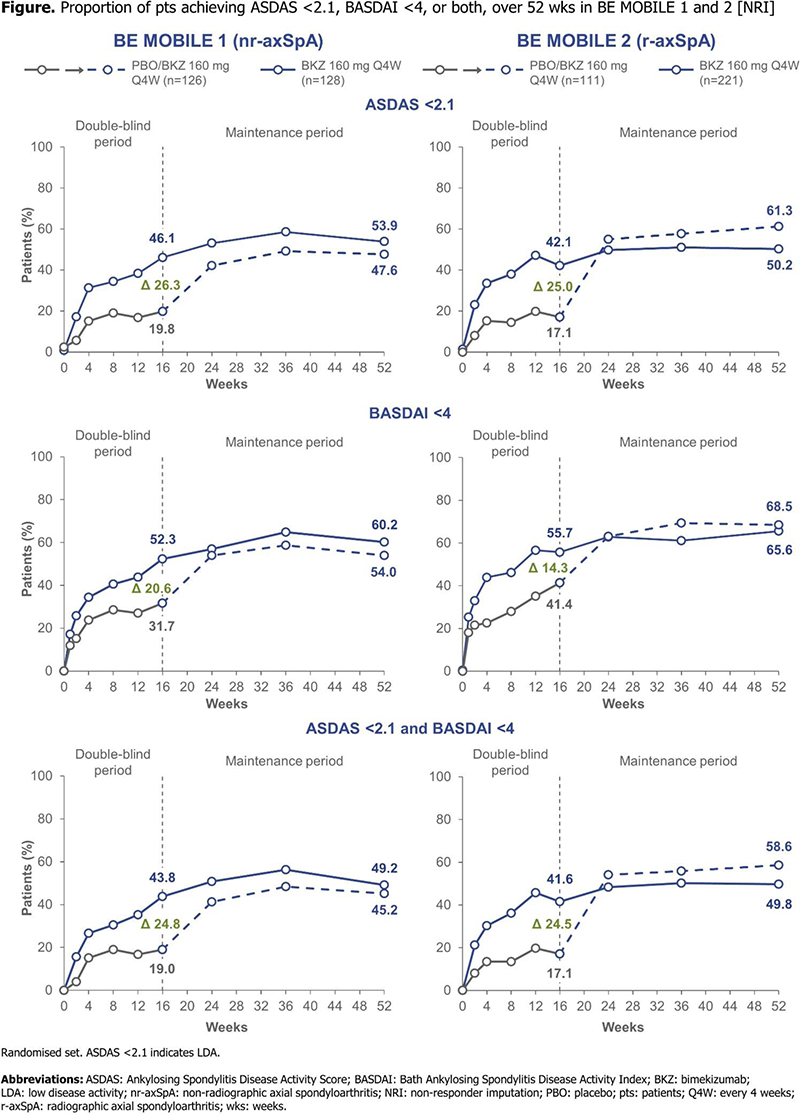
In pts with nr-axSpA, a greater proportion of BKZ vs PBO-treated pts achieved LDA at Wk 16 according to ASDAS <2.1 (BKZ: 46.1%, PBO: 19.8%), BASDAI <4 (BKZ: 52.3%, PBO: 31.7%), and both (BKZ: 43.8%, PBO: 19.0%). Separation from PBO was apparent from first post-baseline assessment for ASDAS <2.1 and both ASDAS <2.1 and BASDAI <4 (Figure 1). Results were similar for pts with r-axSpA (Figure 1).
Across continuous BKZ-treated pts and PBO/BKZ switchers, achievement of LDA, according to ASDAS <2.1, BASDAI <4, and both, was sustained or improved in both studies to Wk 52 (Figure 1). Proportion of pts achieving BASDAI <4 was consistently higher compared with achievement of ASDAS <2.1, regardless of treatment arm.
Conclusion Across the full axSpA disease spectrum, dual inhibition of IL-17A and IL-17F with BKZ resulted in rapid achievement of LDA vs PBO to Wk 16, as assessed by ASDAS <2.1, BASDAI <4, or both. Proportion of pts achieving LDA increased to Wk 52. These data suggest that ASDAS <2.1 is a more stringent criteria for LDA than BASDAI <4, and the majority of pts who achieved ASDAS <2.1 also achieved BASDAI <4. This is relevant for the consideration of BKZ in the context of a potential treat-to-target approach for pts with axSpA in daily practice.
References
[1] Smolen J. Ann Rheum Dis. 2018;77:3–17;
[2] Kwon OC. Rheumatology (Oxford). 2022;61:2369–74;
[3] Chen Y-H. Front Med (Lausanne). 2022;9:856654;
[4] Boel A. Ann Rheum Dis. 2019;78:1545–9;
[5] Baraliakos X. Arthritis Rheumatol. 2022;74(Suppl 9).
Image/graph:
Acknowledgements This study was funded by UCB Pharma. Medical writing support was provided by Costello Medical, funded by UCB Pharma.
Disclosure of Interests Xenofon Baraliakos Speakers bureau: AbbVie, BMS, Chugai, Eli Lilly, Galapagos, Gilead, MSD, Novartis, Pfizer, and UCB Pharma, Paid instructor for: AbbVie, BMS, Chugai, Eli Lilly, Galapagos, Gilead, MSD, Novartis, Pfizer, and UCB Pharma, Consultant of: AbbVie, BMS, Chugai, Eli Lilly, Galapagos, Gilead, MSD, Novartis, Pfizer, and UCB Pharma, Sofia Ramiro Consultant of: AbbVie, Eli Lilly, Novartis, Pfizer, Sanofi, and UCB Pharma, Grant/research support from: AbbVie, Galapagos, MSD, Novartis, Pfizer, and UCB Pharma, Marina Magrey Consultant of: AbbVie, Eli Lilly, Novartis, Pfizer, and UCB Pharma, Grant/research support from: AbbVie and UCB Pharma, Martin Rudwaleit Speakers bureau: AbbVie, BMS, Boehringer Ingelheim, Chugai, Eli Lilly, Janssen, Novartis, Pfizer, and UCB Pharma, Consultant of: AbbVie, Eli Lilly, Novartis, and UCB Pharma, Nigil Haroon Consultant of: AbbVie, Eli Lilly, Janssen, Novartis, and UCB Pharma, Carmen Fleurinck Employee of: UCB Pharma, Ute Massow Employee of: UCB Pharma, Natasha de Peyrecave Employee of: UCB Pharma, Thomas Vaux Employee of: UCB Pharma, Helena Marzo-Ortega Speakers bureau: AbbVie, Biogen, Eli Lilly, Janssen, Moonlake, Novartis, Pfizer, Takeda and UCB Pharma, Consultant of: AbbVie, Biogen, Eli Lilly, Janssen, MoonLake, Novartis, Pfizer, Takeda, and UCB Pharma, Grant/research support from: Janssen, Novartis, and UCB Pharma, Victoria Navarro-Compán Speakers bureau: AbbVie, Eli Lilly, Janssen, MSD, Novartis, Pfizer, and UCB Pharma, Consultant of: AbbVie, Eli Lilly, Galapagos, MoonLake, MSD, Novartis, Pfizer, and UCB Pharma, Grant/research support from: AbbVie and Novartis.
Keywords: Spondyloarthritis, Clinical trials, Treat to target
DOI: 10.1136/annrheumdis-2023-eular.833