fetching data ... 
Background SURPASS, a phase IIIb randomised controlled study in patients (pts) with radiographic axial spondyloarthritis (r-axSpA), found low spinal radiographic progression over 2 years with no significant difference between the secukinumab (SEC) and adalimumab biosimilar (SDZ-ADL) arms.[1,2] Baseline (BSL) radiographic damage (presence of syndesmophytes) and elevated C-reactive protein (CRP) levels have been identified as predictors of radiographic progression in r-axSpA.[3]
Objectives To evaluate the effect of SEC and SDZ-ADL on spinal radiographic progression in subgroups of pts based on the presence of syndesmophytes and elevated high-sensitivity CRP (hsCRP) levels at BSL, from the SURPASS study.
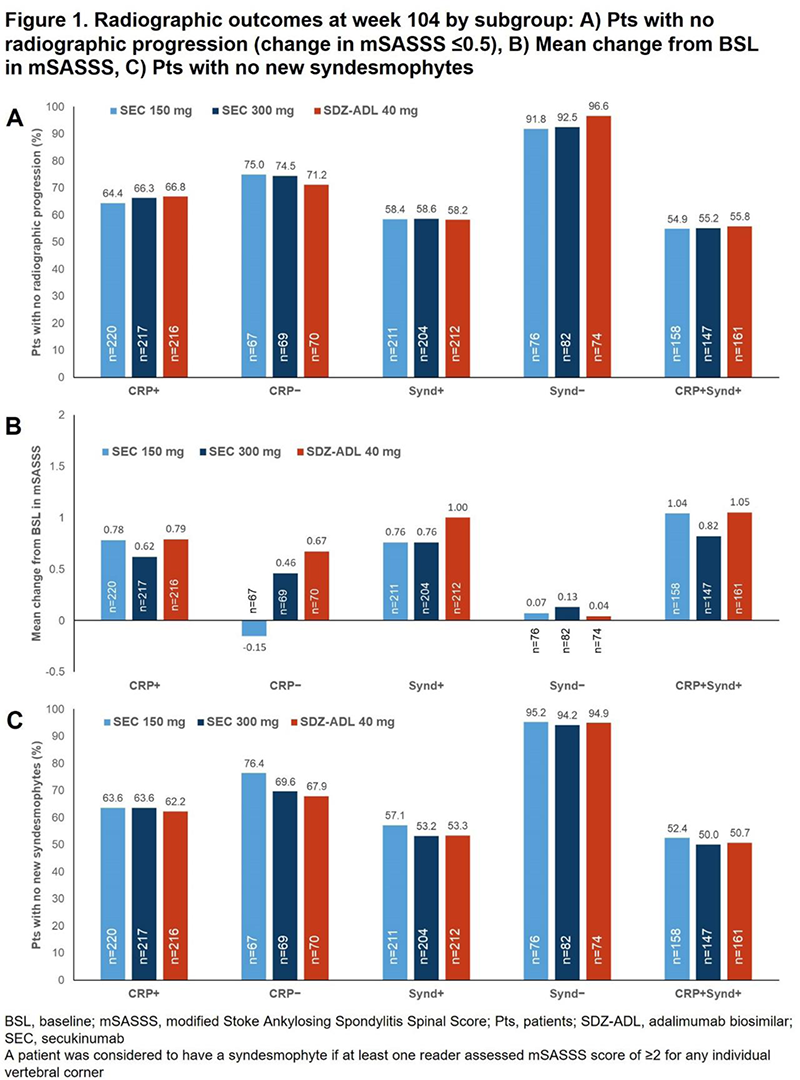
Methods Biologic-naïve pts with active r-axSpA and with hsCRP ≥5 mg/L and/or ≥1 syndesmophyte(s) on spinal radiographs were randomised (1:1:1) to SEC (150 or 300 mg; dose-blinded) or SDZ-ADL (40 mg; open label). Pts were categorised into the following subgroups at BSL: hsCRP ≥5 mg/L (CRP+), hsCRP <5 mg/L (CRP−), presence of syndesmophyte(s) (Synd+), absence of syndesmophyte(s) (Synd−), and CRP+Synd+. The proportion of pts with no radiographic progression (change from baseline in modified Stoke Ankylosing Spondylitis Spinal Score [mSASSS] ≤0.5), mean change from BSL in mSASSS, and proportion of pts with no new syndesmophytes(s) in each subgroup at week 104 (all as observed) are reported.
Results Of the 859 pts, 653 (76%) were CRP+, 627 (73%) were Synd+, and 466 (54%) were CRP+Synd+ at BSL. Demographic and BSL disease characteristics were largely balanced across subgroups and treatment arms, except for the Synd− group in which mean age, proportion of male pts, and mean time since diagnosis were lower than in other subgroups (Table 1).
All radiographic outcomes at week 104 were similar across treatment arms; however, differences were observed between subgroups irrespective of the treatment arm. The Synd− subgroup followed by the CRP− subgroup showed the least progression in all radiographic outcomes (as indicated by the higher proportion of pts with no radiographic progression and no new syndesmophytes, and lower mean change from BSL in mSASSS), across treatment arms (Figure 1). The CRP+Synd+ subgroup followed by the Synd+ subgroup and the CRP+ subgroup had higher radiographic progression compared with the Synd− and CRP− subgroups (Figure 1).
Conclusion Spinal radiographic progression over 2 years was low with no notable difference between SEC and SDZ-ADL arms regardless of the presence or absence of specific predictive factors for progression (syndesmophytes/elevated CRP). Expectedly, pts from subgroups without predictive factors (especially Synd−, followed by CRP−) had lower rates of radiographic progression.
References
Image/graph:
| Characteristics, mean values unless specified otherwise | CRP+ N=653 | CRP− N=206 | Synd+ N=627 | Synd− N=232 | CRP+Synd+ N=466 |
|---|---|---|---|---|---|
| Age (years) | 40.7 | 46.4 | 45.0 | 34.2 | 43.4 |
| Male, % | 80.1 | 73.3 | 82.1 | 68.5 | 84.3 |
| BMI (kg/m²) | 27.3 | 27.2 | 27.6 | 26.4 | 27.6 |
| Time since diagnosis of r-axSpA (years) | 6.3 | 8.0 | 7.6 | 4.3 | 7.2 |
| mSASSS | 16.2 | 17.8 | 22.5 | 0.1 | 22.5 |
| Number of syndesmophytes | 6.8 | 7.6 | 9.6 | 0 | 9.5 |
| BASDAI | 7.2 | 6.9 | 7.1 | 7.2 | 7.2 |
| hsCRP (mg/L) | 26.1 | 2.6 | 19.9 | 22.0 | 25.8 |
| HLA-B27 positive, % | 82.4 | 77.7 | 81.2 | 81.5 | 82.0 |
BASDAI, Bath Ankylosing Spondylitis Disease Activity Index; BMI, body mass index; HLA-B27, human leukocyte antigen B27; hsCRP, high-sensitivity C-reactive protein; mSASSS, modified Stoke Ankylosing Spondylitis Spinal Score; r-axSpA, radiographic axial spondyloarthritis
Acknowledgements: NIL.
Disclosure of Interests Xenofon Baraliakos Speakers bureau: AbbVie, BMS, Celgene, Chugai, MSD, Novartis, Pfizer, UCB, Consultant of: AbbVie, BMS, Celgene, Chugai, Galapagos, MSD, Novartis, Pfizer, UCB, Grant/research support from: AbbVie, BMS, Celgene, Chugai, MSD, Novartis, Pfizer, UCB, Désirée van der Heijde Consultant of: Personal fees from Novartis, AbbVie, Bayer, BMS, Cyxone, Eisai, Galapagos, Gilead, Glaxo-Smith-Kline, Janssen, Lilly, Pfizer, UCB Pharma, Pedro Machado Speakers bureau: Abbvie, BMS, Celgene, Eli Lilly, Galapagos, Janssen, MSD, Novartis, Orphazyme, Pfizer, Roche and UCB, Consultant of: Abbvie, BMS, Celgene, Eli Lilly, Galapagos, Janssen, MSD, Novartis, Orphazyme, Pfizer, Roche and UCB, Victoria Navarro-Compán Speakers bureau: Abbvie, BMS, Eli Lilly, Galapagos, Janssen, MoonLake, MSD, Novartis, Pfizer, Roche and UCB, Consultant of: Abbvie, BMS, Eli Lilly, Galapagos, Janssen, MoonLake, MSD, Novartis, Pfizer, Roche and UCB, Grant/research support from: AbbVie, Novartis, Lianne S. Gensler Consultant of: AbbVie, Acelyrin, Gilead, Eli Lilly, Fresenius Kabi, Janssen, MoonLake, Novartis, Pfizer and UCB, Grant/research support from: Novartis, UCB, Patricia Pertel Shareholder of: Novartis, Employee of: Novartis, Erhard Quebe-Fehling Shareholder of: Novartis, Employee of: Novartis, Aimee Readie Shareholder of: Novartis, Employee of: Novartis, Hanno Richards Shareholder of: Novartis, Employee of: Novartis, Denis Poddubnyy Speakers bureau: AbbVie, BMS, Lilly, MSD, Novartis, Pfizer, UCB, Consultant of: AbbVie, Biocad, BMS, Eli Lilly, Gilead, MSD, Novartis, Pfizer, Samsung Bioepis, UCB, Grant/research support from: AbbVie, Eli Lilly, MSD, Novartis, Pfizer.
Keywords: Spondyloarthritis, bDMARD
DOI: 10.1136/annrheumdis-2023-eular.1274