fetching data ... 
Background: Behçet’s syndrome (BS) is a chronic, recurrent, systemic vasculitis with unknown etiology. Coronavirus disease 2019 (COVID-19) infection is a trigger for BS flares or exacerbations presenting with uveitis, genital ulcers, and erythema nodosum [1-3]. However, there are no population-based clinical studies investigating the association between COVID-19 infection and BS disease flares.
Objectives: This study investigated the impact of COVID-19 infection, post-infection immunosuppressant adjustment, and previous vaccination status on disease flares in patients with BS.
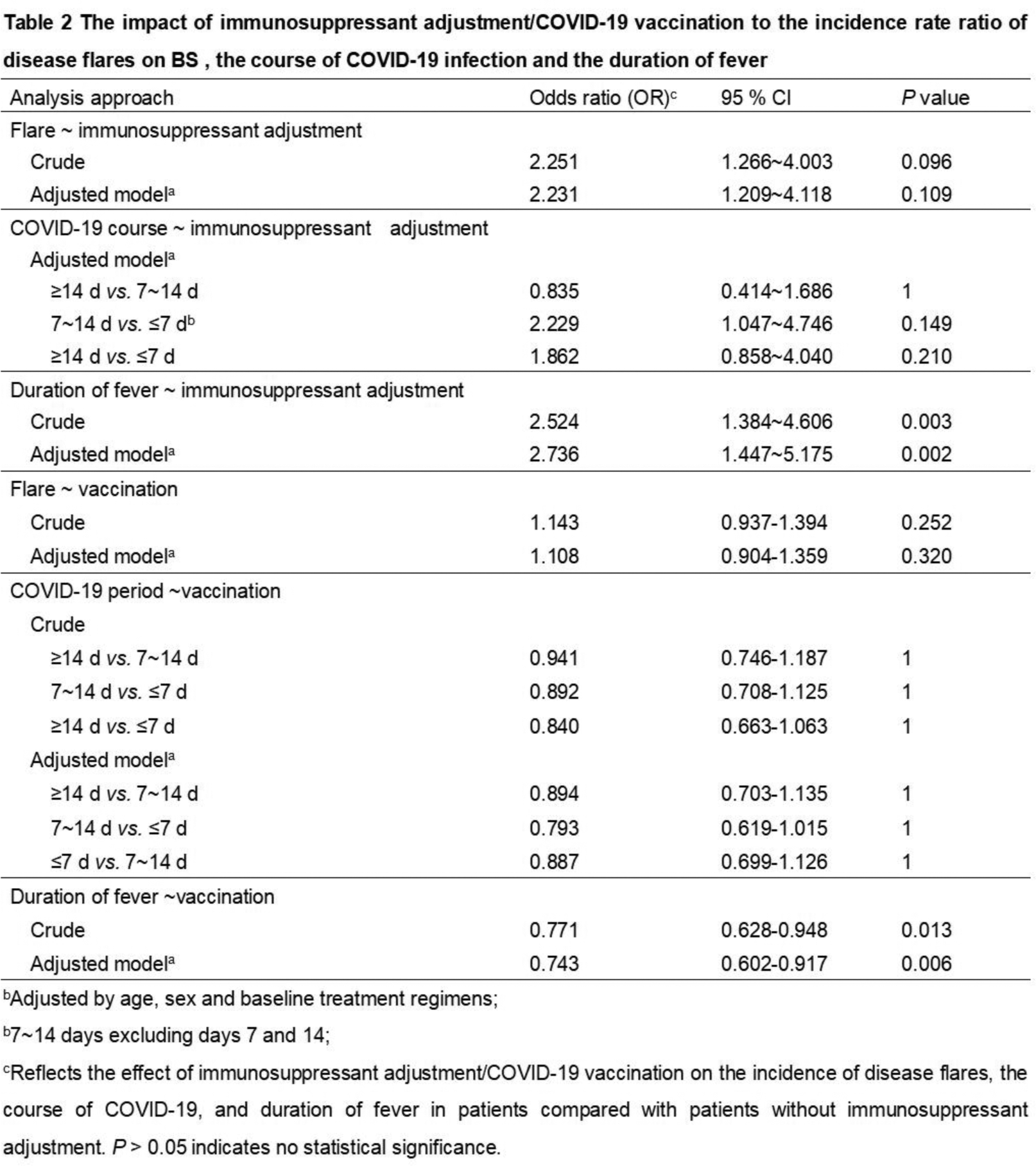
Methods: A retrospective questionnaire-based survey was conducted on BS patients with and without COVID-19 infection between Dec 2022 and Jan 2023, during the second wave of the COVID-19 pandemic in China. A multivariable Poisson generalized estimating equation model was constructed to assess the incidence rate ratio (IRR) of disease flares in BS between the COVID-19 infection status and the non-infection status adjusting for potential confounders including age, sex and baseline treatment regimens. Logistic and linear regression analyses were employed to evaluate the effects of immunosuppressant adjustments and vaccination status on disease flares, COVID-19 infection course, and fever duration based on odds ratios (OR).
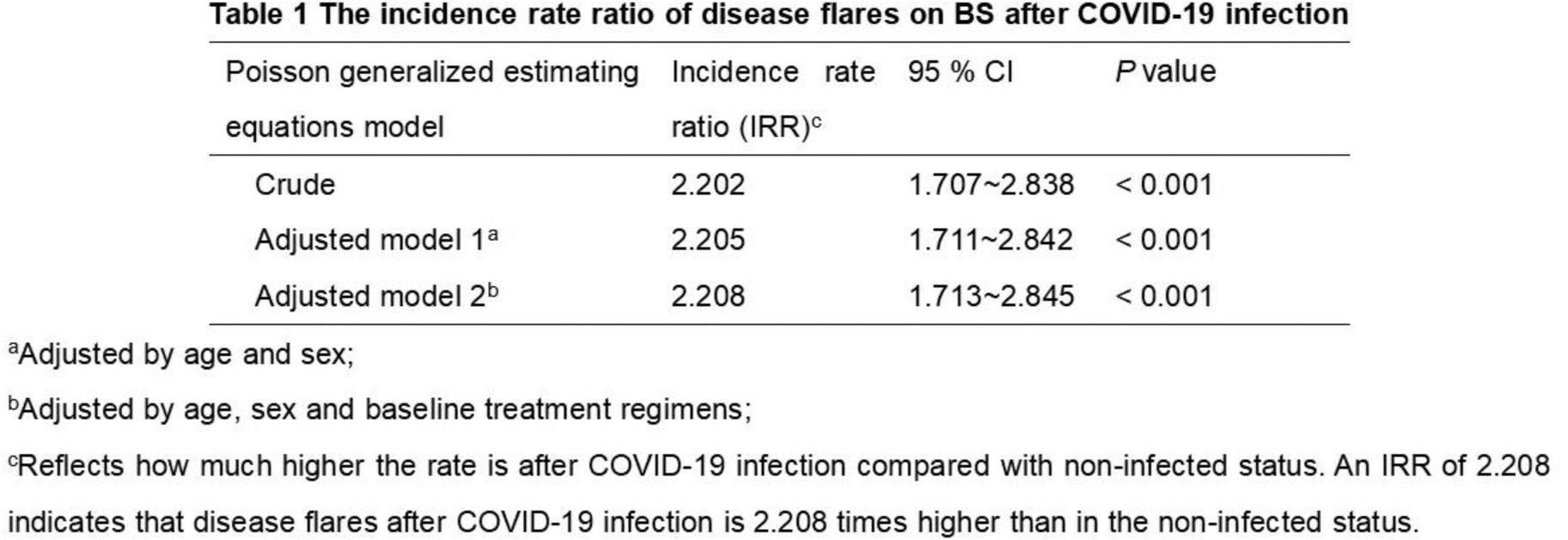
Results: 228 patients with COVID-19 infection and 31 patients without COVID-19 infection were recruited. There were 140 (54.05%) males and 119 (45.95%) females with a mean age of (38.91±11.68) years and a median disease duration of 51 (IQR 20.12 - 60.38) months. The rate of disease flares 1 month before COVID-19 infection was 14.03 (32/228) per 100 person-months in the infected group and 35.48 (11/31) in the non-infected group. After COVID-19 infection, it increased to 35.09 (80/228) in the infected group and did not increase in non-infected group. Among 80 BS patients with disease flares in the infected group, skin and mucosal lesions were the most common (53, 66.25%), followed by new or worsening gastrointestinal ulcers (19, 23.75%), arthralgia/arthritis (13, 16.25%), uveitis flares (7, 8.75%), worsening aortic valve regurgitation or new thrombosis (3, 3.75%), and parenchymal neuro-BS (3, 3.75%). COVID-19 infection was significantly associated with a higher IRR of disease flares in univariable and multivariable models (adjusted IRR = 2.208, 95% CI: 1.713-2.845, P < 0.001) (Table 1). The incidence of disease flares and the course of COVID-19 infection were not associated with immunosuppressant adjustments and COVID-19 vaccination status. However, immunosuppressant adjustments prolonged the duration of fever in infected patients (adjusted OR = 2.736, 95% CI: 1.447-5.175, P = 0.003), while vaccination status reduced the duration of fever (adjusted OR = 0.743, 95% CI: 0.602-0.917, P = 0.006) (Table 2).
Conclusion: COVID-19 infection increases the risk of disease flares in BS patients, and immunosuppressant adjustments and vaccination may impact the duration of COVID-19 infection fever.
REFERENCES: [1] Sanjay S, Mutalik D, GOwda S, et al. Post coronavirus disease (COVID-19) reactivation of a quiescent unilateral anterior uveitis [J]. SN Compr Clin Med, 2021, 3: 1843-1847.
[2] Sharifian R, Mirjalili A M, Zamani hajiabadi A. Genital ulcer as a complication of COVID-19 infection: A case report [J]. Am J Mens Health, 2023, 17: 15579883231184683.
[3] El hasbani G, Jawad A S, UTHMAN I. Erythema nodosum in Behçet’s disease in remission: Think COVID-19? [J]. SAGE Open Med Case Rep, 2023, 11: 2050313x231154316.
Acknowledgements: We thank all patients for their consent to participate in the study.
Disclosure of Interests: None declared.