fetching data ... 
Background: Eosinophilic granulomatosis with polyangiitis (EGPA) is a rare form of ANCA-associated vasculitis which is frequently characterised by a combination of vasculitic and eosinophilic manifestations. Although the efficacy of rituximab (RTX) [1] and mepolizumab (MEPO) [2] in EGPA treatment has been shown in randomized controlled trials, these trials were conducted in patient populations with different clinical characteristics. The strategy of combining RTX and MEPO both for induction and maintenance treatment of relapsing EGPA has not been previously extensively explored.
Objectives: To study the efficacy and safety of the simultaneous use of RTX and MEPO in patients with relapsing EGPA.
Methods: Retrospective study of all patients with EGPA who received combination of RTX and MEPO treatment in our academic reference center until January 1, 2024. Demographic and clinical data were recorded at baseline (start of combination treatment) and at last follow up visit.
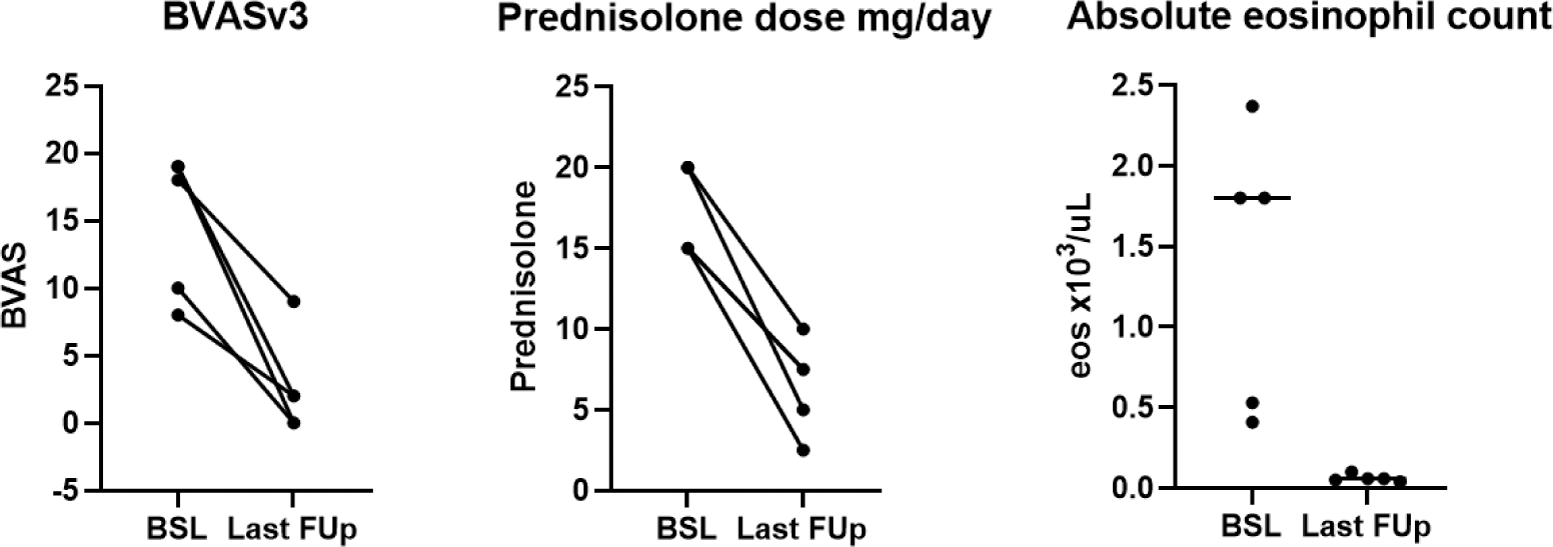
Results: Five EGPA patients (female sex 80%, median (IQR) age 51 (40-57), median (IQR) disease duration 4 (2.5-7) years) were treated by combining RTX and MEPO due to relapsing disease with a mixed vasculitic and eosinophilic clinical phenotype for a mean (SD) of 1.5 (1.3) years. At baseline (combination treatment start), the median (IQR) BVASv3 was 18 (8-19), the mean (SD) prednisolone dose was 17 (2.7) mg/day and the median (IQR) absolute eosinophil count was 1.8 (0.47-2.1)x10 3 /uL. The system involvement at baseline was: asthma 100%, nasal polyps 20%, gastrointestinal involvement 80%, peripheral nervous involvement 60%, heart involvement (pericarditis) 20%.
At the end of follow up, the median (IQR) BVASv3 was 2 (0-5.5), the mean (SD) prednisolone dose reduced to 6.5 (2.8)mg/day and the median (IQR) absolute eosinophil count to 0.6 (0.45-0.8) x10 3 /uL. Overall, 3/5 had achieved complete and 1/5 partial remission. There was one patient with refractory disease (lung and GI involvement) who was switched from mepolizumab to benralizumab, again in combination with rituximab.
The combination treatment was generally well tolerated by the patients. All patients developed mild hypogammaglobulinaemia (500<IgG<700 mg/L). The most frequent adverse event was Covid-19 infection in 3/5 patients. There was one serious adverse event (Covid-19 pneumonia) leading to hospitalization which was resolved without sequelae.
Conclusion: In this difficult to treat small cohort of patients with ANCA negative relapsing EGPA with predominant lung, gastrointestinal and peripheral nervous involvement, the combination of rituximab and mepolizumab proved to be an efficacious and safe therapeutic choice.
REFERENCES: [1] Rituximab versus Conventional Therapeutic Strategy for Remission Induction in Eosinophilic Granulomatosis with Polyangiitis: A Double-blind, Randomized, Controlled Trial. ACR Meeting Abstracts. Accessed January 15, 2024.
[2] Wechsler ME, Akuthota P, Jayne D, et al. Mepolizumab or Placebo for Eosinophilic Granulomatosis with Polyangiitis. N Engl J Med. 2017;376(20):1921-1932. DOI:10.1056/NEJMoa1702079
BVASv3, Prednisolone dose and absolute eosinophil count differences at baseline and last follow up
Acknowledgements: NIL.
Disclosure of Interests: None declared.