fetching data ... 
Background: Interstitial lung disease (ILD) encompasses a wide variety of parenchymal lung pathologies with different clinical, histological, radiological and serological features. In terms of diagnosis and the proper selection of treatment, the key point is to know the underlying ethiology, Rheumatic diseases are a systemic inflammatory group of diseases that affect all organs and systems, including the lung. Although such diseases show up by different symptoms such as arthritis, pleuritis, photosensitivity, constitutional symptoms, raynoud’s phenomenon, sicca, musculoskeletal weakness present the diseases, from months to years ago before these symptoms disease may show-up itself by isolated pulmonary involment.
Objectives: In this study, we aimed to identify both underlying rheumatological diseases and interstitial pneumania with autoimmune features (IPAF) in newly diagnosed ILD patients and thus to increase awareness.
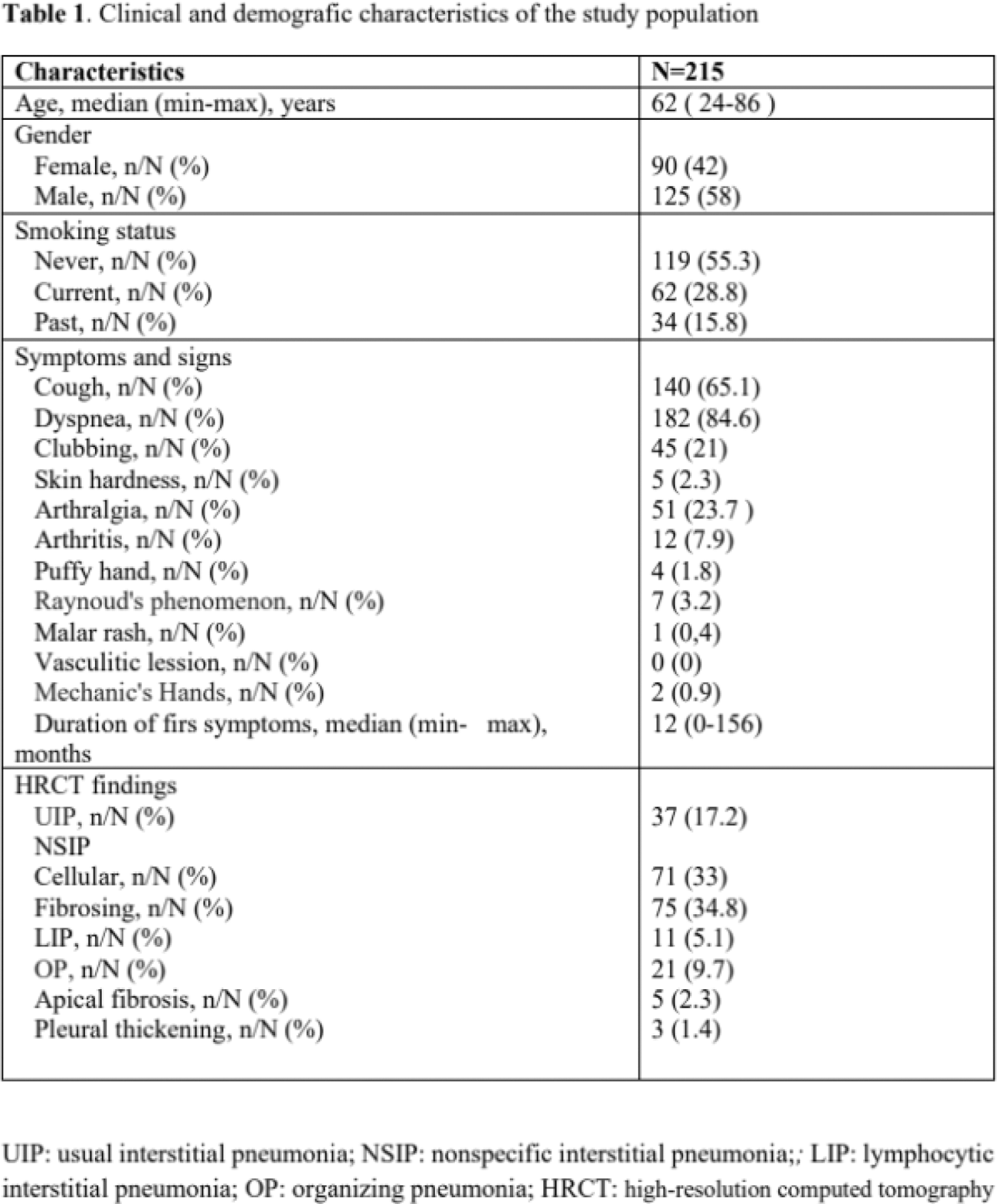
Methods: Data of 215 patients with newly diagnosed ILD who were evaluated by a pulmonologist and referred to the rheumatology clinic were included in the study. All patients evaluated by both pulmonologist and rheumatologist with history, physical examination, blood tests, pulmonary function tests, serological tests, high-resolution computed tomography (HRCT) and biopsies, if needed.
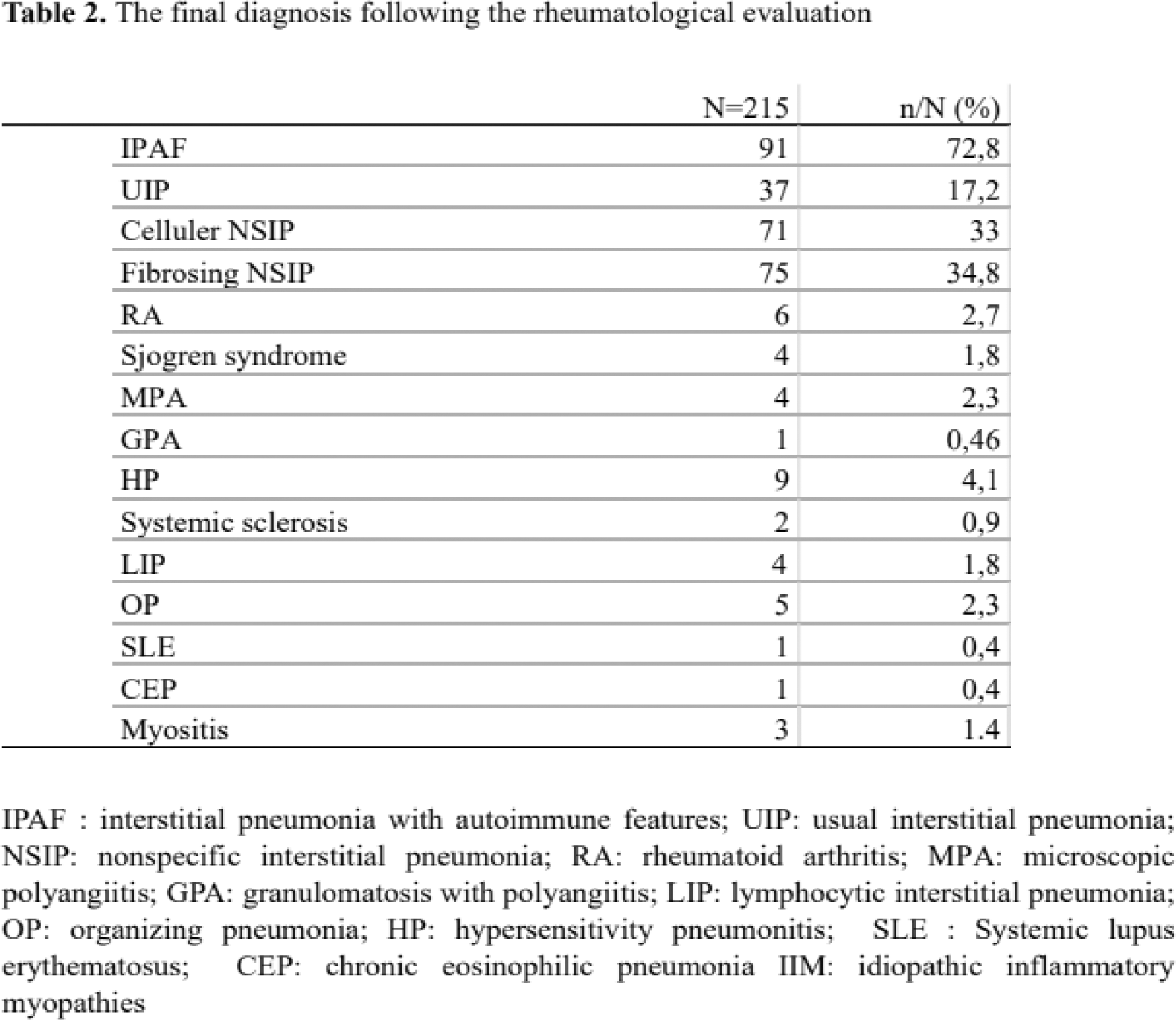
Results: Within this study, ILD diagnosed patients includes 90 woman and 125 men with and average age of 62 were evaluated (SD: 11.27). 22 of 215 (10.2 %) patients were diagnosed with specific rheumatologic disease (2.7% rheumatoid arthritis, 1.86 % sjogren syndrome, 2.3% microscopic polyangiitis, 0.9 % systemic sclerosis, 0.4% granulomatosis with polyangiitis, 0.4% systemic lupus erythematosus 1.4 % idiopathic inflammatory myopathies).
Rheumatological assesments showed that in 42,3% of them interstitial pneumania with autoimmune features (IPAF) were detected. As a result of our study we have also diagnosed non-specific interstitial pneumonia (NSIP) in 67.9% patients where 48,6% of them were cellular NSIP and rest of the patients were fibroting NSIP. Steroid treatment was started to the 53.8% of patient diagnosed by IPAF and 69.3% of these patients received non-steroid maintenance therapy.
Conclusion: In terms of the understanding ethiology of ILD, it is important to add routine rheumatology evaluations in patients with newly diagnosed. The determination and treatment of rheumatological disease that cause ILD will prevent the possible complications in further times caused by rheumatologic diseases. We believe that a multidisciplinary approach may be important in diagnostic studies of IPAF in order to increase diagnostic confidence. If ILD is cause due to rhemautological pathology, it should be evaluated for immunsupresive treatment rather than the follow-up or antifibrotic treatments.
REFERENCES: NIL.
Acknowledgements: NIL.
Disclosure of Interests: None declared.