fetching data ... 
Background: Juvenile psoriatic arthritis (JPsA) and enthesitis-related-arthritis (ERA) are 2 categories of Juvenile Idiopathic Arthritis (JIA) according to the International League of Associations for Rheumatology classification and represent analogous pediatric forms of adult psoriatic arthritis (PsA) and axial spondyloarthritis (axSpA), respectively. Ixekizumab (IXE), an anti-interleukin-17A monoclonal antibody, has demonstrated efficacy and safety in adult patients with PsA and axSpA.
Objectives: To evaluate efficacy and safety of IXE in paediatric patients with active JPsA and ERA through week (W) 16.
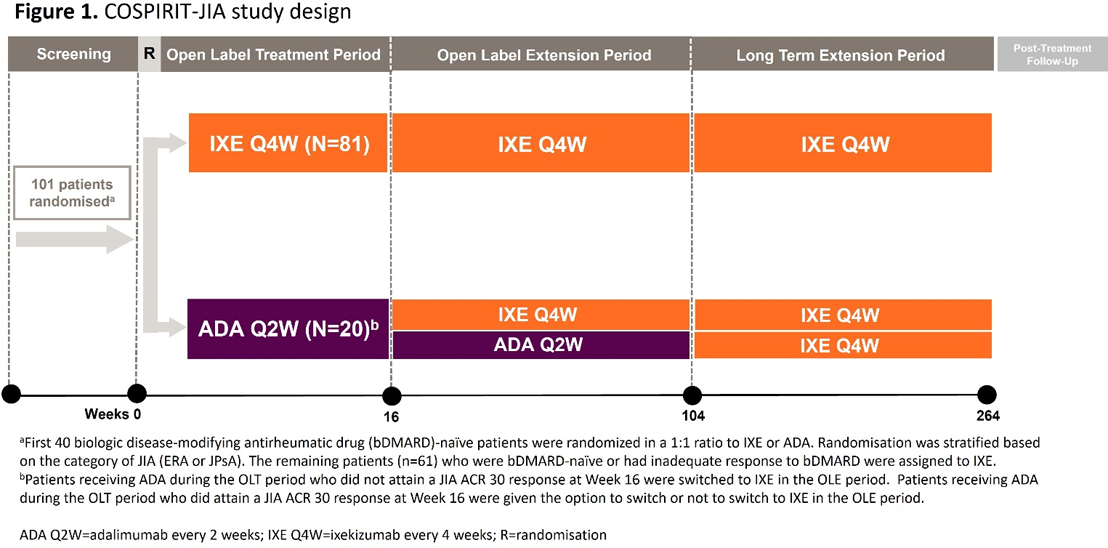
Methods: COSPIRIT-JIA is an on-going multicentre, randomised, open-label Phase 3 study of IXE, with adalimumab (ADA) as a reference arm in patients aged from 2 to <18 with a diagnosis of active JPsA or ERA. It is conducted in 3 periods: a 16W open-label treatment (OLT) period followed by an open-label extension (OLE) period proceeding to W104, followed by an open-label long term extension period (LTE) out to a total of 264W (Figure 1). Patients received either subcutaneous IXE or ADA based on weight during the OLT and OLE period (IXE every 4 weeks (Q4W): 20mg (with a staring dose of 40 mg) for patients 10 to <25kg; 40mg (with a starting dose of 80 mg) for patients 25 to 50kg and 80mg (with a starting dose of 160 mg) for patients >50kg; and ADA every 2 weeks (Q2W): 20 mg for patients 10 to <30 kg and 40mg for patients ≥30kg). At the end of OLE, all remaining ADA patients will be transitioned to IXE or discontinued. Primary endpoint was the percentage of IXE-treated patients meeting the JIA American College of Rheumatology (ACR) 30 response criteria at Week 16. All efficacy and safety data collected are summarized using descriptive statistics without any inferential statistics. Analysis of missing primary efficacy outcome variable was imputed using non-responder imputation (NRI).
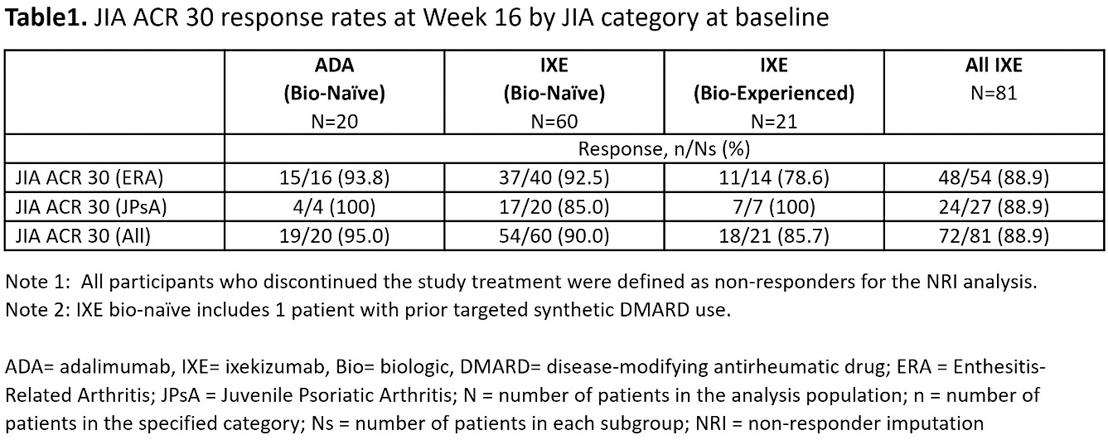
Results: A total of 101 patients (IXE=81, ADA=20) were enrolled into the 16-W OLT period. At baseline, the study population included 44 (43.6%) female patients, had a mean±SD age of 13.1±3.1 years, total Psoriasis Area and Severity Index (PASI) score of 4.4±3.0 and Leeds Enthesitis Index (LEI) of 2.1± 1.1. Patients were diagnosed with JPsA (31 [30.7%]) and ERA (70 [69.3%]). At the end of OLT, 72 (88.9%) of all IXE-treated patients achieved JIA ACR30 (Table 1). Response rates were similar across IXE-treated bio-naïve (54 [90.0%]) and bio-experienced (18 [85.7%]) patients and across ERA (48 [88.9%]) and JPsA (24 [88.9%]) categories (Table 1). In the OLT period, 81.5% of IXE-treated patients presented treatment-emergent adverse events (TEAEs), most of them were mild. Serious AEs were reported by 3.7% of IXE-treated patients. No new safety signals were observed in the studied period.
Conclusion: In paediatric patients with JPsA and ERA, efficacy of IXE was demonstrated with an overall 88.9% JIA ACR30 response rate at W16. Safety findings were consistent with the known safety profile of IXE.
REFERENCES: NIL.
Acknowledgements: Eli Lilly and Company would like to thank the participants, their caregivers, and the investigators, without whom this work would not be possible. The authors would also like to thank Ana Paula Accioly and So Young Park for providing medical and statistical review, respectively, and Laura de Ugarte Corbalan for providing medical writing assistance.
Disclosure of Interests: Athimalaipet V. Ramanan Abbvie, Eli Lilly, Pfizer, Roche, Novartis, Astra Zeneca, UCB and SOBI, Abbvie, Eli Lilly, Pfizer, Roche, Novartis, Astra Zeneca, UCB and SOBI, Nicolino Ruperto Abbvie, Aclaris, Amgen, AstraZeneca, Aurinia, Boehringer Ingelheim, BMS, Eli Lilly, Galapagos, Guidepoint, Janssen, Novartis, Pfizer, Roche Genentech, Takeda., Abbvie, Aclaris, Amgen, AstraZeneca, Aurinia, Boehringer Ingelheim, BMS, Eli Lilly, Galapagos, Guidepoint, Janssen, Novartis, Pfizer, Roche Genentech, Takeda., Ivan Foeldvari Abbvie, Pfizer, Eli Lilly, Mitsubishi, Gabriel Vega Cornejo: None declared, Stuart Keller Eli Lilly and Company, Eli Lilly and Company, Rona Wang Eli Lilly and Company, Joana Araújo Eli Lilly and Company, Eli Lilly and Company, Maja Hojnik Eli Lilly and Company, Eli Lilly and Company, Priyanka Sen Eli Lilly and Company, Eli Lilly and Company, Ketan Marulkar Eli Lilly and Company, Eli Lilly and Company, Pierre Quartier AbbVie, Amgen, Bristol-Myers Squibb, Chugai-Roche, Lilly, Novartis, Novimmune, Pfizer, Sanofi and Swedish Orphan Biovitrum, AbbVie, Amgen, Bristol-Myers Squibb, Chugai-Roche, Lilly, Novartis, Novimmune, Pfizer, Sanofi and Swedish Orphan Biovitrum.