fetching data ... 
Background: Patient education is crucial for individuals with rheumatoid arthritis (RA), empowering them to understand their condition, acquire self-management skills, and engage with healthcare services. Despite positive research on digital patient education in inflammatory arthritis, evidence for its effectiveness in newly diagnosed RA is lacking. This gap is crucial as early self-management plays a vital role in improving long-term outcomes for patients with RA.
Objectives: To evaluate the effectiveness of a novel digital patient education programme in improving self-management in patients newly diagnosed with RA.
Methods: This was a pragmatic, parallel, open-label, two arms, randomised controlled trial with superiority design. Patients from five rheumatology clinics were randomised into digital patient education (intervention) or face-to-face patient education (control) delivered by rheumatology nurses. The primary outcome was self-efficacy, measured by average difference in the Rheumatoid Arthritis Self-Efficacy (RASE) score from baseline to month 12. Secondary outcomes were RA knowledge, health literacy, adherence, and quality of life. Healthcare utilisation data and digital patient education programme usage were recorded. Self-efficacy, knowledge, and health literacy data were analysed using mixed-effects repeated measures modelling; adherence using logistic regression, and quality of life and healthcare utilisation using descriptive statistics with the Wilcoxon rank-sum test.
Results: A total of 180 patients were randomised to intervention (n=89) and control (n=91). Data from 175 were available for analysis. Median age was 59.0 years, and 61% were women. Compared to the control group, the intervention group demonstrated a significantly greater increase in self-efficacy at month 12, with an average RASE score difference of –4.34 (95%CI -8.17 to -0.51; p=0.026) (Table 1). RA knowledge, health literacy, and quality of life showed minor improvements over time but no difference between groups. There were no significant differences in the odds for low adherence between groups from baseline to month 12 (Table 1). The intervention group showed fewer out-patient clinic contacts during the 12-month follow-up. Engagement with the novel digital patient education programme was excellent, with 90.5% of patients completing mandatory modules (3.6% partially engaging and 5.9% not accessing it at all). Additionally, 72.3% of those who engaged with the mandatory module did so within a month of enrolling, demonstrating early commitment.
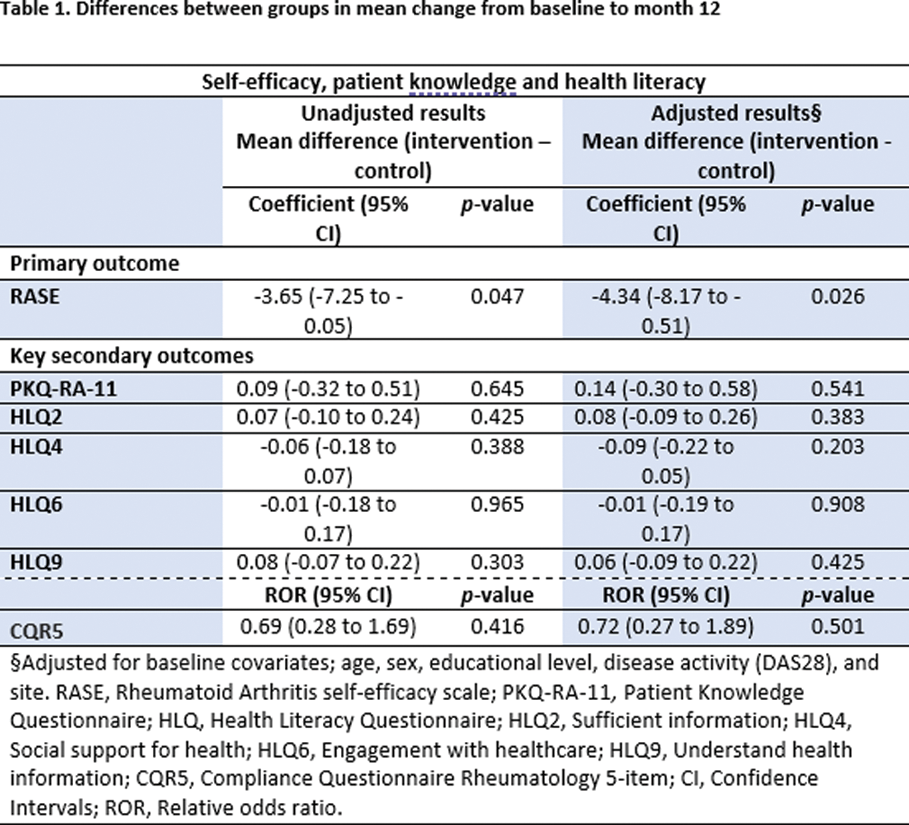
Conclusion: The findings suggest that the novel digital patient education programme is effective in improving self-efficacy and subsequently self-management in patients with early RA. This intervention has potential to lower healthcare costs by decreasing out-patient clinic visits.
REFERENCES: NIL.
Acknowledgements: NIL.
Disclosure of Interests: Line Raunsbæk Knudsen Novartis, Phizer, Eli Lilly, Mwidimi Ndosi: None declared, Ellen-Margrethe Hauge Novo Nordic, Novartis, AbbVie, Sanofi, Sobi, MSD, UCB, Novo Nordic, Novartis, AbbVie, Sanofi, Sobi, MSD, UCB, Novo Nordic Foundation, Galapagos, AbbVie, Roche, Novartis, Kirsten Lomborg: None declared, Lene Dreyer BMS, AbbVie, Sidsel Aaboe: None declared, Marie Bækmark Kjær: None declared, Lis Sørensen: None declared, Lena Volsmann: None declared, Heidi Mächler Christensen: None declared, Annette de Thurah: None declared.