fetching data ... 
Background: Active inflammatory changes, such as bone marrow edema or osteitis detected through magnetic resonance imaging (MRI) of the sacroiliac joints (SIJ), are widely considered hallmarks of axial spondyloarthritis (axSpA). This imaging is commonly used for diagnosing and classifying this condition. However, recent studies suggest that bone marrow edema in the sacroiliac joints could be an unspecific finding, potentially resulting from mechanical stress or degeneration.
Objectives: To investigate the prevalence of active inflammatory and structural changes in MRI scans of the SIJs within a general population sample and to identify factors associated with these changes.
Methods: Our database is the German National Cohort (GNC), a population-based cohort study in Germany. As part of the GNC study program, 30,000 participants underwent whole-body MRI using uniform 3.0-T scanners at five dedicated centers. For this study, T1 weighted and 3D-proton density weighted fat saturated sequences of pelvis (including SIJs and hips) of a random subset of 1,000 subjects were analyzed by three trained and calibrated readers. These readers independently evaluated the MRIs for active inflammatory and structural changes, without considering age, sex, or clinical data. Findings were recorded in an electronic case report form, noting the presence or absence of active inflammatory changes (any or suggestive of axSpA) and structural changes (again, any or suggestive of axSpA). A consensus was reached by a majority vote among the three readers. Logistic regression was employed to examine associations between various covariates and the observed outcomes.
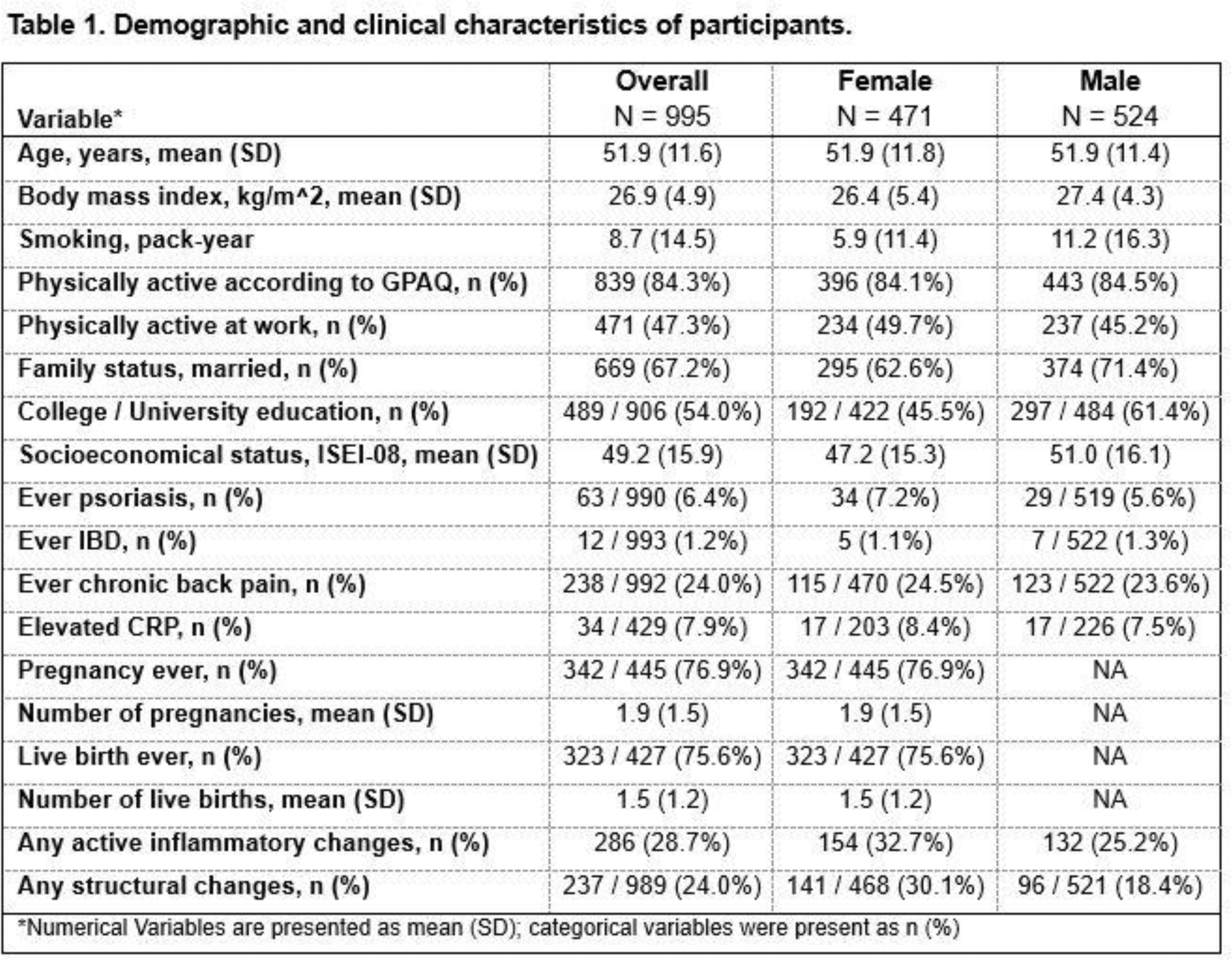
Results: The analysis included 995 subjects, excluding five participants with a known axSpA diagnosis. Active inflammatory changes were observed in 286 (28.7%) subjects, while structural changes were found in 237 (24.0%). The axSpA compatible active inflammatory/ structural changes were recorded in 5 (0.5 %) and 11 (1.1 %) of the subjects, respectively.
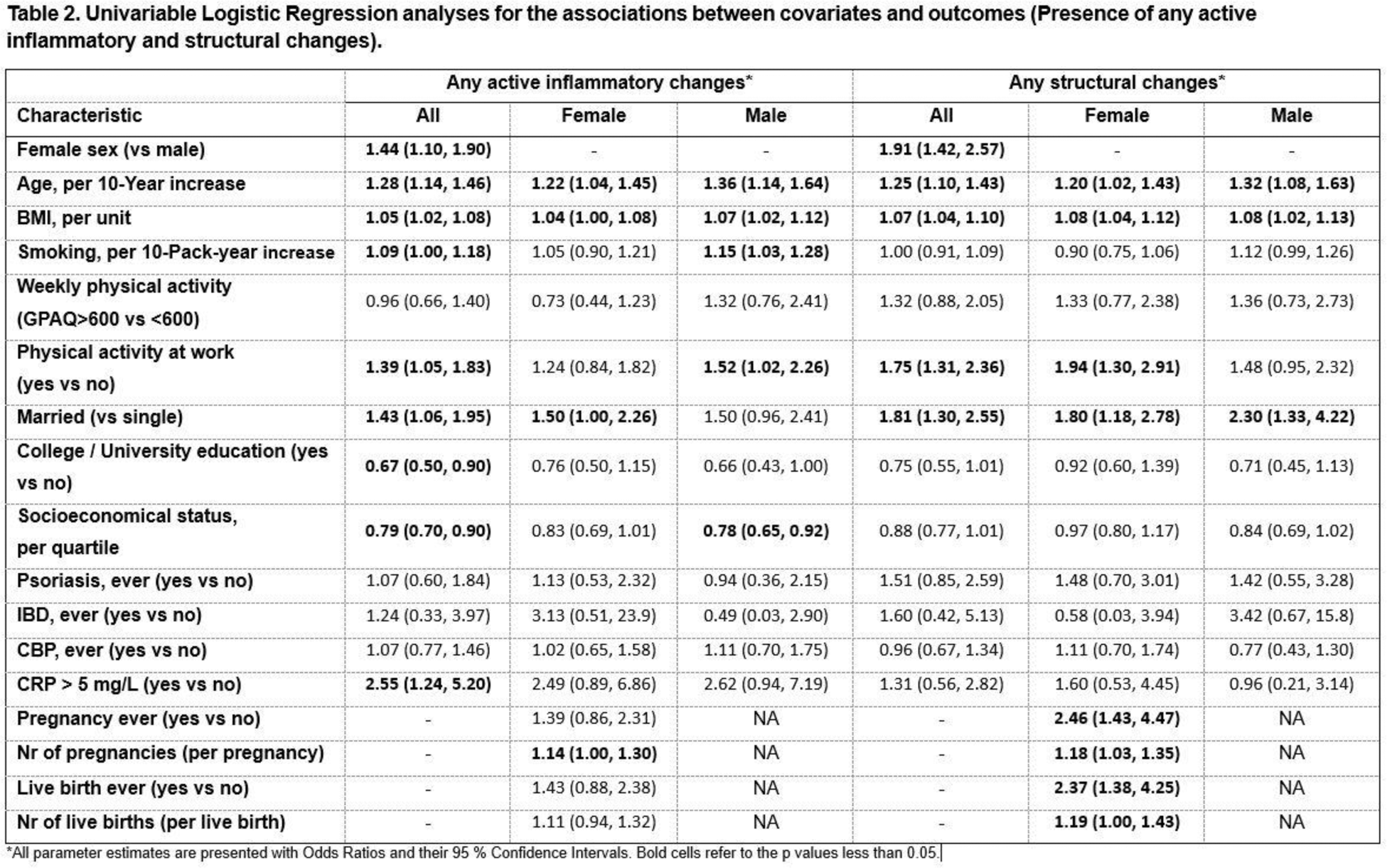
Univariable logistic regression analysis revealed that female gender, older age, higher BMI, and physically demanding work were associated with both types of changes. Higher C-reactive protein (CRP) levels were associated with active inflammatory changes but less so with structural changes. After sex stratification, a history of pregnancy and an increased number of pregnancies were more strongly associated with structural changes compared to inflammatory changes. Multivariable logistic regression analysis in the entire group showed similar trends. Factors like older age, female gender, and higher BMI were associated with a greater chance of active inflammatory changes, whereas females and individuals in physically demanding jobs were more prone to structural changes.
Conclusion: This study reveals that approximately one-third of the general population exhibits active inflammatory and/or structural changes in SIJ MRI scans. The associations of these changes with older age, higher BMI, physically demanding work, and an increased number of pregnancies indicate that mechanical factors may contribute to the pathogenesis of non-specific changes but limitations regarding causal inferences due to the cross-sectional analysis must be taken into account. Experienced readers could differentiate between changes typical of axSpA and non-specific changes.
REFERENCES: NIL.
Acknowledgements: NIL.
Disclosure of Interests: Murat Torgutalp: None declared, Xenofon Baraliakos: None declared, Torsten Diekhoff: None declared, Nikolaos Kougkas Novartis, Pfizer, AbbVie, Amgen, UCB, MSD, Carsten Schmidt: None declared, Denis Poddubnyy: None declared