fetching data ... 
Background: The prevalence of cancer in patients with autoimmune disorders is increased compared to the general population, suggesting a pathogenetic relationship between cancer and autoimmunity[1]. The association between cancer and IgG4-RD is poorly understood, and epidemiological data from European populations are missing[2].
Objectives: The aims of this study are to investigate the prevalence of malignancies among IgG4-RD patients, to describe epidemiological and clinical characteristics of patients with IgG4-RD and cancer (comprehending the recently characterized four phenotype-clusters), and to analyze the timing of the onset of cancers compared with the onset of IgG4-RD.
Methods: Two hundred and ten patients with operative diagnosis of IgG4-RD from a monocentric Italian cohort were included. The following variables were analyzed: mean age at IgG4-RD diagnosis, gender, mean follow-up c/o our center, familiar history of cancer, clusters of disease phenotype, personal history of malignancy and serum IgG4 levels. Among IgG4-RD patients with a history of malignancy the following variables were studied: cancer histotype, mean age at cancer diagnosis, time from IgG4-RD onset to tumor onset and vice versa. These data were then compared (stratified for age) with data from Italian registries accessible from the Global Cancer Observatory (GCO)[3] of the World Health Organization.
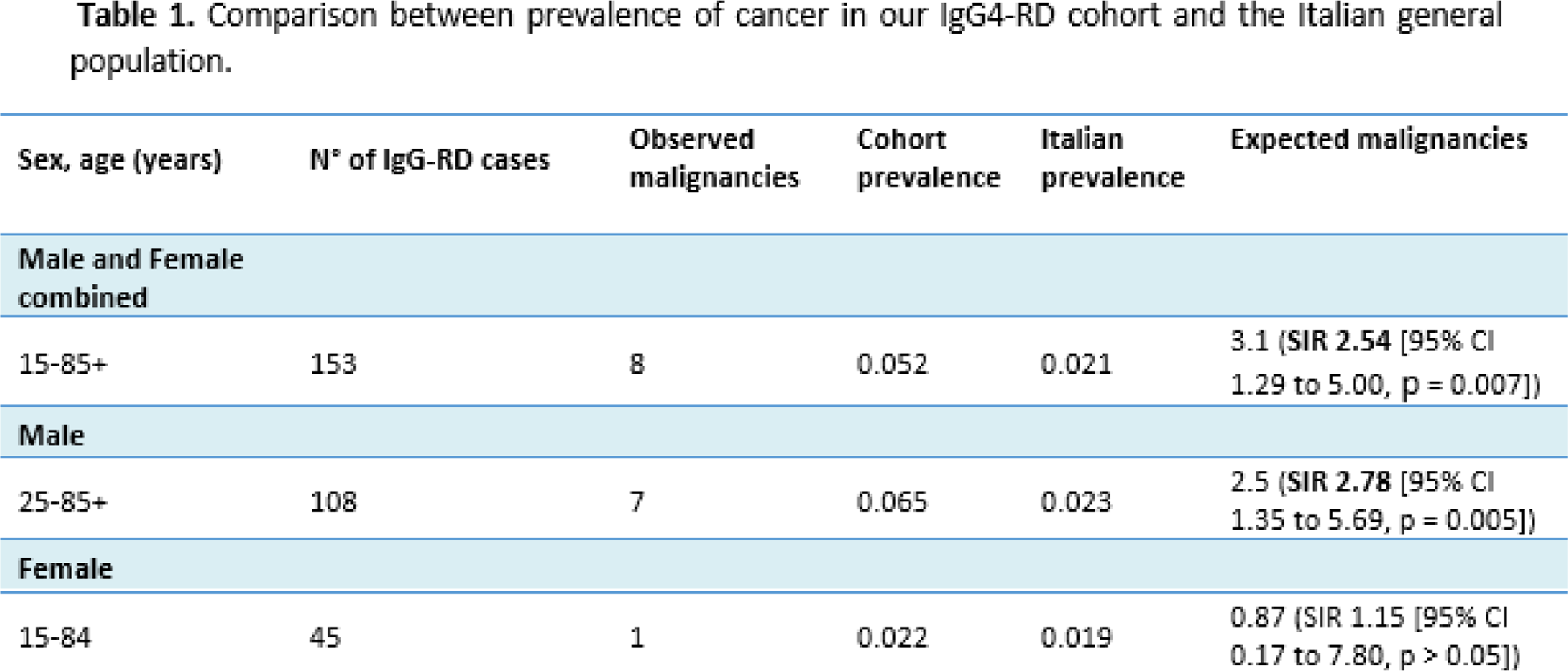
Results: Thirty seven of the 210 patients (17.6%) were diagnosed with a malignancy (48 malignancies in total) before or after the onset of IgG4-RD. The mean age at malignancy diagnosis was 62.9 years. 83% of cancers were solid, and 17% hematologic. Cluster 1 (pancreatic/biliary) was positively correlated with a history of cancer, while cluster 3 (head and neck) was negatively correlated with a history of cancer. Twenty nine of the 210 patients (13.8%) were diagnosed with malignancy (for a total of 32 malignancies) before the onset of IgG4-RD. During the follow-up, 16 new malignancies were diagnosed. Limiting the analysis to the 10 years before or after the first diagnosis, difference between time from cancer diagnosis to IgG4-RD diagnosis (50.6 months) and time from IgG4-RD to cancer diagnosis (46.1 months) wasn’t statistically different. Only one patient of the whole cohort died of cancer. Although without statistically significant difference, systemic/cluster 4 phenotype was more prevalent in patients with cancer onset after IgG4-RD than before (55% vs 22%). In order to compare our cohort with the prevalence data of the Italian population taken from GCO register, we limited our analysis to patients with cancer diagnosed between 2015 and 2020. Based on Italian population estimates (with a duration-limited prevalence of 5 years) the Standardized Incidence Ratio (SIR) for malignancies among IgG4-RD patients was 2.54 compared to the general Italian population [ p = 0.007]. In particular, the SIR was 2.78 for males [ p = 0.005] and 1.15 for females [ p > 0.05] ( Table 1 ).
Conclusion: Our retrospective study suggests that the prevalence of cancer in patients with IgG4-RD is increased compared to the Italian general population.
REFERENCES: [1] Cappelli LC, Shah AA. The relationships between cancer and autoimmune rheumatic diseases. Best Pract Res Clin Rheumatol. 2020;34:101472.
[2] Okamoto A, Watanabe T, Kamata K, Minaga K, Kudo M. Recent updates on the relationship between cancer and autoimmune pancreatitis. Intern Med. 2019;58:1533-1539.
[3]
Acknowledgements: John Stone (MD, MPH), Zachary Wallace (MD, MSc).
Disclosure of Interests: None declared.