fetching data ... 
Background: The diagnosis of Sjogren’s disease (SjD) relies on clinical, serological, and functional tests combined with the evaluation of Focus Score (FS). The FS serves as the histopathological hallmark of the disease, characterized by the presence of one or more dense aggregates with 50 or more lymphocytes (focus), typically located in the periductal space. A minor salivary gland biopsy (MSG) can also provide valuable clinical information regarding prognosis of the disease and the potential presence of lymphoma. However, whether performing a second biopsy under specific clinical indications provides any useful clinical information remains still unknown.
Objectives: The aim of this study is to assess whether the inflammatory infiltrate of the MSG and the clinical associated features change over time. This analysis may enhance our understating of the circumstances under which a second biopsy may be necessary.
Methods: We retrospectively evaluated all patients who fulfilled the 2016 ACR/EULAR and underwent at least two minor salivary gland biopsies over time. Patients diagnosed with lymphoma at any timepoint during their disease course were excluded from the present study. The decision to perform a second biopsy was made according to physicians’ clinical judgement including new onset of clinical manifestations, exclusion of lymphoma, or abrupt reduction in saliva production. All first and second biopsies were re-evaluated by the same expert on MSG biopsy of SjD. Our analysis focused on assessing changes in the Focus Scores from the first to the second biopsy. Patients were divided into three categories based on the increase (>1), decrease (<1) or stability of FS. For the overall focus score comparison, the Wilcoxon matched-pairs signed ranked test was used while for the 3-group comparison the Kruskal-Wallis test.
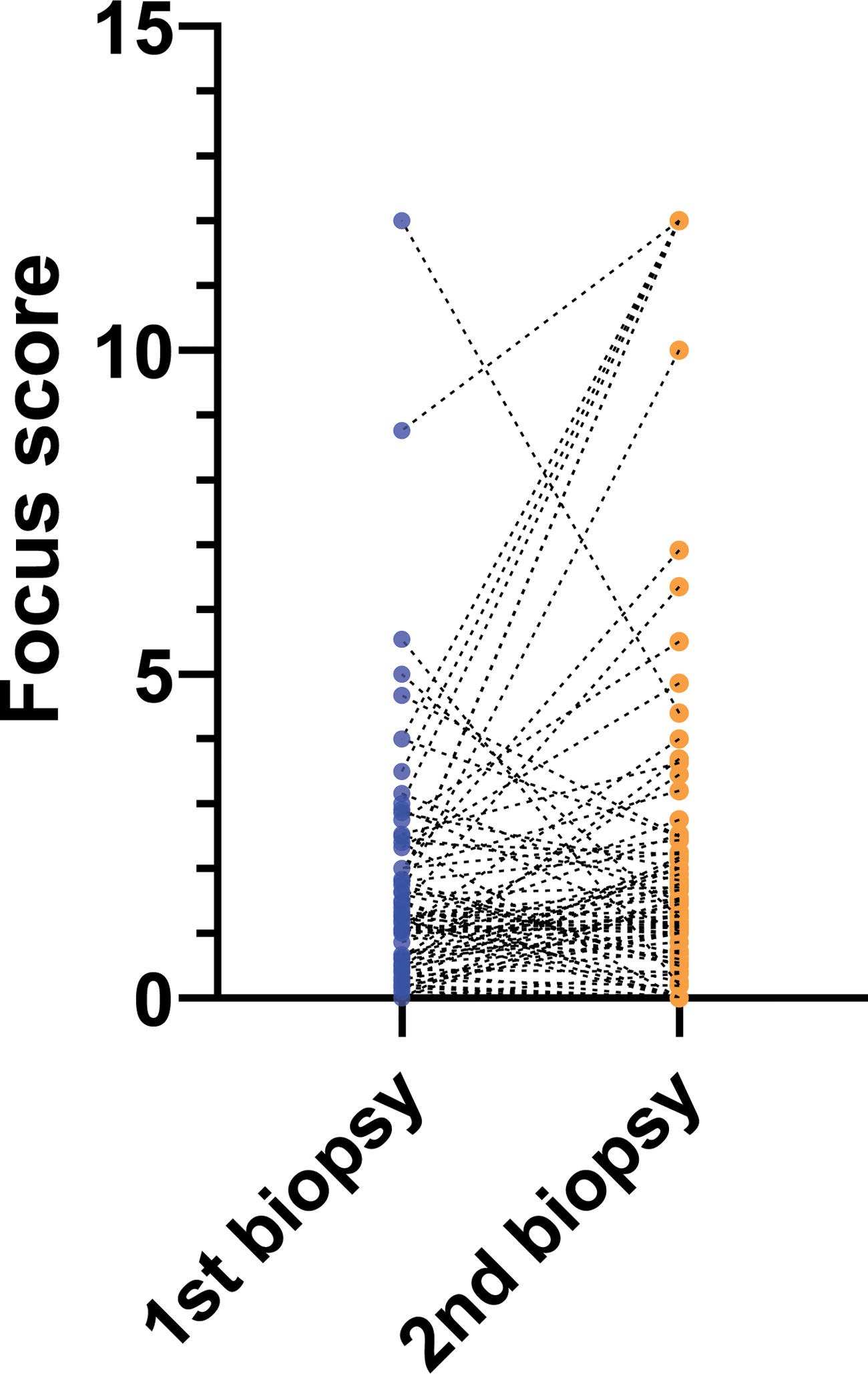
Results: In our histologic database of 1117 SjD patients, 132 individuals underwent 2 or more MSG biopsies. We excluded 51 patients with lymphoma diagnosis, resulting in 81 subjects eligible for the current analysis. The median biopsy time interval was 5,28 years (range 1-25 years). In 28 patients the focus score increased by at least 1 absolute point (group 1). In 14 patients decreased by at least 1 point (Group 2) and in 34 patients the FS remained relatively unchanged (Group 3). Overall, there was a statistically significant difference between the first and second biopsy in terms of the Focus Score (mean FS Value 1.61 vs. 2.4 respectively, p=0.0285) (Image). A statistically significant difference was also noted in FS at the first diagnostic biopsy between the three groups (Mean FS value Group 1:1,115, Group 2: 2.655 and Group 3: 1.02, P<0.0001). Exploring clinical and serologic parameters, the group exhibiting an elevated FS demonstrated a higher prevalence of Raynaud’s phenomenon (48.1% vs. 20.5%, p=0.04), while the group with decreased FS showed higher frequency of cryoglobulinemia (33,3% vs 0%, p=0,03), lower C4 hypocomplementemia (58,3% vs 18,1%, p=0,03) and less arthralgias (21,4% vs 55,8% p=0,05) compared to patients with a second stable FS.
Conclusion: Sequential biopsy data suggest that the focus score may change across time implying a potential correlation with key clinical characteristics of the disease. Initial analyses suggest that patients with a lower focus score in the second biopsy began with a higher starting point and exhibited more cryoglobulinemia along with lower C4 levels. These observations raise considerations about the potential influence of treatment selection on the reduction of the focus score.
REFERENCES: NIL.
Acknowledgements: NIL.
Disclosure of Interests: None declared.