fetching data ... 
Background: Vascular involvement in Systemic Sclerosis (SSc) is known to start even before clinical diagnosis, to drive Digital Ulcer (DU) disease and, later in the disease natural history, to cause Pulmonary Artery Hypertension (PAH), among other manifestations. Reliable outcome measures of vascular disease activity are a deep unmet need in SSc.
Objectives: To assess the ability of a contrast-free Magnetic Resonance Imaging index to predict DU disease in patients with SSc and explore its validity as outcome measure for Scleroderma vascular complications.
Methods: 227 patients attending our Scleroderma Program were consecutively enrolled. Clinical features including presence or history of DUs, presence of PAH, FVC, DLCO, and mRSS were recorded. Digital Artery Vascular Index (DAVIX) of the dominant hand’s fingers was calculated using time of flight magnetic resonance images analysed through IAG proprietary algorithm, as previously described. Patients were followed up longitudinally for 12 months and assessed for the presence of new DUs as primary outcome. Medians were compared by Mann-Whitney-Wilcoxon test, correlation with clinical parameters was performed using Spearman’s or Pearson test, as appropriate (R).
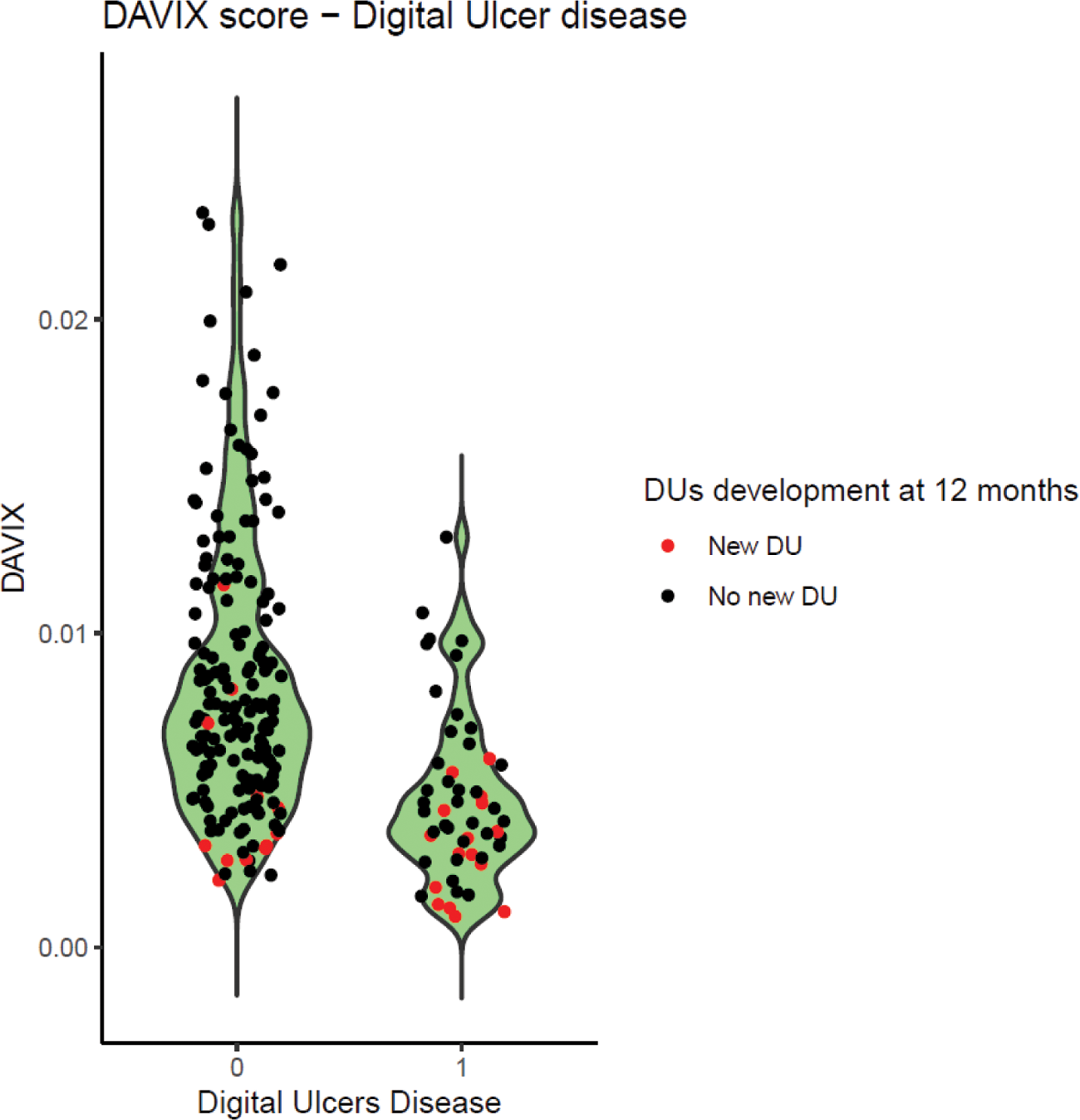
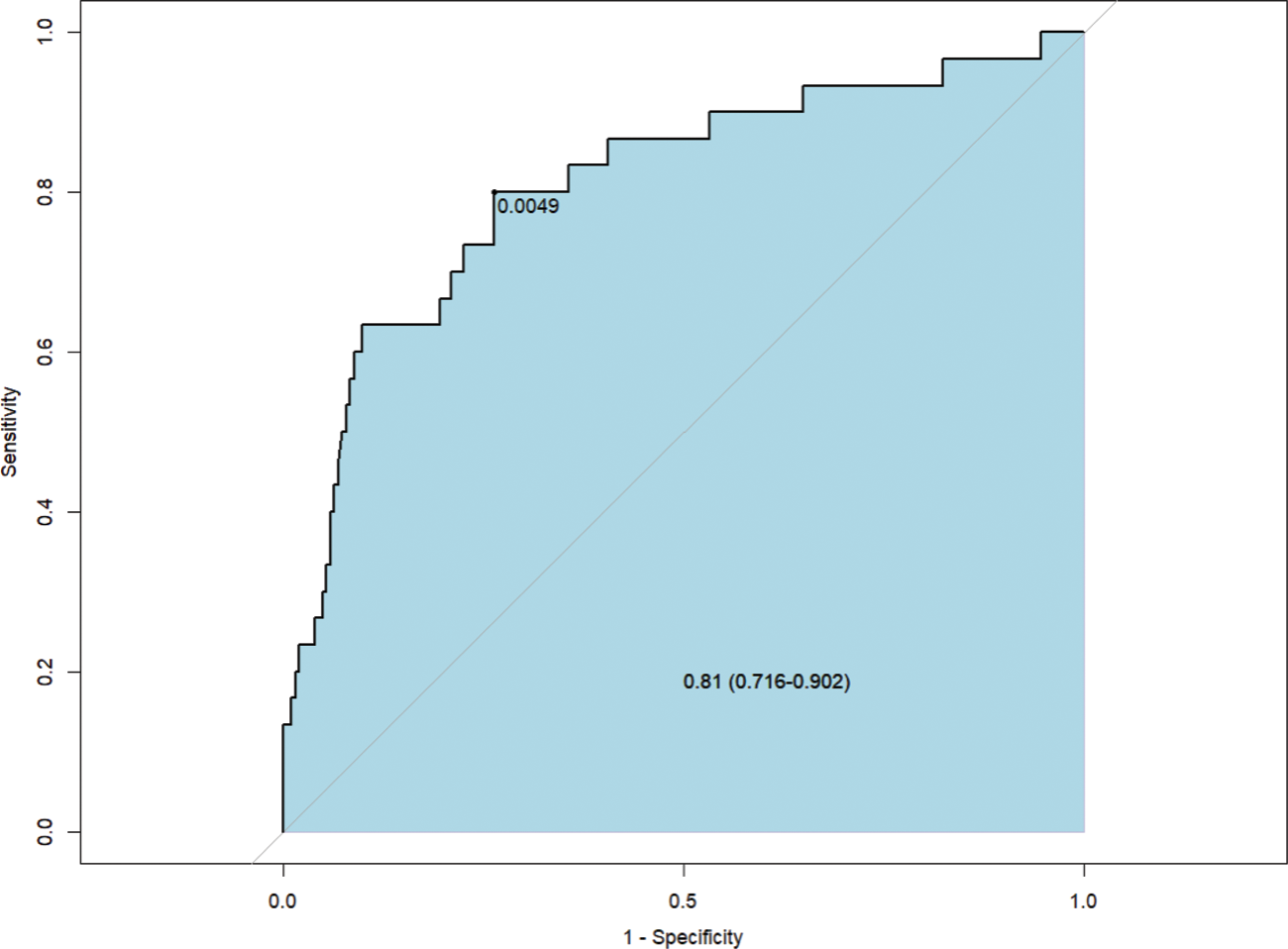
Results: 145/227 patients (63.9%) fulfilled the 2013 ACR/EULAR classification criteria for SSc (47/227 diffuse cutaneous [20.7%] and 99/227 limited cutaneous [43.6%]) whereas 82/227 (36.1%) were classified as Very Early Diagnosis of Systemic Sclerosis (Criteria score between 6 and 8). 53/227 (23.3%) patients had DU disease (History of DUs in the previous 48 weeks or presence of DUs at baseline assessment), this group showed a significantly lower DAVIX compared to patients without DU disease (0.47 vs 0.84, p<0.0001). 28/227 (12.3%) patients developed new DUs during the 12-month follow up, this group had a significantly lower DAVIX compared to patients who did not develop new DUs (0.39% vs 0.80%, p<0.0001). Receiver Operating Curve for DAVIX plotted against new DU showed an AUC 0.83 (95% CI: 0.75-0.91) with highest Youden index threshold associated with 11.10 Odds Ratio (OR) of developing new DUs (95% CI 4.03-35.65, p<0.0001). DU disease at baseline conferred an OR of 4.4 (2.2-12.2, p=0.0032) of developing new DUs at 12-months. Beyond DU disease, DAVIX correlated with DLCO (rho=0.349, p<0.0001) and inversely with FVC/DLCO ratio (rho=-0.299, p=0.0006), as well as capillaroscopy pattern (p<0.0001). DAVIX negatively correlated with mRSS (rho=-0.259, p=0.0003).
Conclusion: DAVIX is a contrast-free MRI method that shows strong clinical value as surrogate outcome measure of DU disease in SSc and excellent predictive ability for new DUs at 12-month. Prospective testing in the context of randomized controlled trials to assess reliability and sensitivity to change are ongoing to determine the value of DAVIX as surrogate endpoint for vascular disease assessment in SSc clinical trials.
REFERENCES: NIL.
Different DAVIX score in patients grouped by DUs disease presence at baseline (red dots represent patients developing a new digital ulcer during the 12-month follow-up).
ROC curve for DAVIX score plotted against the presence of DUs at 12-month follow-up.
Acknowledgements: NIL.
Disclosure of Interests: Stefano Di Donato: None declared, Michael Hughes Actelion pharmaceuticals, Eli Lilly, and Pfizer, Certa Therapeutics, Janssen, Klodian Gjeloshi: None declared, Giovanni Lettieri: None declared, Fiammetta Danzo: None declared, Giuseppina Abignano: None declared, Dominic Bertham: None declared, Enrico De Lorenzis: None declared, Jamshid Dehmeshki Image Analysis Group, Olga Kubassova Image Analysis Group, MiMedx, Werfen, CureMatch, Inc., Philip O’Connor: None declared, Francesco Del Galdo AstraZeneca, AstraZeneca, Janssen, Janssen, AstraZeneca, Abbvie, AstraZeneca, Boehringer-Ingelheim, Capella Biosciences, Chemomab Therapeutics, Ergomed, GSK, Janssen, Mitsubishi-Tanabe.