fetching data ... 
Background: Rheumatoid arthritis (RA) causes joint symptoms due to inflammation in the bones and joints, which leads to physical dysfunction and contributes to frailty. However, advances in drug therapy have led to better control of disease activity, while the rate of frailty in RA patients is higher than that in healthy controls (1). Frailty is a concept that describes a state of frailty and is multifaceted with physical, mental, and social frailty. There are some reports on physical and mental frailty in RA patients, but few reports on social frailty. It is important to explore the association between RA patients and social frailty in order to address patient unmet needs.
Objectives: The aim of this study was to investigate social frailty in RA patients.
Methods: Data for this study were obtained from a multicenter observational study (T-FLAG), involving patients at three institutions. Of 696 RA patients enrolled in the study from June to August 2022, 655 patients with complete responses to the KCL and social frailty questionnaires were included. Social frailty was defined by Makizako using from 0 to 5 points, with 2-5, 1, and 0 points defining ‘Frailty,’ ‘Prefrailty,’ and ‘Nonfrailty,’ respectively (2). Patient backgrounds with and without social frailty were compared, and factors associated with social frailty were examined by multivariate logistic regression analysis. Correlations between scores in each domain of KCL (activities of daily living [questions 1-5], physical strength [questions 6-10], nutrition [questions 11-12], oral function [questions 13-15], isolation [questions 16-17], cognitive function [questions 18-20], and depressive mood [questions 21-25]) and social frailty indices were examined using Spearman’s rank correlation coefficient (3).
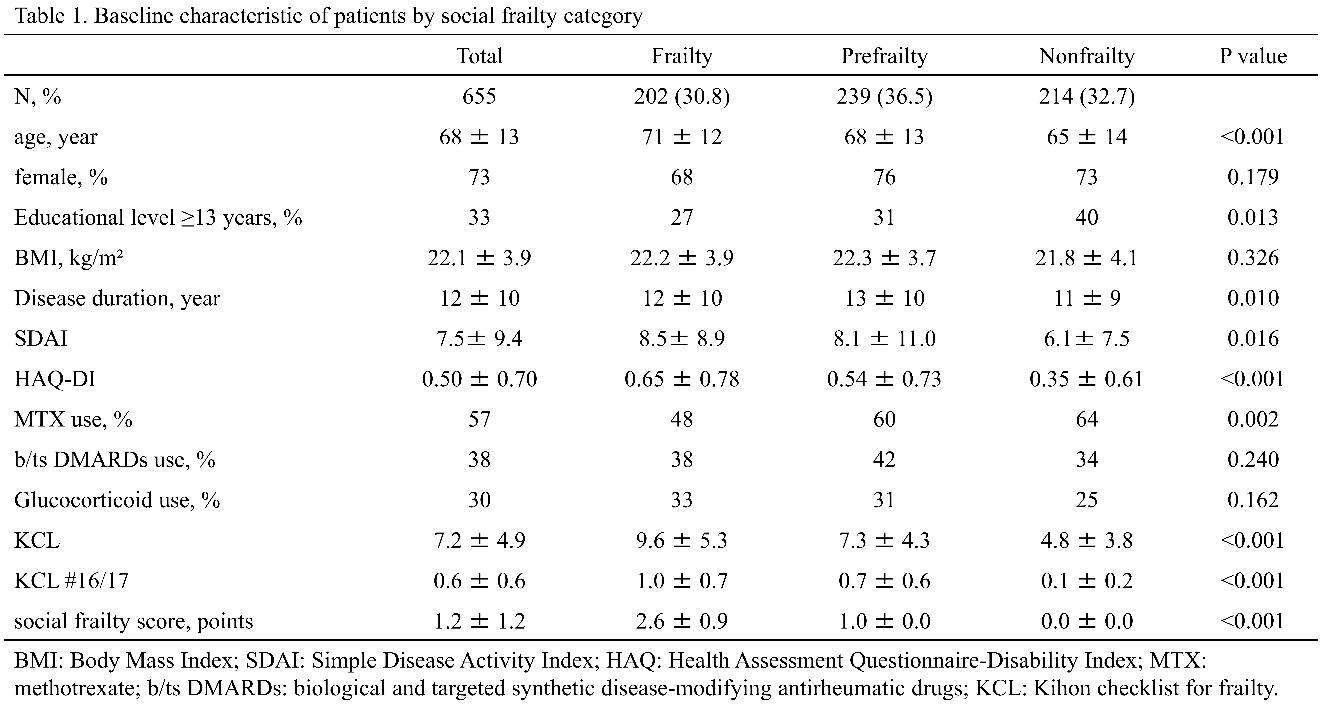
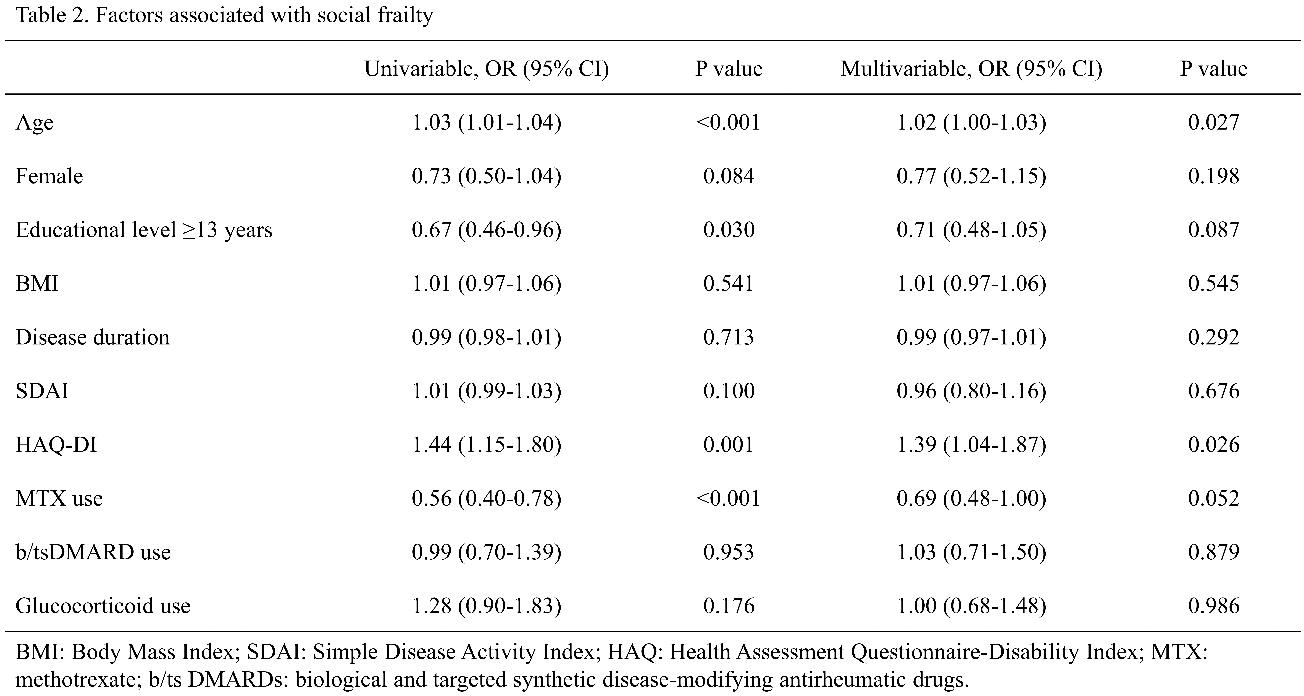
Results: Patient background (mean ± standard deviation or percentage) was as follows: age 68 ± 13 years, disease duration 12 ± 10 years, 73% female, SDAI 7.5 ± 9.4, KCL 7.2 ± 4.9 points, and social frailty index 1.2 ± 1.2 points (Table 1). Frailty was 30.8% and Prefrailty 36.5%. One way ANOVA revealed significant differences in age among the frailty (71 ± 12), Prefrailty (68 ± 13), and Nonfrailty (65 ± 14) groups (P<0.001). Educational level, disease duration, SDAI, HAQ-DI, percentage of MTX use, and KCL also showed significant differences. Multivariate analysis revealed that age (OR: 1.02 95% IC: 1.00-1.03) and HAQ (OR: 1.39, 95% IC: 1.04-1.87) were factors associated with the social frailty index (Table 2). The correlation coefficient between the total KCL score and the social frailty index was 0.395 (P<0.001). The correlation coefficients between KCL scores and social frailty index were 0.316 (P<0.001) for activities of daily living, 0.205 (P<0.001) for physical strength, 0.089 (P=0.023) for nutrition, 0.155 (P<0.001) for oral function, 0.601 (P<0.001) for isolation, and cognitive function was 0.110 (P=0.00), and depressive mood 0.275 (P<0.001).
Conclusion: Age and HAQ-DI were factors associated with social frailty in RA patients. In addition, “ isolation #16-17,” an assessment of social frailty in the KCL, had a slightly stronger positive correlation with social frailty than other items in the KCL, suggesting that it is a useful tool in the assessment of social frailty.
REFERENCES: [1] Cook MJ, et al. Increased Frailty in Individuals With Osteoarthritis and Rheumatoid Arthritis and the Influence of Comorbidity: An Analysis of the UK Biobank Cohort. Arthritis Care Res (Hoboken). 2022;74(12):1989-96.
[2] Makizako H, et al. Social Frailty in Community-Dwelling Older Adults as a Risk Factor for Disability. J Am Med Dir Assoc. 2015;16(11):1003.e7-11.
[3] Satake S, et al. Validity of the Kihon Checklist for assessing frailty status. Geriatr Gerontol Int. 2016;16(6):709-15.
Acknowledgements: We thank Ms Sachiko Kato, Ms Emi Yokota, Ms Ritsuko Otakeand Ms Takako Sashikata for their assistance with informationcollection.
Disclosure of Interests: None declared.