fetching data ... 
Background: The treatment of haemophilia A and B (HA/HB) has historically been based on the on-demand administration of the deficient clotting factor (CF): VIII in HA and IX in HB. Subsequently, the use of prophylaxis treatments has led to a reduction in bleeding episodes in these patients. In recent years, biological therapy has emerged as the treatment of choice, not only reducing the frequency of haemorrhagic episodes but also improving haemophilic arthropathy, one of the main causes of morbidity in this population.
To analyze the number of hemarthrosis (H) per year in patients with HA/HB on CF treatment.
To assess the association between switching to emicizumab (EM) treatment and the reduction in the number of H per year.
To determine the relationship between switching from on-demand administration of CF to prophylaxis regimen and the reduction in the frequency of H.
Methods: Retrospective descriptive study conducted in patients with HA/HB and H episodes between 2010-2024. The therapeutic regimen (TR) is categorised as on-demand or prophylaxis regimen. EM is a humanised monoclonal antibody for HA and concizumab is for HA/HB with inhibitor. Total H was collected through the electronic clinical station of our hospital, divided into those obtained at the doctor’s consulting room or described at home and self-treated by the patient with CF. Quantitative variables are expressed as median and dichotomous variables as percentages. To assess the association of the variables under study, the Wilcoxon Signed-Rank test were used.
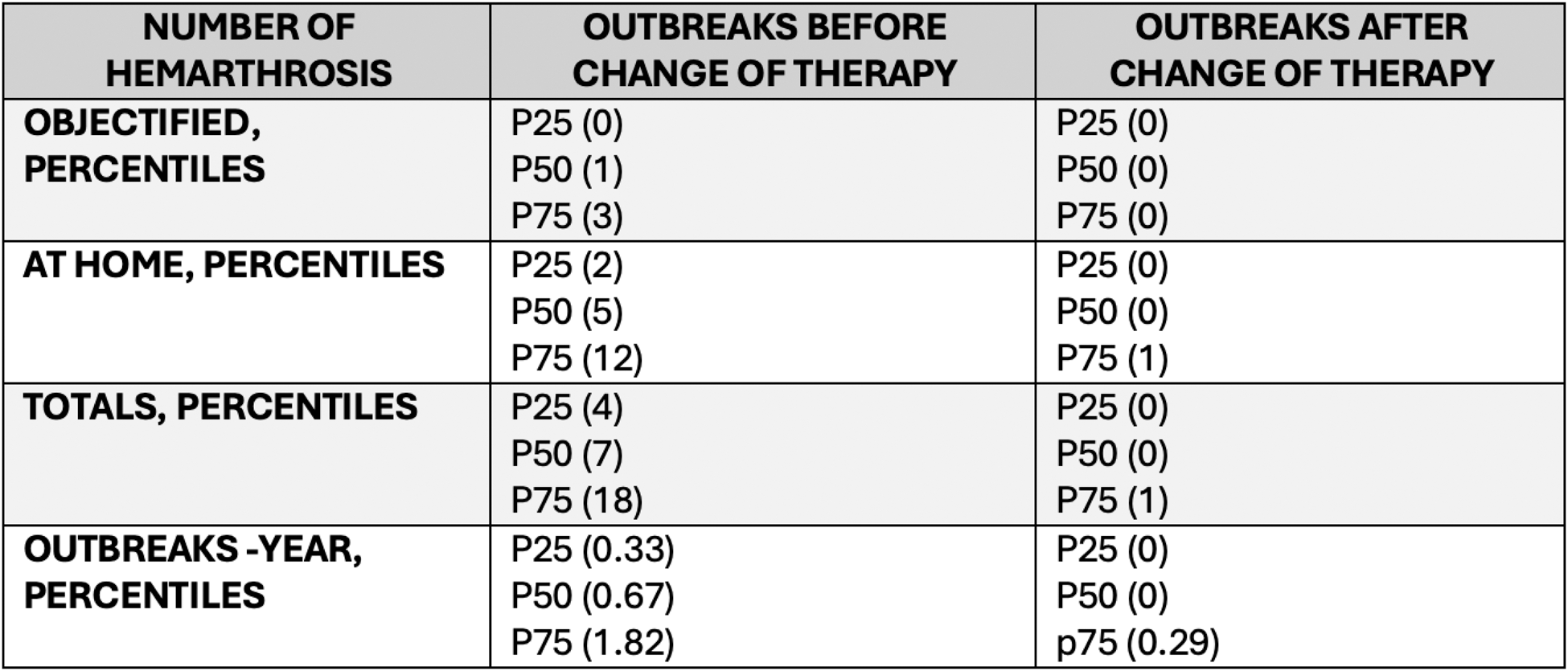
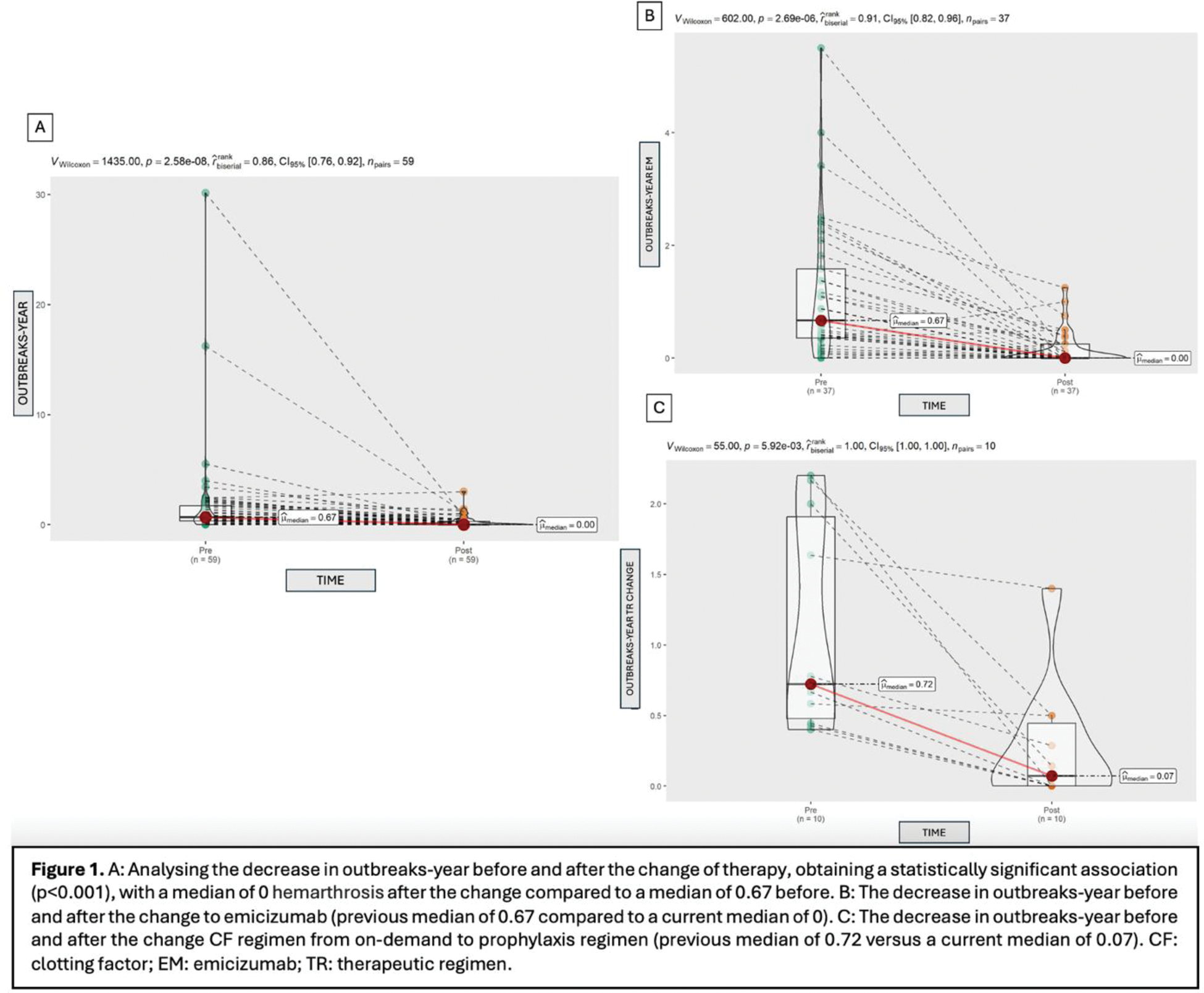
Results: At the beginning of the period, 59 patients on CF treatment were studied, divided into 26 on demand regimen (44.07%) and 33 on prophylaxis regimen (55.93%). The number of H episodes was evaluated, obtaining the percentiles (p) shown in table 1. After analysing these H with the period of time in years that they were on CF treatment, the following outbreaks-year (O/Y) results were obtained: p25 (0.33), p50 (0.67) and p75 (1.82). Following the high prevalence of H and with the advances in recent years, 40 patients switched to biologic therapy (37 EM and 3 concizumab) and 10 changed the CF regimen from on-demand to prophylaxis regimen. The H episodes after this are listed in Table 1. Re-analysis of H resulted in the following O/Y: p25 (0), p50 (0) and p75 (0.29). We analysed the decrease in O/Y before and after the change, obtaining a statistically significant association (SSA) (p<0.001), with a median (Me) of 0 H after the change compared to a Me of 0.67 before (Figure 1A). Analysing the number of H recorded before and after the change of therapy, a SSA (p<0.001) was obtained, with a Me of 7 before and 0 after the change, in the reduction of H. When subdividing the number of H, the SSA (p<0.001) was achieved for both those objectified in consultation (Me of 1 before and 0 at switch) and those self-treated at home (Me of 5 before and 0 at switch). Patients on current EM treatment were individually assessed and the number of O/Y pre-use [p25 (0.35), p50 (0.67) and p75 (1.70)] compared to current [p25 (0), p50 (0) and p75 (0.25)]. A SSA (p<0.001) in H reduction was obtained, with a previous Me of 0.67 compared to a current Me of 0 (Figure 1B). When analysing the number of total H independently, SSA (p<0.001) was also achieved in the reduction, with a previous Me of 7 versus a current Me of 0. Similarly, if subdivided, SSA (p<0.001) was again achieved in the reduction of H in both objectified (Me of 1 versus current 0) and at-home (Me of 5 versus current 0) H. Of the 10 patients who changed their CF regimen from on-demand to prophylaxis regimen, a pre-change O/Y value [p25 (0.44), p50 (0.72) and p75 (2.04)] and a post-change value [p25 (0), p50 (0.07) and p75 (0.5)] were obtained. A SSA (p=0.005) was obtained in the reduction of H, with a previous Me of 0.72 versus a current Me of 0.07 (Figure 1C). The number of total H was analysed independently with a SSA (p=0.005) in the reduction, with a previous Me of 8.5 and a current Me of 0.5. Similarly, when subdivided, the SSA (p=0.005) was achieved in the reduction of H at home (Me of 7 versus current Me of 0). However, significance (p=0.068) was not obtained in the objectified ones.
Conclusion: The progress in the treatment of HA/HB in recent years has been exponential. Patients who switched their treatment to EM in our cohort had a significant reduction in H episodes. Our results confirm what has been observed in other studies and reinforce the need for a change in treatment to prevent haemophilic arthropathy, which causes so much comorbidity and detriment to quality of life. Similarly, patients who were receiving CF regimen on-demand and switched to prophylaxis regimen also showed a reduction in the number of H. This finding reaffirms the benefit of prophylaxis-based therapeutic approach that not only limits itself to the management of bleeding events, but also prevents them and contributes to reducing the sequelae derived from them.
REFERENCES: NIL.
Table 1.
Acknowledgements: NIL.
Disclosure of Interests: None declared.
© The Authors 2025. This abstract is an open access article published in Annals of Rheumatic Diseases under the CC BY-NC-ND license (