fetching data ... 
Background: Osteoporotic fractures pose a significant public health burden. According to the Spanish Fracture Registry (REFRA) and existing literature, hip fractures are more common in older patients (>80 years) with a low BMI (<25), while humerus fractures tend to occur in younger patients (<80 years) with a higher BMI (>25). Despite their prevalence, humerus fractures remain under-researched and often underestimated in clinical practice.
Objectives: This study aimed to identify risk factors associated with humerus fractures, to enable early detection and management of osteoporosis. Our goal was to enhance patients’ quality of life and optimize healthcare resource allocation.
Methods: We performed a single-center, retrospective, comparative study of hip and humerus fractures within the framework of a Fracture Liaison Service (FLS) program at the Infanta Leonor University Hospital in Madrid. Data were collected from clinical records and the MINIREFRA tool (2019-2023). Statistical analyses were performed using the SAS software. Population comparisons were conducted using the Student’s t-test and chi-square test.
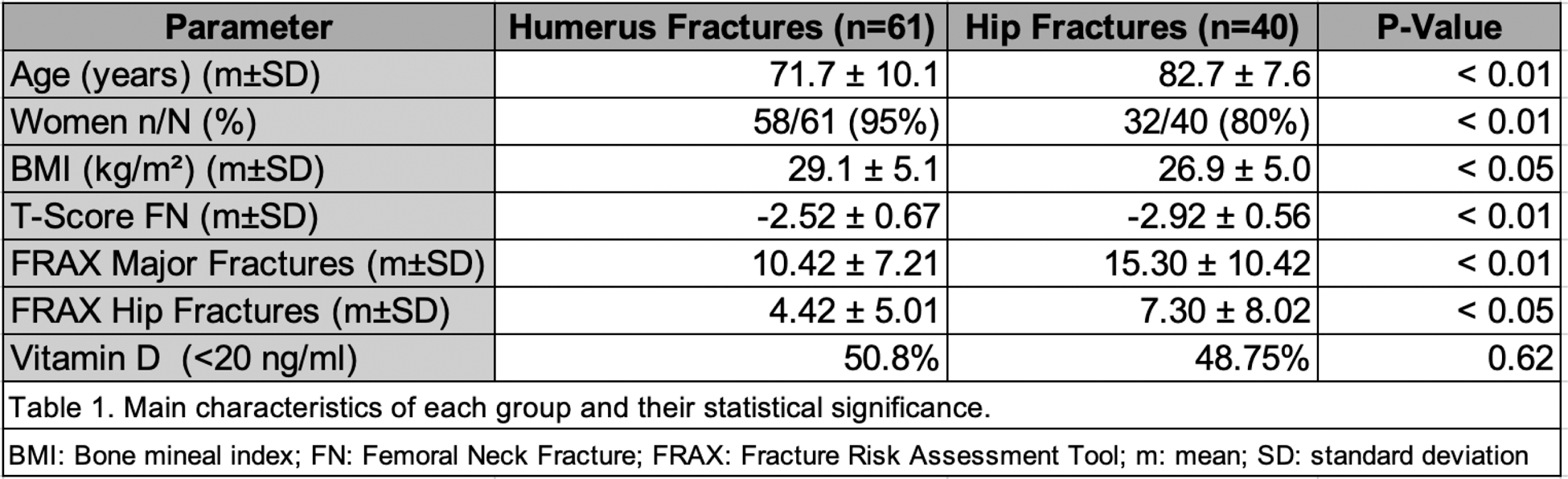
Results: A total of 101 patients were included: 61 (60.4%) with humerus fractures and 40 (39.6%) with hip fractures. Patients with hip fractures were older (82.7 ± 7.6) and had a lower BMI (26.9 ± 5.0). Furthermore, the hip fracture group exhibited a higher fracture risk according to FRAX scores for major fractures (15.30 vs. 10.42, P <0.01) and hip fractures (7.30 vs. 4.42, P <0.05), as well as lower densitometric scores (-2.92 ± 0.56). Vitamin D deficiency was prevalent in both groups (<20 ng/ml), with no significant differences between them (P = 0.62). Regarding treatment, Denosumab was predominantly used in hip fracture patients (67.5%), while bisphosphonates were more commonly prescribed for humerus fractures (68.57%).
Conclusion: Patients with humerus fractures were younger, have a higher BMI, and exhibit less severe densitometric osteoporosis. It is crucial to focus on this group to implement effective preventive measures. Our findings suggest a trend of underestimating humerus fractures, resulting in lower initiation rates of treatment.
REFERENCES: NIL.
Acknowledgements: NIL.
Disclosure of Interests: None declared.
© The Authors 2025. This abstract is an open access article published in Annals of Rheumatic Diseases under the CC BY-NC-ND license (