fetching data ... 
Background: Recent studies have demonstrated that several cell types express glycosylated RNA on their surface. This surface expression exposes them to the extracellular space and, consequently, to the immune system. Specifically, a glycosylated YRNA (glyYRNA) has been identified on the cell surface using the anti-dsRNA J2 antibody [1]. It is known that YRNA tends to form ribonucleoprotein complexes with the Ro60 protein, a well-known antigen associated with several autoimmune diseases [2].
Objectives: Our objective was to investigate the presence of this RNA on the surface of monocytes and to isolate the glyYRNA/Ro60 complex from monocytes in patients affected by cutaneous lupus erythematosus and Sjögren’s syndrome.
Methods: Ten patients with a diagnosis of Cutaneous Lupus Erythematosus (CLE), ten patients with a diagnosis of Sjögren’s Syndrome (SjS), and ten healthy donors (HD) matched for sex and age were enrolled in the study. Demographic and clinical data were collected from these patients, and venous blood samples were obtained. Peripheral blood mononuclear cells were isolated using Ficoll density gradient centrifugation. The samples were then treated with RNase inhibitor, followed by incubation with the anti-dsRNA J2 antibody and subsequently with Goat anti-Mouse-IR680 antibody. Acquisition was performed using a FACS Calibur flow cytometer, and 20,000 events were evaluated per sample. Data were analyzed using Cell Quest Pro software. For complex isolation, immunoprecipitation and Dot Blot techniques were employed.
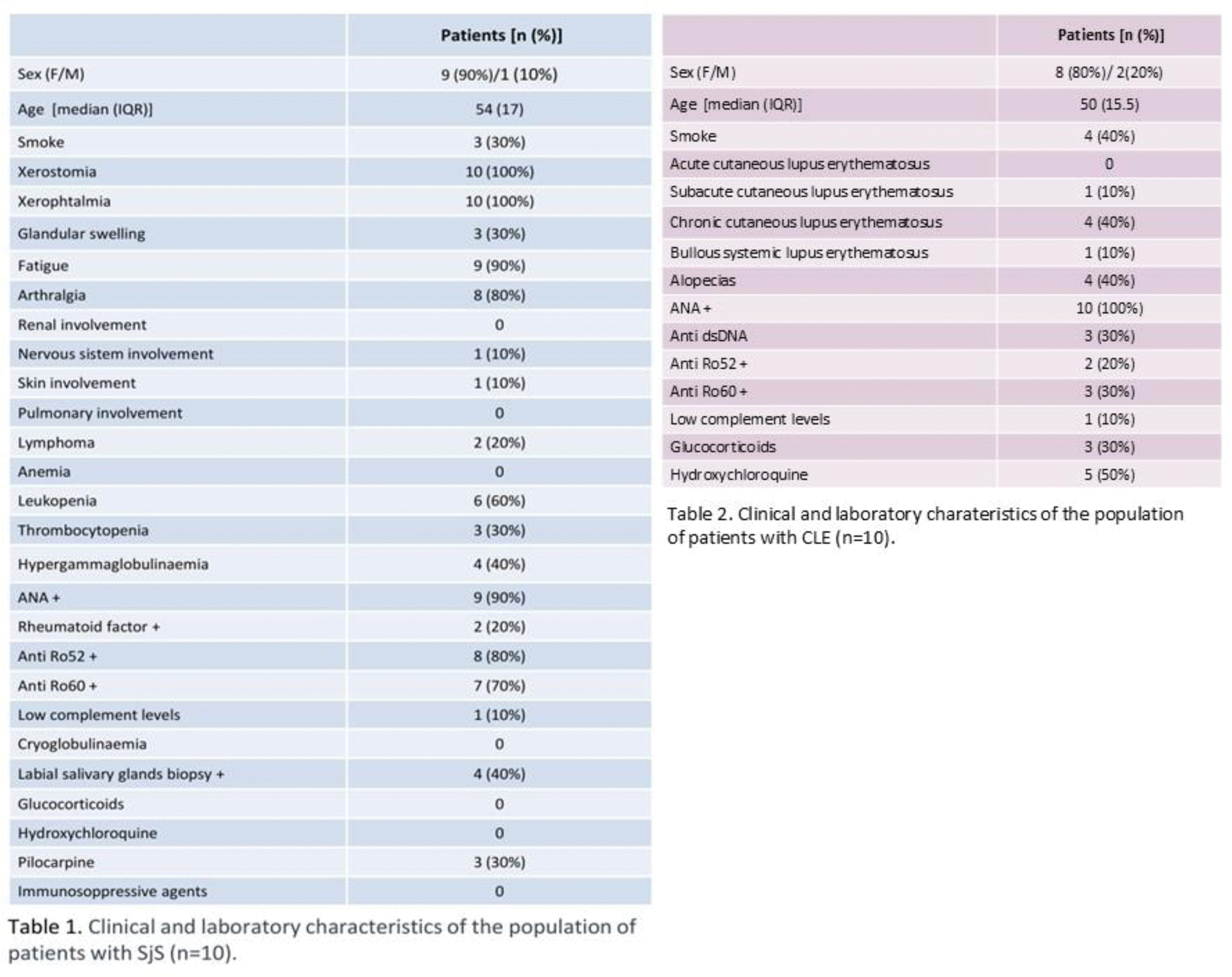
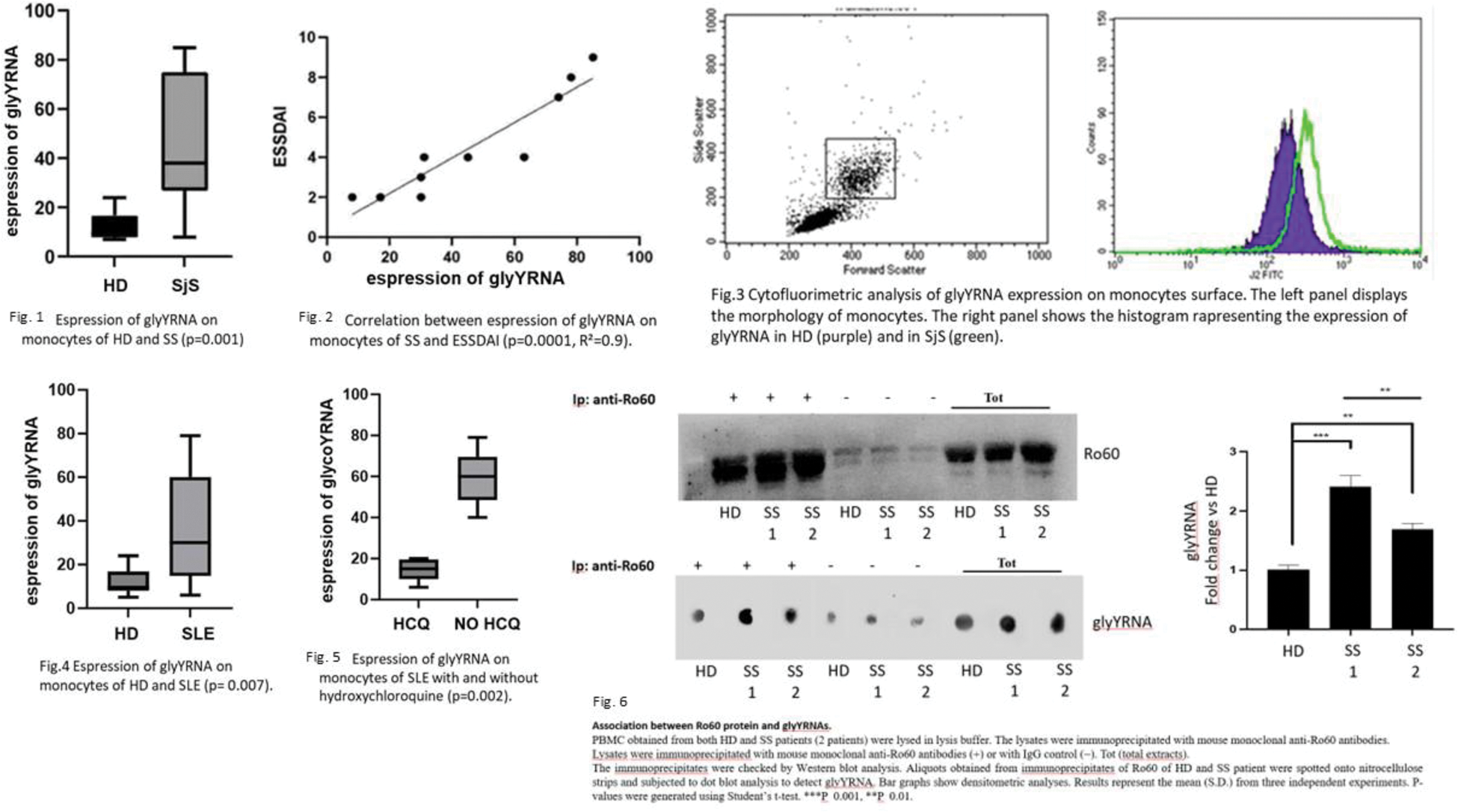
Results: The clinical and laboratory characteristics of the patients are summarized in Tables 1 and 2. Our study found that patients with SjS exhibit higher expression of glyYRNA on the surface of monocytes compared to healthy donors (HD) (p = 0.001) (Figures 1 and 3), and this expression correlates with disease activity as assessed by the ESSDAI (EULAR Sjögren’s Syndrome Disease Activity Index) (p = 0.0001, R² = 0.9) (Figure 2). Additionally, patients with CLE also show higher expression of glyYRNA compared to HD (p = 0.007) (Figure 4). Five patients with CLE who were taking hydroxychloroquine exhibited lower expression of glyYRNA compared to those not on this therapy (p = 0.002) (Figure 5). Finally, two patients with SjS showed higher expression of the glyYRNA/Ro60 complex compared to HD (Figure 6).
Conclusion: The results of this study show that the expression of glyYRNA on the surface of monocytes is increased in patients with SjS and CLE compared HD, that this expression correlates with disease activity in SjS patients, that hydroxychloroquine use in CLE patients reduces its expression, and that the expression of the complex is higher in patients compared to HD. In conclusion, glicoYRNA may represent a new surface antigen and a potential marker for disease activity.
REFERENCES: [1] Flynn RA, Pedram K, Malaker SA, Batista PJ, Smith BAH, Johnson AG, George BM, Majzoub K, Villalta PW, Carette JE, Bertozzi CR. Small RNAs are modified with N-glycans and displayed on the surface of living cells. Cell. 2021 Jun 10;184(12):3109-3124.e22. doi: 10.1016/j.cell.2021.04.023. Epub 2021 May 17. PMID: 34004145; PMCID: PMC9097497.
[2] Boccitto M, Wolin SL. Ro60 and Y RNAs: structure, functions, and roles in autoimmunity. Crit Rev Biochem Mol Biol. 2019 Apr;54(2):133-152. doi: 10.1080/10409238.2019.1608902. Epub 2019 May 14. PMID: 31084369; PMCID: PMC6542706.
Acknowledgements: NIL.
Disclosure of Interests: None declared.
© The Authors 2025. This abstract is an open access article published in Annals of Rheumatic Diseases under the CC BY-NC-ND license (