fetching data ... 
Background: Idiopathic inflammatory myopathies (IIM) are rare autoimmune diseases that can affect women of childbearing age, potentially resulting in adverse pregnancy outcomes (APOs). Although uncommon, IIM are being increasingly observed in pregnant women due to advancements in healthcare and disease management, which encourage more patients to pursue pregnancy. However, data on pregnancy outcomes in this population remain limited, especially concerning preconception disease control and treatment regimens.
Objectives: This study aims to assess maternal and perinatal outcomes in pregnant women with IIM, with a particular focus on the impact of disease activity, antibody profiles, and treatment strategies on the occurrence of APOs.
Methods: This was a multicenter, retrospective study of pregnant women with IIM, conducted across four Portuguese centers from 2009 to 2023, after a nationwide call for data.
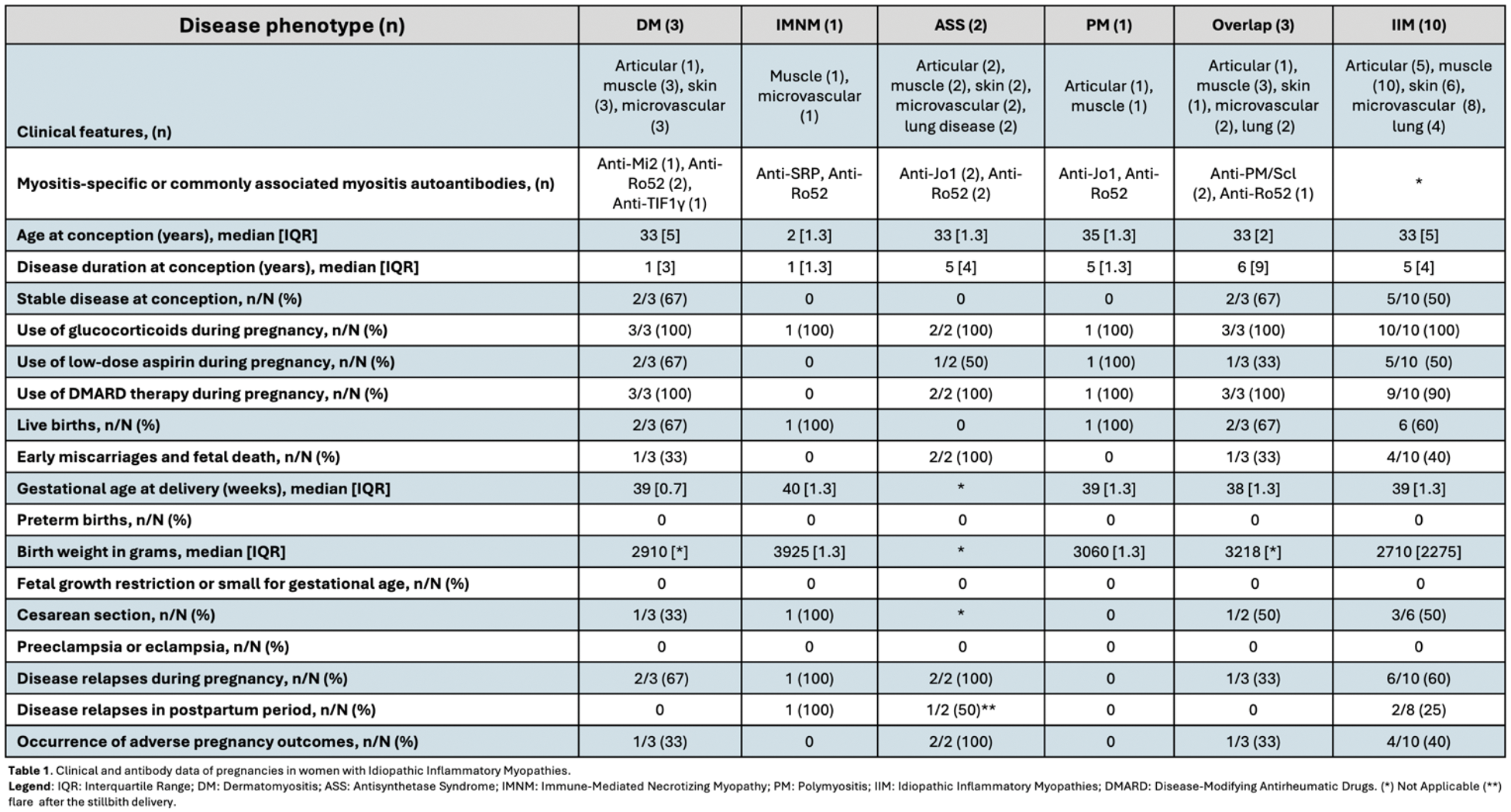
Results: A total of 10 pregnancies in 9 women were identified. Table 1 provides a summary of clinical and antibody data. The most frequent diagnoses were overlapping syndromes and dermatomyositis (DM), each accounting for 3 pregnancies. Concerning overlapping syndromes, there were two pregnancies in a patient with systemic sclerosis and polymyositis, and one in a patient with rheumatoid arthritis and polymyositis. Antisynthetase syndrome (ASS) was diagnosed in two patients. Additionally, one patient was diagnosed with immune-mediated necrotizing myopathy (IMNM) and another with polymyositis (PM). Clinical manifestations included articular, muscular, cutaneous, and microvascular involvement. Major organ involvement, particularly interstitial lung disease, was documented in 4 patients (40%). Regarding myositis-specific or commonly associated autoantibodies, the following were identified: Anti-Mi2, Anti-Ro52, Anti-TIF1γ, Anti-SRP, Anti-Jo1 and Anti-PM/Scl. Anti-SSA/B antibodies were present in 9 (90%) women. Antiphospholipid antibodies were negative in all patients. The majority women (6; 60%) received preconception counseling. Conventional disease-modifying antirheumatic drugs (DMARDs) were prescribed in 8 patients, namely azathioprine prescribed to 5 (2 DM, 2 overlapping syndromes and 1 PM) and hydroxychloroquine to 6 (3 overlapping syndromes, 2 DM and 1 IMNM). Rituximab and cyclosporine were prescribed for a patient with ASS, and intravenous immunoglobulin for a patient with DM. One patient with ASS had an unplanned pregnancy while on mycophenolate mofetil and cyclophosphamide with a subsequent early miscarriage. All patients were treated with glucocorticoids (GC), and 4 of them (2 IMNM, 1 DM and 1 overlapping syndromes) received doses of prednisolone above 7.5 mg/day. Low-dose aspirin was prescribed to 5 patients. Disease relapses occurred in 6 patients (60%) during pregnancy, with disease control achieved in 2 of them prior to conception (1 DM and 1 IMNM). Five patients (1 DM, 2 ASS and 1 IMNM) required higher doses of GC due to worsening disease activity. One patient (DM) experienced elevated creatine kinase (CK) levels, which were detected exclusively through laboratory tests and not noted prior to the pregnancy outcome, and thus, GC doses were not increased. In two cases, the diagnosis was made during pregnancy: one patient (IMNM) presented with proximal myopathy and elevated CK levels, and another patient (DM) presented with skin rash and polyarthritis. Both were treated with azathioprine and high doses of prednisolone during the pregnancy. Four patients (1 DM, 1 PM and 2 overlapping syndromes) who continuously received immunosuppressive drugs showed no increase in disease activity.
APOs included 3 first-trimester miscarriages (1 DM, 1 ASS and 1 overlapping syndrome) and 1 stillbirth at 37 weeks of gestation. The stillbirth occurred in an ASS patient who had high titers of anti-Jo1 antibodies (11828 U/mL). All patients with APOs experienced disease flares during pregnancy including myositis or polyarthritis. All these women had poorly controlled disease at conception, with only one exception – a case of a patient with DM who had controlled disease at conception and was receiving immunosuppressive therapy, that experienced an APO – a 1 st trimester miscarriage. Two patients (ASS and IMNM) experienced disease relapses in the postpartum period, presenting with myositis or polyarthritis. No cases of birth defects, neonatal infections, or neonatal lupus were reported.
Conclusion: This study highlights the increased risk of APOs in women with IIM, particularly those with uncontrolled disease at conception. Special attention should be given to ASS patients with high titers of anti-Jo1, considering other cases of late fetal demise described in the literature. Achieving effective disease control with pregnancy-compatible drugs is critical for improving obstetric outcomes.
REFERENCES: NIL.
Acknowledgements: NIL.
Disclosure of Interests: None declared.
© The Authors 2025. This abstract is an open access article published in Annals of Rheumatic Diseases under the CC BY-NC-ND license (