fetching data ... 
Background: Ankylosing spondylitis (AS) is a chronic inflammatory disease primarily affecting the spine and sacroiliac joints, leading to significant pain and disability. The interleukin-17 (IL-17) pathway is implicated in AS pathogenesis. Vunakizumab, a humanized monoclonal IgG1/k antibody targeting IL-17A, has shown significant improvement in AS signs and symptoms compared to placebo with manageable safety in a randomized, double-blind, phase 2/3 trial (NCT04840485).
Objectives: This study aimed to evaluate the efficacy of vunakizumab 120 mg compared to placebo across subgroups categorized by gender (male vs. female), utilizing data from the phase 2/3 trial.
Methods: Patients with active AS, confirmed by radiographic evidence and meeting the modified New York criteria, were initially randomized in a 2:2:1 ratio to receive either 120 mg or 240 mg of vunakizumab, or placebo. At week 16, placebo recipients were re-randomized 1 1 to one of the active doses. In phase 3, patients were randomized in a 2:1 ratio to receive 120 mg of vunakizumab or placebo. Treatments were administered at weeks 0, 2, 4, 8, and 12, followed by every four weeks through week 32. The study included patients who were treated with either a placebo or 120 mg of vunakizumab. We analyzed the primary endpoint Assessment of Spondyloarthritis International Society 20 (ASAS20) response criteria at week 16, and secondary endpoints ASAS40 response criteria and ASAS5/6 response at week 16. Results from weeks 2 and 32 were also analyzed. A logistic regression model was used to compare the differences in response rates between the vunakizumab and placebo groups at week 2 and 16.
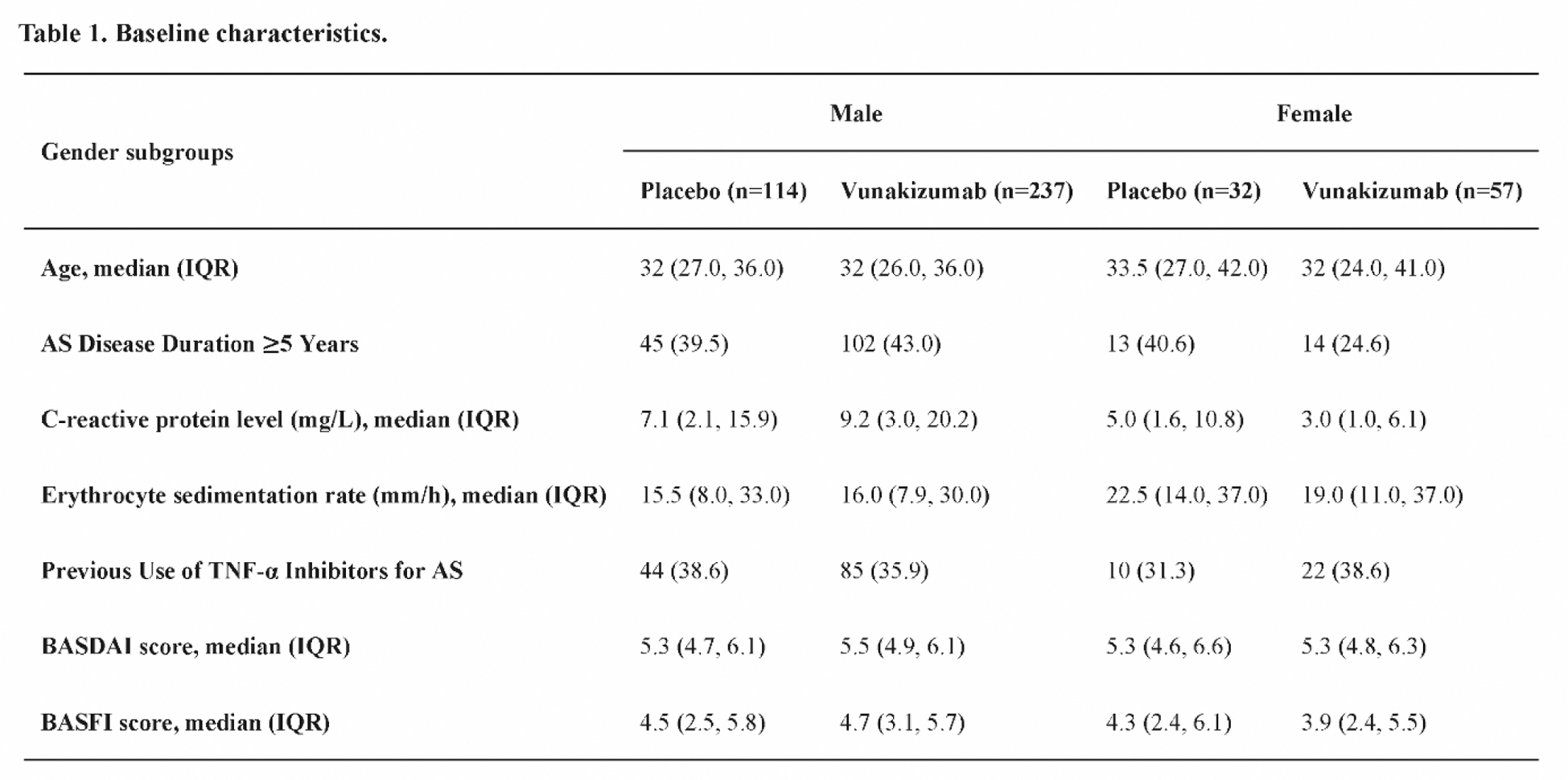
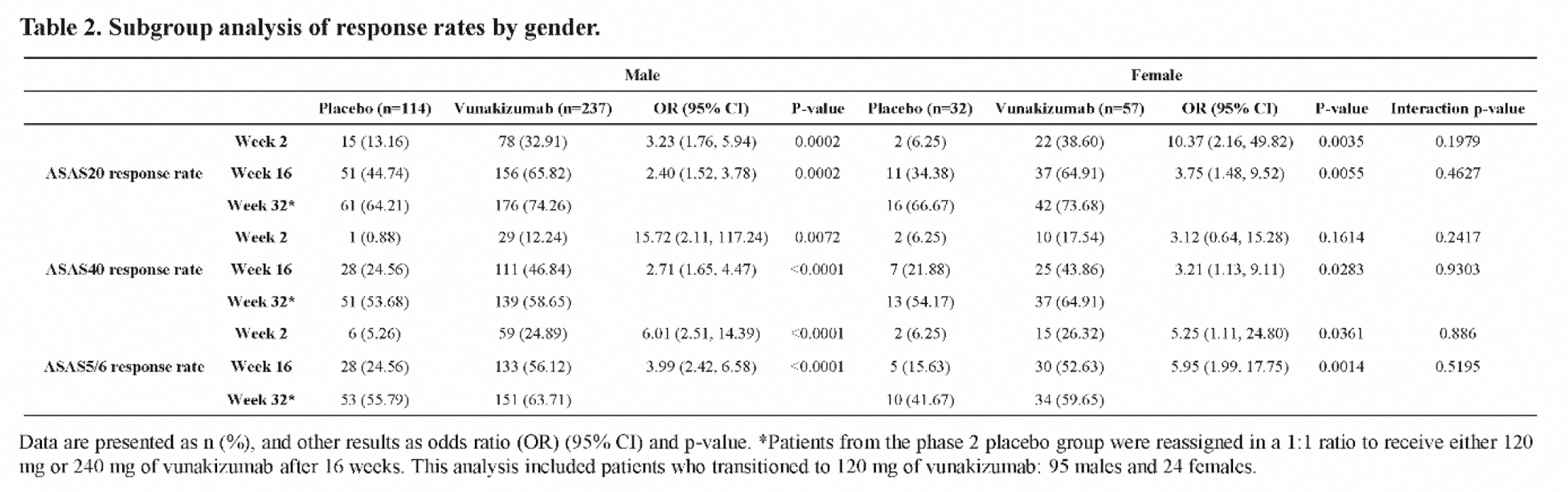
Results: A total of 114 males were assigned to the placebo group, while 237 received vunakizumab 120 mg. Among females, 32 were assigned to the placebo group and 57 received vunakizumab 120 mg. Baseline characteristics were generally balanced between the placebo and vunakizumab groups in both male and female subgroups. However, a higher percentage of females in the placebo group (40.6%) had an AS duration of ≥5 years compared to the vunakizumab group (24.6%) (Table 1). In male patients, the ASAS20 response at week 16 was observed in 65.82% of the vunakizumab group compared to 44.74% of the placebo group (p = 0.0002). ASAS40 and ASAS5/6 responses were also higher for vunakizumab than for placebo (46.84% vs. 24.56%, p < 0.0001; 56.12% vs. 24.56%, p < 0.0001). Among female patients, improved response rates for vunakizumab compared to placebo were observed for ASAS20, ASAS40, and ASAS5/6 (64.91% vs. 34.38%, p = 0.0055; 43.86% vs. 21.88%, p = 0.0283; 52.63% vs. 15.63%, p = 0.0014). Additionally, vunakizumab demonstrated a rapid onset of action, achieving higher ASAS20, ASAS40, and ASAS5/6 response rates compared to placebo as early as week 2 in both male and female subgroups. No significant differences in these response rates were observed between the vunakizumab and placebo groups within either gender subgroup at weeks 2 and 16. Furthermore, by week 32, the ASAS20, ASAS40, and ASAS5/6 response rates in the placebo group that was transitioned to 120 mg of vunakizumab showed improvement compared to week 16 (Table 2). Over the 16-week period, most treatment-emergent adverse events (TEAEs) were mild. Among males, mild TEAEs occurred in 96.88% of the placebo group and 87.72% of the vunakizumab group, while among females, the rates were 89.47% and 90.30%, respectively. The most common TEAE was upper respiratory tract infection, reported by 28.07% of males in the placebo group and 28.69% in the vunakizumab group. Among females, this TEAE was noted in 43.75% of the placebo group and 35.09% of the vunakizumab group.
Conclusion: Vunakizumab 120 mg demonstrated statistically significant and clinically meaningful improvements in AS symptoms across both male and female patient populations, with a rapid onset of response observed by week 2. The safety profile was manageable and tolerable. These findings highlight the potential of vunakizumab as an effective treatment option for AS patients, regardless of gender.
REFERENCES: NIL.
Acknowledgements: NIL.
Disclosure of Interests: None declared.
© The Authors 2025. This abstract is an open access article published in Annals of Rheumatic Diseases under the CC BY-NC-ND license (