fetching data ... 
Background: According to recent epidemiological studies using administrative data, the prevalence of systemic lupus erythematosus (SLE) in Northern European countries ranges between 45 and 75 per 100,000 inhabitants [1–3]. Information on epidemiological studies in the European Mediterranean region mainly comes from cohorts in academic centers, but population-based data remains limited.
Objectives: Our objective was to determine the prevalence and incidence rates of SLE in Catalonia (Spain) during the period from January 1, 2006, to December 31, 2021.
Methods: We conducted a population-based cohort study of all existing Catalonian cases diagnosed with systemic lupus erythematosus (SLE) between 2006 and 2021 using ICD-10-CM codes from the Information System for the Development of Research in Primary Care (SIDIAP). SIDIAP is a database of primary care electronic health records that includes data from 328 primary care practices, covering 5.8 million people, or 75% of the Catalan population [1]. Prevalence rate was defined as the number of affected persons in the population at a specified time divided by the number of persons at that time. The numerator of prevalence rate was the number of persons, within 10-year age-sex groups, who met the definition of PsA between January 1, 2006, and December 31, 2021, and alive and registered with the SIDIAP on Dec 31, 2021. The prevalence rate was defined as the number of affected individuals in the population at a specified time, divided by the total population at that time. The numerator for the prevalence rate was the number of individuals diagnosed with SLE between January 1, 2006, and December 31, 2021, who were alive and registered in SIDIAP on December 31, 2021. Incidence rates by age and sex were calculated for the 1-year period between January 1, 2011, and December 31, 2021. Individuals diagnosed with SLE during the 5-year run-in period from January 1, 2006, to December 31, 2010, were excluded from being classified as incident cases.
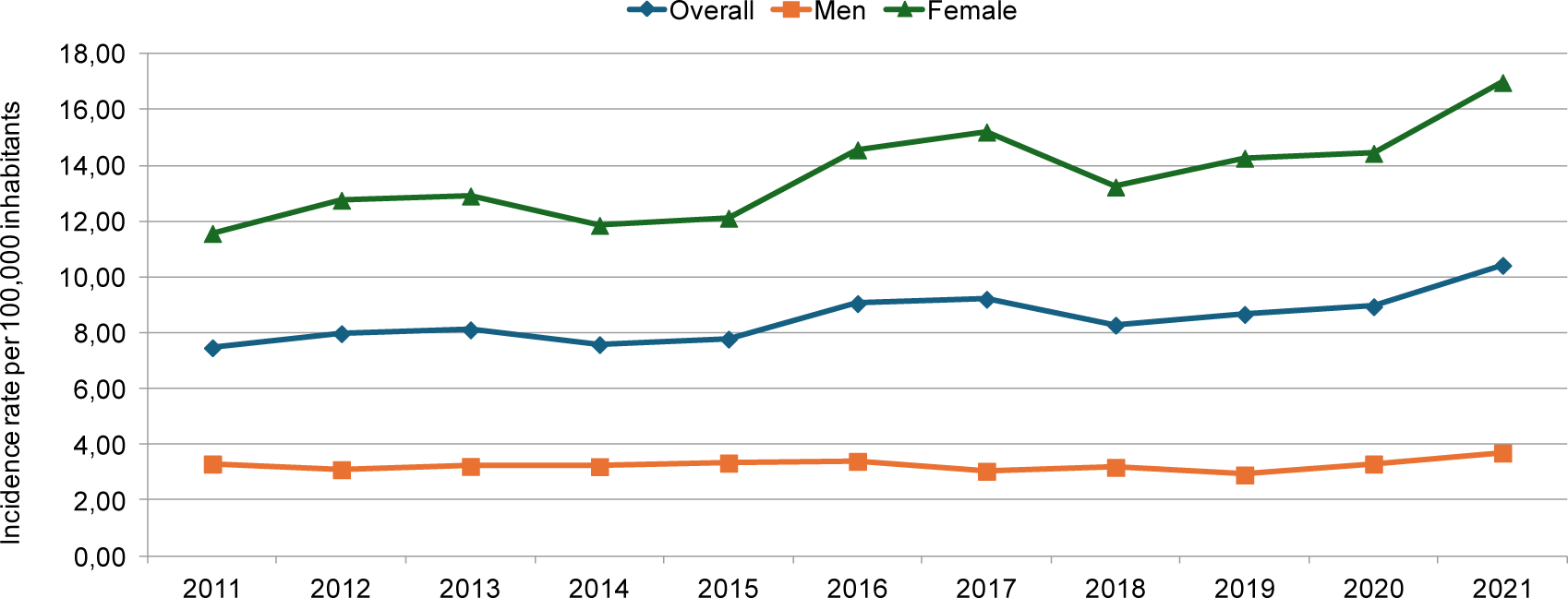
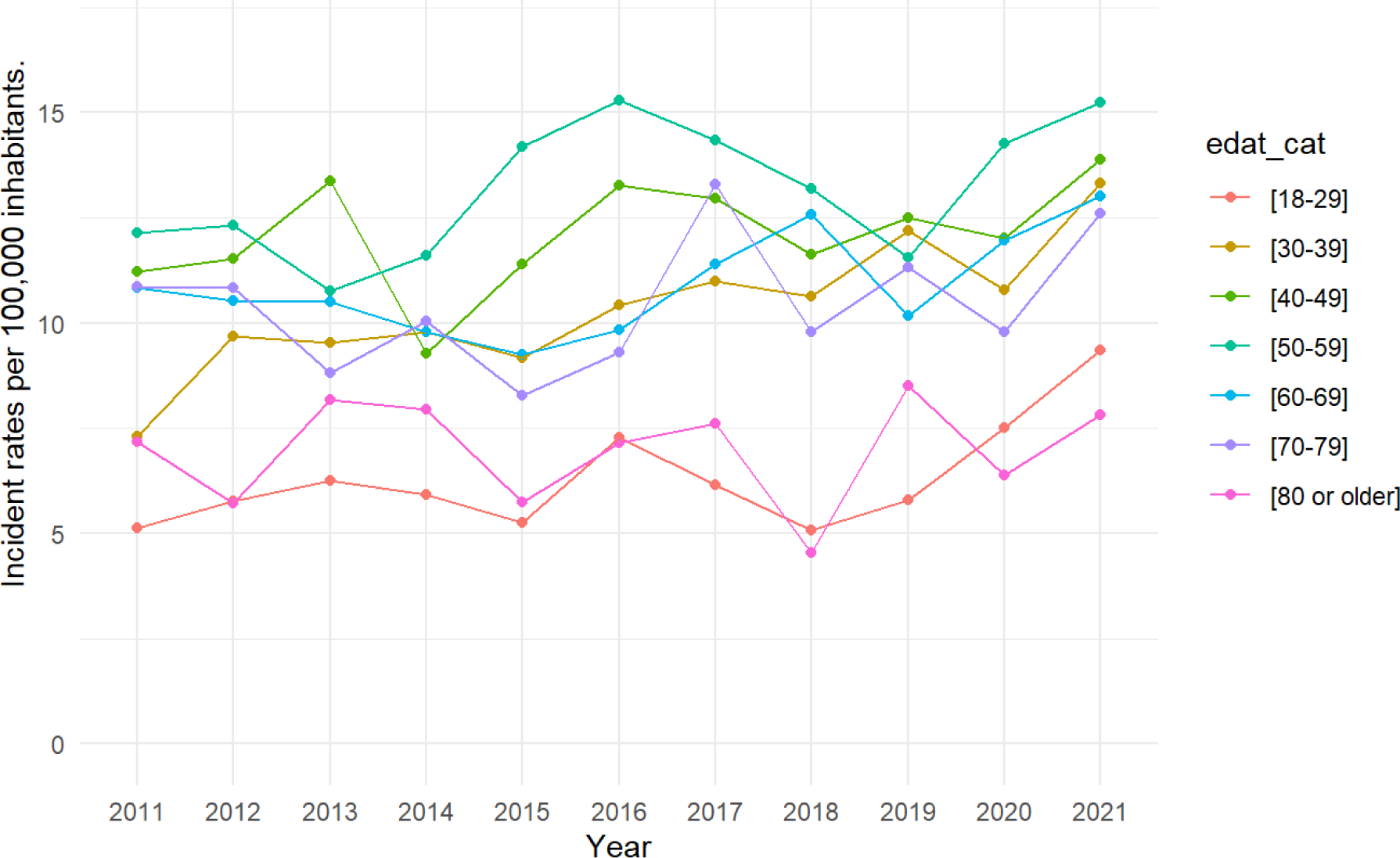
Results: We identified 10,687 prevalent cases of SLE, with a mean age of 47.3 years (SD 16.3). Of these patients, 8,924 (83.5%) were female, and 6,943 (64.9%) had Spanish nationality. Other origins included 531 individuals (4.9%) from Latin American countries, 280 (2.6%) from other European countries, and 159 (1.5%) from Africa. The overall prevalence rate was 92.3 per 100,000 inhabitants (155.2 per 100,000 for females and 27.9 per 100,000 for males). By age group, the distribution of prevalent cases was as follows: 1,608 (15.0%) in the 18–29 age group, 2,350 (21.9%) in the 30–39 group, 2,416 (22.6%) in the 40–49 group, 1,948 (18.2%) in the 50–59 group, 1,182 (11.0%) in the 60–69 group, 802 (7.5%) in the 70–79 group, and 381 (3.5%) in those older than 80 years. We identified 5,173 incident cases of SLE during the study period. The overall incidence rate was 8.51 per 100,000 person-years, with 13.6 per 100,000 for females and 3.25 per 100,000 for males. Sex-specific and overall incidence rates by year are depicted in Figure 1. Incidence rates were higher among the 40–50 and 50–64 age groups. Detailed information on incidence rates by age is presented in Figure 2.
Conclusion: This is the first study to assess the prevalence and incidence of SLE in Catalonia at a population level. We found that more than a quarter of individuals with SLE are not of Spanish origin, which may have implications for disease burden assessment and resource allocation. We observed a lower prevalence of SLE in Catalonia compared to Northern European countries [1–3]. Incidence rates were stable in males but slightly increased in females during the study period, with women showing incidence rates 4–5 times higher than men.
REFERENCES: [1] Rees F et al. Ann Rheum Dis. 2016 Jan;75(1):136-41.
[2] Alexander T et al. Ann Rheum Dis 2023 (AB0512).
[3] Arkema EV et al. ACR Open Rheumatol. 2023;5(8):426-432.
[4] Recalde M et al Int J Epidemiol. 2022 Dec 13;51(6):e324-e33.
Incident rate of SLE by sex.
Indicence rate of SLE by age groups.
Acknowledgements: This work was supported by Instituto Carlos III (PI22/00212) and Catalan Society of Rheumatology.
Disclosure of Interests: José A Gómez-Puerta Astra Zeneca, Abbvie, GSK, Janssen, Lilly, Pfizer, Otsuka, Frezenius, Janssen, Sanofi, Maria Grau: None declared, Cristian Tebe: None declared, Beatriz Frade-Sosa Alfa Sigma, Juan Sarmiento-Monroy Boehringer Ingelheim, Cristina Carbonell-Abella: None declared, Daniel Martínez-Laguna: None declared, Patricia Corzo GSK and Boehringer Ingelheim, Raimon Sanmarti Abbvie, BMS, Galápagos, Lilly, Pfizer, Roche, J. Antonio Aviña-Zubieta: None declared.
© The Authors 2025. This abstract is an open access article published in Annals of Rheumatic Diseases under the CC BY-NC-ND license (