fetching data ... 
Background: varmacitinib, a selective Janus kinase 1 inhibitor, has shown significant efficacy in patients with moderate-to-severe rheumatoid arthritis (RA) in a randomized, double-blinded, placebo-controlled phase III clinical trial (NCT04333771).
Objectives: This study aimed to explore the efficacy of Ivarmacitinib in RA patients who have not used biological disease-modifying antirheumatic drugs (bDMARDs) previously (bDMARDs-naïve RA patients).
Methods: This post-hoc study utilized the data from the phase III trial of Ivarmacitinib in patients with RA, in which moderate-to-severe RA patients with inadequate response to conventional DMARDs received 4 mg or 8 mg Ivarmacitinib or placebo daily for 24 weeks [1]. bDMARDs-naïve (n=421) patients were included for analysis.
Results: At week 24, both Ivarmacitinib 4 mg and 8 mg groups achieved significantly higher rates of achieving 20%, 50%, and 70% improvement in American College of Rheumatology response criteria (ACR20/50/70) compared to the placebo group (all P <0.001). Both Ivarmacitinib groups also had significantly higher response rates for disease Activity Score 28-C reactive protein (DAS28-CRP)≤3.2/<2.6, clinical disease activity index (CDAI)≤10/≤2.8, and simplified disease activity index (SDAI)≤11/≤3.3 (all P <0.001). Furthermore, in the Ivarmacitinib groups, the achievement rates of Health Assessment Questionnaire Disability Index (HAQ-DI)<0.5, HAQ-DI improvement≥0.22, and HAQ-DI improvement≥0.3 were all greater than in the placebo group (all P <0.01) (Figure 1).
Comparison of ACR20/50/70 response rates at week 24 among groups (A). Comparison of DAS28-CRP≤3.2, CDAI≤10, and SDAI≤11 response rates at week 24 among groups (B). Comparison of DAS28-CRP<2.6, CDAI≤2.8, and SDAI≤3.3 response rates at week 24 among groups (C). Comparison of HAQ-DI improvement of ≥0.22, HAQ-DI improvement of ≥0.3, and HAQ-DI<0.5 rates at week 24 among groups (D)
**, P <0.01 in Ivarmacitinib 4 mg group compared with placebo group; ***, P <0.001 in Ivarmacitinib 4 mg group compared with placebo group; ##, P <0.01 in Ivarmacitinib 8 mg group compared with placebo group; ###, P <0.001 in Ivarmacitinib 8 mg group compared with placebo group.
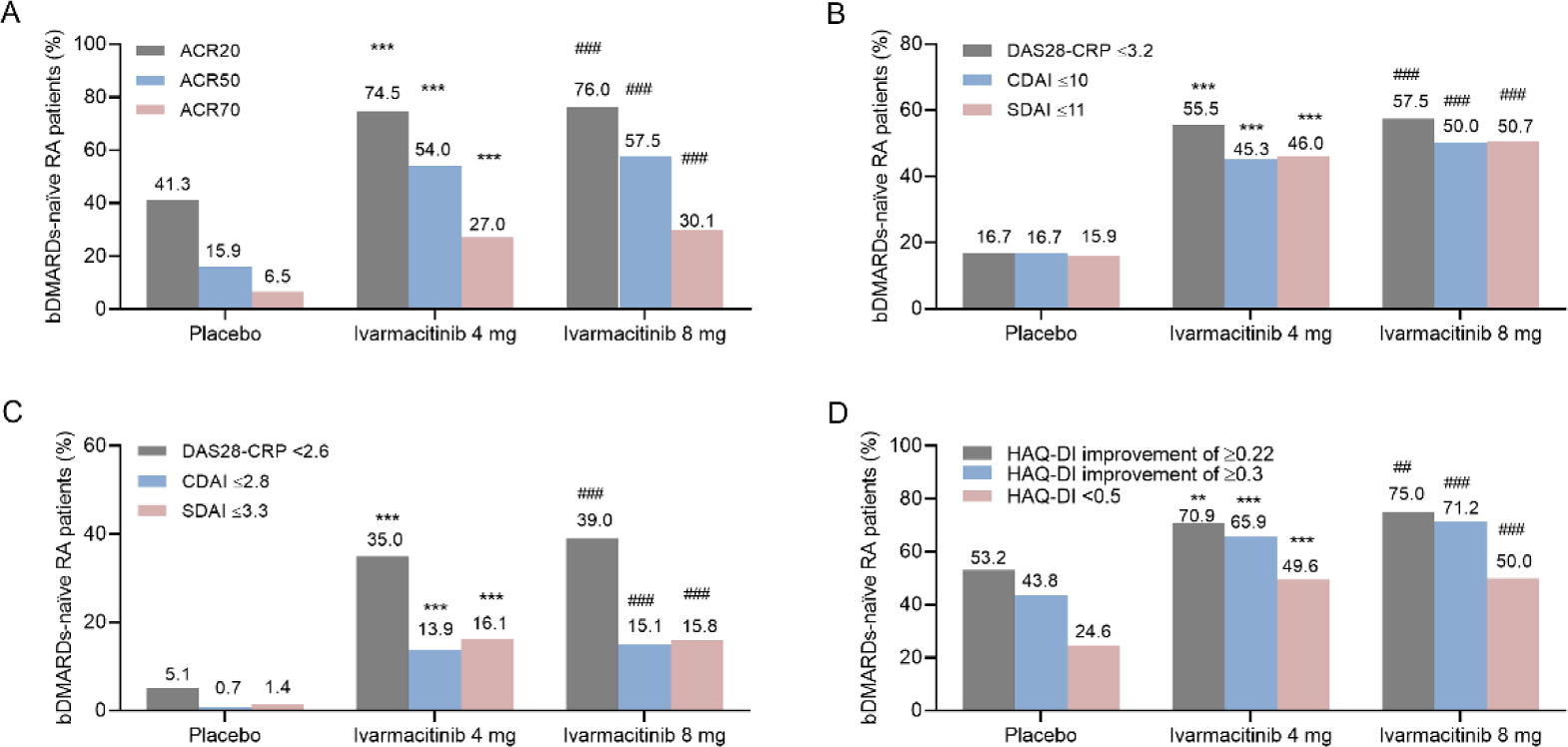
Conclusion: Ivarmacitinib effectively reduces disease activity and improves health-related quality of life in bDMARDs-naïve RA patients.
REFERENCES: [1] Liu J, Jiang Y, Zhang S, et al. Ivarmacitinib, a selective Janus kinase 1 inhibitor, in patients with moderate-to-severe active rheumatoid arthritis and inadequate response to conventional synthetic DMARDs: results from a phase III randomised clinical trial. Ann Rheum Dis. Published online November 27, 2024. doi:10.1136/ard-2024-226385.
Acknowledgements: NIL.
Disclosure of Interests: None declared.
© The Authors 2025. This abstract is an open access article published in Annals of Rheumatic Diseases under the CC BY-NC-ND license (