fetching data ... 
Background: Osteogenesis Imperfecta (OI) is a hereditary condition primarily caused by collagen mutations. It is associated with recurrent fractures, bone deformities, osteoporosis, and various ocular, auditory, and cardiorespiratory manifestations.
Objectives: To describe the medical spectrum in adults with OI, including their clinical, analytical, densitometric, and radiographic characteristics, as well as details about their fractures (both previous and incidental), skeletal deformities, and the antiosteoporotic treatments they have received.
Methods: Descriptive observational study involving patients with OI who are managed at a tertiary hospital. Data collected included clinical information (such as age at diagnosis, dentinogenesis imperfecta, hearing loss, skeletal deformities, and fracture history), genetic studies, OI subtype, analytical data, densitometric data (using Lunar DPX), radiology results, and antiosteoporotic treatments received. For patients under 50 years old, the Z score was utilized (with Z < -2 SD indicating low bone mass). Trabecular structure was assessed using TBS (TBS Insight®). Statistical analyses were conducted using SPSS (27 th version).
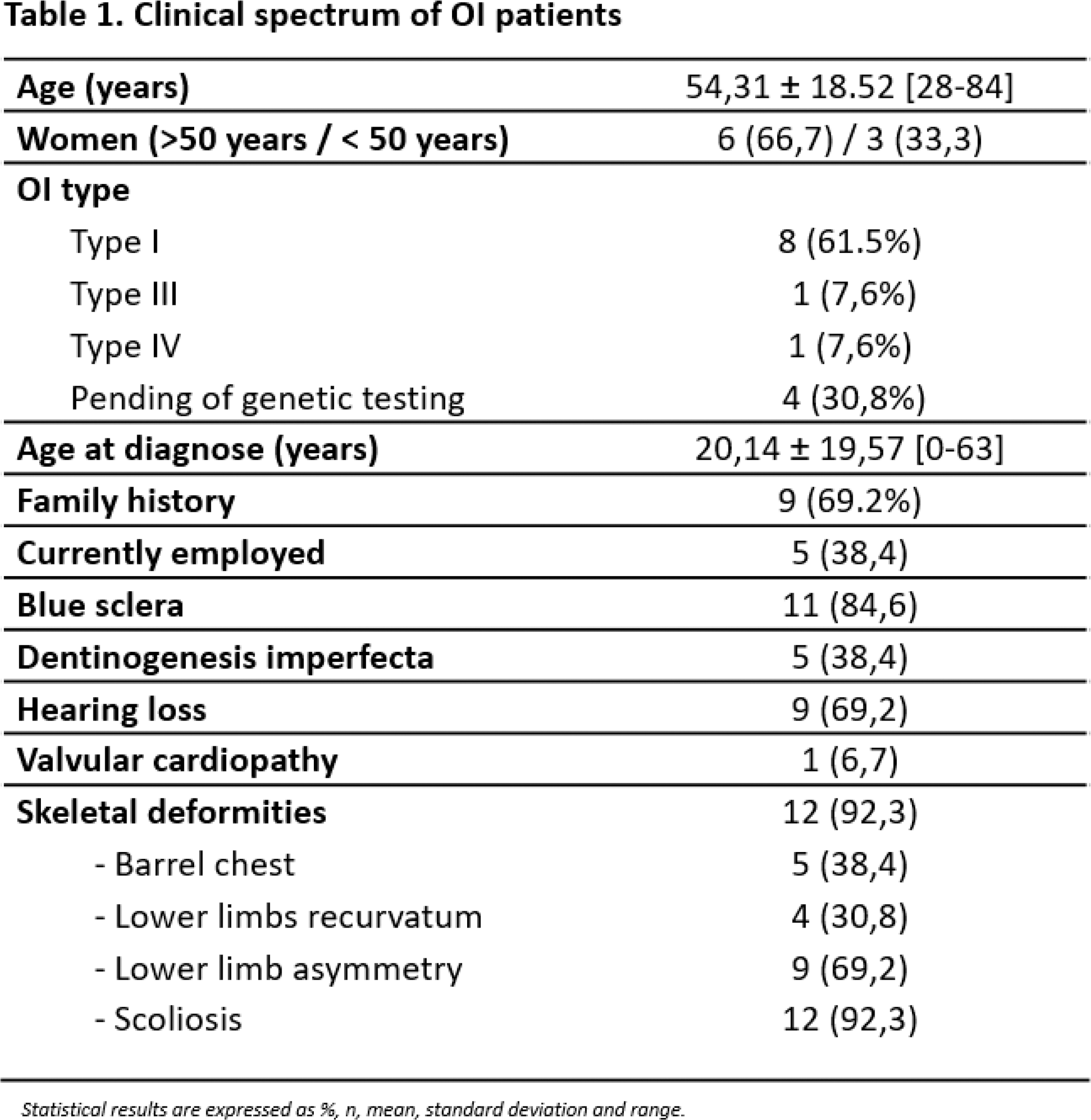
Results: A total of 13 patients (9 women and 4 men) with a mean age of 54±19 years [range 28-84] diagnosed with OI were included. Among them, 6 patients were the index case for OI diagnosis. The clinical spectrum of the patients is summarized in Table 1. The mean age at diagnosis was 20±19.57 years [range 0-63]. Genetic mutations were found in COL1A1 (n=8) and COL1A2 (n=2), while 3 patients have yet to undergo genetic testing. At the densitometric level, 9 patients were diagnosed with osteoporosis or low bone mass (mostly in the lumbar region). 4 patients exhibited degraded TBS results. Eleven of the patients had received antiOP treatment during their follow-up, including oral bisphosphonates (n=9), intravenous bisphosphonates (n=10), denosumab (n=4), and teriparatide (n=4). One patient recieved substitutive hormonal therapy. Nine patients remained on antiOP treatment at their last follow-up visit. The 13 patients had experienced a total of 167 fractures, with 25 classified as traumatic, leading to an average of 12.84 fractures per patient [range 1-27]. 7 patients had one or multiple vertebral fractures. Over the last two years, while under follow-up, 7 patients sustained a total of 15 incidental fractures (10 fragility fractures and 5 traumatic fractures) while being treated with bisphosphonates (n=4), denosumab (n =2), and without treatment (n =1).
Conclusion: More than half of the patients with OI who were undergoing antiOP treatment and follow-up at a tertiary hospital experienced incidental fractures (both fragility and traumatic) in the last two years. Notably, TBS does not seem to effectively predict the risk of fractures in OI patients. These results align with previous evidence, and they emphasize the need to develop targeted anti-OP treatment for OI patients.
REFERENCES: [1] van Welzenis, T., Westerheim, I., Hart, T.
et al.
The IMPACT Survey: the humanistic impact of osteogenesis imperfecta in adults.
BMC Public Health
24, 3318 (2024).
[2] Florez, H, Muxi, A, González, E, Monegal, A, Guañabens, N, & Peris, P. Utilidad del trabecular bone score en sujetos adultos con osteogénesis imperfecta. Rev Osteoporos Metab Miner,
14
(4), 125-130. Epub 27 de marzo de 2023.
Acknowledgements: NIL.
Disclosure of Interests: None declared.
© The Authors 2025. This abstract is an open access article published in Annals of Rheumatic Diseases under the CC BY-NC-ND license (